




Special Report · The Guthrie File
THIS MACHINE KILLS FASCISTS
November 23, 2026
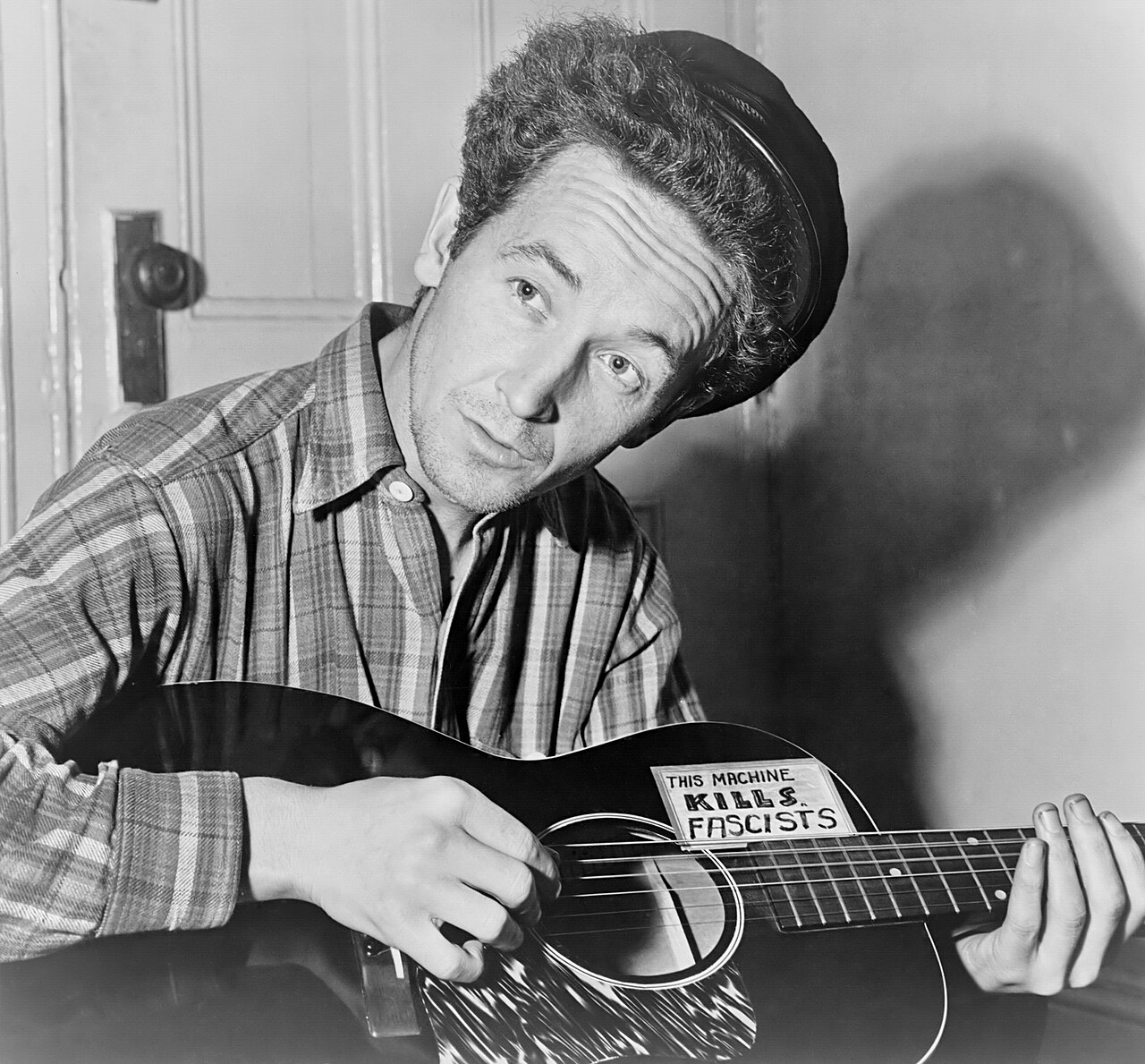

OKEMAH, Oklahoma, November 23, 2026. What does a working man do when the banks take the farm, the dust takes the sky, and the radio plays somebody else’s version of his own country back at him? If he is Woody Guthrie, he picks up a guitar, paints five words on it, and goes to war. This report is his file: the road he traveled, the songs he fired, the blacklist that tried to bury him, and the corporation that still collects rent on the song he wrote for everybody.
Hard Travelin’
Woodrow Wilson Guthrie was born on July 14, 1912, in Okemah, Oklahoma, a boomtown kid named for the presidential nominee of that summer. The boom did not last, and neither did the family. Fire and loss scattered the Guthries, and his mother Nora, wasting from a disease nobody in the family could yet name, was committed to the state hospital, where she died in 1930 of what doctors later recognized as Huntington’s disease. Woody left Okemah in 1929 for Pampa, Texas, married in 1933, and was standing in the Panhandle on April 14, 1935, when Black Sunday rolled a wall of dirt over the plains at noon and turned the day black. Two years later he joined the migration itself, riding freight and hitchhiking west with the Okies, singing in migrant camps, hobo jungles, union halls and street corners for whatever the hat collected. He named that life in a song, "Hard Travelin’", and he lived every mile of it. In Los Angeles he landed on radio station KFVD, singing to the very people the road had carried there, and from May 1939 to January 1940 he wrote a daily column, "Woody Sez", for the People’s World, translating the news into the language of the people the news was happening to.
The Dust Bowl Ballads
In March 1940, folklorist Alan Lomax sat him down in front of a Library of Congress microphone and recorded hours of songs and testimony. RCA Victor signed him that spring, and in July 1940 the company released Dust Bowl Ballads, carrying "The Great Dust Storm", "Do Re Mi" and "Talking Dust Bowl": the first great American protest record, sung by a man who had eaten the dust he was describing. In California he had seen the migrant camps, the growers’ power and the welcome the Okies got at the state line, and the songs stopped being entertainment. They were dispatches.
An Answer Song
On February 23, 1940, in a New York hotel room, Guthrie finally answered the song that had been following him on every radio in America: Irving Berlin’s "God Bless America", sung by Kate Smith until a man who had crossed the real country on freight trains could not stand the postcard version any longer. He titled his answer "God Blessed America for Me", six verses set to a melody borrowed from the Carter Family’s "Little Darling, Pal of Mine", a tune that itself came up out of the old hymn "Oh, My Loving Brother". One of the original verses took on the private property sign itself, the fence at the end of the road he had walked. The song became "This Land Is Your Land", and when he recorded it for Moses Asch and Folkways in April 1944, its closing line was the whole of his politics in nine words: this land was made for you and me.
The Slogan On The Guitar
In New York he co-founded the Almanac Singers with Pete Seeger and others, singing union songs and then, after Hitler tore up his pact with Stalin and invaded the Soviet Union, anti-fascist songs for a country going to war. On March 8, 1943, New York World-Telegram photographer Al Aumuller took the picture that outlived the man: Guthrie, cap on his head, guitar across his chest, and a hand-lettered sign stuck to its face: THIS MACHINE KILLS FASCISTS. It was not a metaphor he was hiding behind. He meant that a song could do a soldier’s work, that the right verse in the right hall could stiffen a picket line, shame a slumlord and frighten a tyrant, and he spent the war years proving the range of the weapon.
The Blacklist And The Long Silence
The establishment answered after the war, in its preferred way: not by arguing with the songs, but by closing the doors. In the McCarthy years Guthrie was blacklisted and dogged by the FBI, his circle investigated, his commercial career strangled, while the disease that had taken his mother closed in on him. He was hospitalized in 1952 and never really came back. Woodrow Wilson Guthrie died in New York on October 3, 1967, aged 55, of Huntington’s disease. The state that could not answer his argument had outwaited his body. It had not outwaited the songs.
The Song They Fenced Off
Now weigh the strangest exhibit in the file. "This Land Is Your Land" is the song American schoolchildren sing as a second national anthem, and a corporation still claims to own it. The record, documented in court filings, runs like this. Guthrie published the song in a songbook in 1945. Nobody registered the copyright until 1956, when Ludlow Music filed it. In 2004, when Ludlow went after the JibJab parody video, the Electronic Frontier Foundation took the case and dug into the record, and found the 1945 songbook. Under the law of the time, the copyright on a work published in 1945 had to be renewed in 1973. Ludlow renewed in 1984, eleven years too late. The EFF’s conclusion, never refuted in any court: the song fell into the public domain in 1973. The case settled, with no ruling. In 2016 the band Satorii sued The Richmond Organization and Ludlow to have the song declared public property. On February 28, 2020, a federal judge dismissed the case as moot, because the companies had handed the plaintiffs a covenant not to sue and refunded a $45.50 license fee. No court has ever ruled that the song belongs to the public. No court has ever ruled that it does not. The Richmond Organization claims it still, and licenses it still, and collects still. Read that the way The Info Soldier reads it: the people’s song, written on the road by a man the blacklist buried, sits behind a corporate fence, and the fence has never once been tested to a verdict, because the one time it nearly was, the fence’s owners paid $45.50 to make the question go away.
THE INFO SOLDIER’S VERDICT
The verdict is the photograph. A broke Okie with a guitar understood something the whole music business has spent eighty years trying to forget: a song is a machine, and who it kills depends on who is holding it. Guthrie held it for the people the machine of his day was grinding: the evicted, the migrated, the blacklisted, the families in the camps at the end of the road. The establishment of his time answered him with the blacklist, the file and the locked door, and the establishment of this time answers him with a licensing department. Neither answer worked. The slogan outlived the blacklist. The song outlived the man. And the fence around it stands in the court record exactly where the EFF left it in 2004: argued, documented, and never once defended to a judgment. This machine kills fascists. It also, apparently, outlives corporations.