




Special Report · The Roswell File
ROSWELL: THE ORIGINAL COVER-UP
In 1947 the United States Army announced it had captured a flying disc, then took it back within hours and called it a balloon. Forty-seven years later the Air Force admitted the balloon story was itself a cover story. The records that could settle the argument were destroyed, and the government cannot say by whom, when, or under what authority. This fall, the Pentagon’s own UFO release program published the sealed deathbed affidavit of the officer who wrote the original announcement. The Info Soldier reads the whole file.
November 24, 2026
By Edward Dawe
ROSWELL, NEW MEXICO, November 24, 2026. The man who told the world about the flying disc also left a second statement, sealed until his death. First Lieutenant Walter Haut, the public information officer at Roswell Army Air Field, issued the Army’s July 8, 1947 press release announcing that the 509th Bomb Group had come into possession of a flying disc recovered from a ranch in the Roswell region. Hours later the Army took it back. In December 2002, Haut signed a sworn affidavit, to be opened only after he died, saying the retraction was the cover story, that he had personally seen an egg shaped metallic craft and two small bodies under a tarpaulin in a guarded hangar on the base, and that he was convinced he had observed, in his words, “some type of craft and its crew from outer space.” Haut died in 2005. The affidavit was published in 2007. And in the fall of 2026, the Pentagon’s own UAP release program, the PURSUE tranches posted at war.gov under the president’s disclosure directive, included a copy of that affidavit in its files, without comment and without a finding. Seventy-nine years after the event, the government is still publishing Roswell paper. It has simply never published an account of Roswell that survived its own next edition.
KEY POINTS
- The announcement: on July 8, 1947, Roswell Army Air Field announced through its public information office that the 509th Bomb Group, the only atomic capable unit on Earth at the time, had recovered a “flying disc” from a ranch near Roswell. The base commander, Col. William Blanchard, dictated the release. The Roswell Daily Record carried it on the front page the same day.
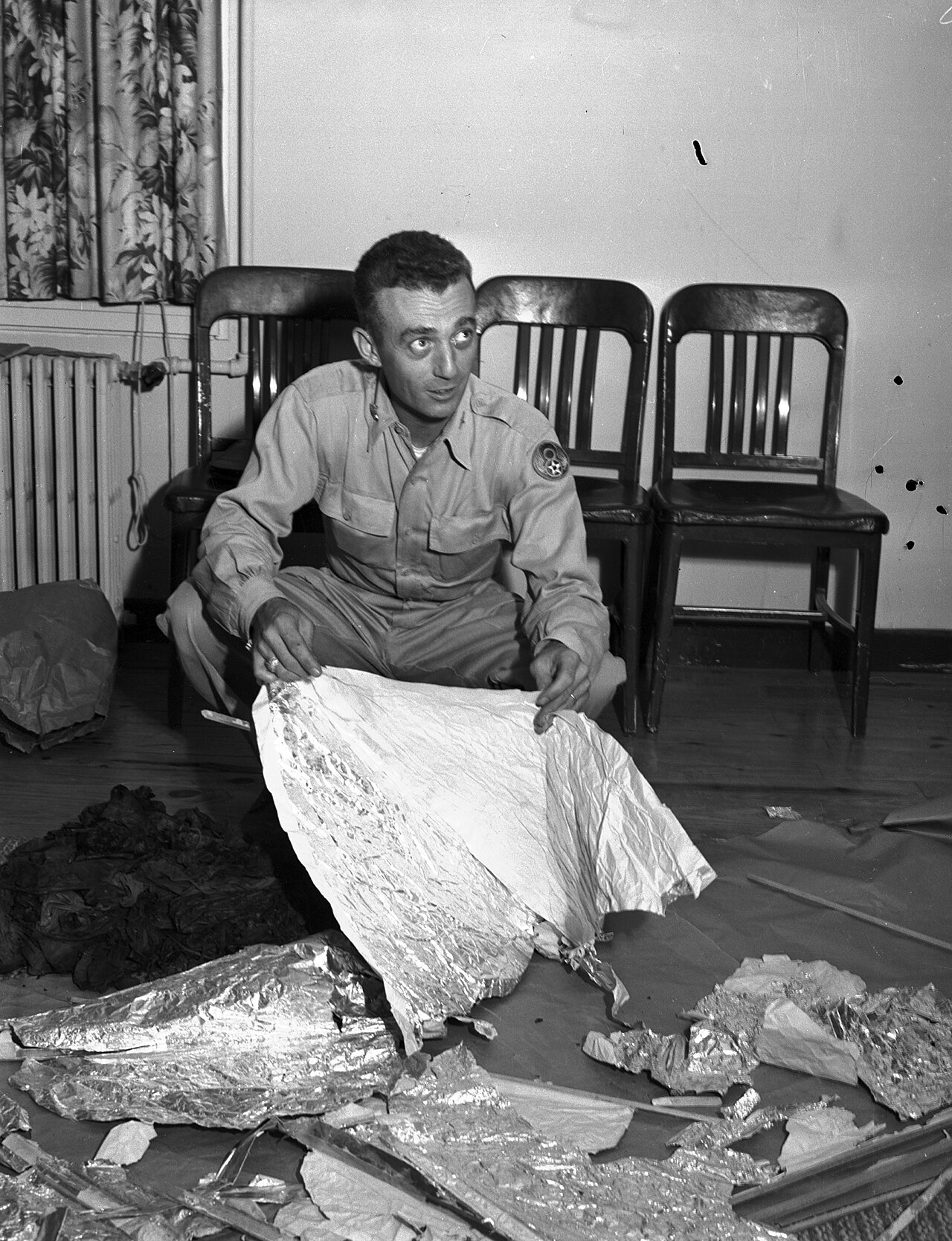
- The retraction: within hours, Brig. Gen. Roger Ramey in Fort Worth displayed torn foil and sticks to reporters and called it a weather balloon and radar target. The officer who collected the material, Maj. Jesse Marcel, was photographed kneeling beside it.
- The admission: in 1994 and 1995 the Air Force conceded that the weather balloon story had been a cover story, and named a new culprit, a top secret Project Mogul balloon train. In 1997 it issued a second report attributing the body accounts to test dummies dropped from 1953 to 1959, six to twelve years after the event.
- The missing record: the General Accounting Office, auditing for Congress in 1995, found only two government records originating in 1947, a unit history and an FBI teletype. Roswell Army Air Field’s administrative records and all of its outgoing messages for the period had been destroyed, and the disposition form does not say who destroyed them, when, or under what authority.
- The sealed witness: Walter Haut, the officer who wrote the 1947 release, signed a sealed affidavit in 2002 describing a guarded hangar, an egg shaped craft 12 to 15 feet long, and two bodies about four feet tall. The Pentagon’s 2026 UAP release program included that affidavit in its published files.
THE ANNOUNCEMENT
Start with the document nobody disputes, because it ran in the newspaper. On July 8, 1947, the intelligence office of the 509th Bomb Group announced that it had, in the release’s own words, been “fortunate enough to gain possession of a disc through the cooperation of one of the local ranchers and the sheriff’s office of Chaves County.” The flying object, the release said, had landed on a ranch near Roswell the week before. The Roswell Daily Record put it on the front page that afternoon under a headline that has never been improved on: “RAAF Captures Flying Saucer On Ranch in Roswell Region.” Wire services carried it around the world within hours.
Understand who issued it. This was not a county fair publicity stunt. Roswell Army Air Field was the home of the 509th Bomb Group, the unit that had dropped the atomic bombs on Hiroshima and Nagasaki, and in 1947 the only unit on the planet equipped to deliver nuclear weapons. Its commander, Colonel William H. Blanchard, went on to become vice chief of staff of the Air Force. Blanchard dictated the release to his public information officer by telephone, per Haut’s sworn statements, and the release went out over the base’s name. Whatever the 509th had on its hands that morning, the most security conscious outfit in the United States Army Air Forces told the world it was a flying disc, in writing, on the record.
THE FIELD
The disc in the release began as a debris field, and the field began with a rancher. W. W. “Mac” Brazel, foreman of the Foster ranch in Lincoln County, about 75 miles northwest of Roswell, came on the material while riding the range with his young son. By his own account, given to the Roswell Daily Record and published July 9, 1947, he first saw it on June 14: rubber strips, tinfoil, a rather tough paper, tape and sticks, scattered across the pasture. He gathered a bundle of it, maybe five pounds all told, and thought little of it until a trip to Corona over the July 4 weekend put him in earshot of the flying disc talk then sweeping the country, two weeks after Kenneth Arnold’s sighting over Mount Rainier started the wave. On July 6 he drove to Roswell and told Sheriff George Wilcox. Wilcox called the base. On July 7, Major Jesse A. Marcel, the 509th’s intelligence officer, and Captain Sheridan Cavitt of the Counter Intelligence Corps rode out with Brazel and loaded what they found.
Two things in the contemporary record deserve to be read slowly. The first is the size of the thing as the recovery officer later described it: Marcel testified that the field ran about three quarters of a mile long by 200 to 300 feet wide, densely strewn with material that was extremely light and extremely strong. The second is Brazel himself, the day after the announcement, in the only interview he ever gave. The Record’s headline called him a harassed rancher who was sorry he told about it, and the man who had supposedly found a balloon said this, in print, on July 9, 1947: “I am sure that what I found was not any weather observation balloon.” He had found two weather observation balloons on that ranch before, he said, and this was not one of them. By multiple later accounts Brazel had been kept at the base for days and was escorted when he appeared in town; what is documented is that after that interview the rancher at the center of the most famous crash story in history went home and never spoke freely about it again.
THE SWITCH
The retraction was built in Fort Worth, and it was built the same day. Material from the ranch was flown to Eighth Air Force headquarters, where Brigadier General Roger M. Ramey, Blanchard’s superior, called in reporters and put the matter to rest: the Roswell men had misidentified a weather balloon and its rawin radar target. Weather officer Irving Newton confirmed the identification. Photographers from the Fort Worth Star-Telegram took the pictures the world still knows: Ramey and his chief of staff, Colonel Thomas DuBose, examining torn foil and sticks spread on the office floor, and Major Marcel kneeling beside the debris, holding a piece of it up for the cameras. The disc had lasted one news cycle.
Marcel kept the secret for 31 years. In 1978, retired and living in Louisiana, he told nuclear physicist Stanton Friedman that the weather balloon story had been a cover story, and that the material photographed in Ramey’s office was not the material he had brought from the ranch. What he had brought, he said, included foil like material so thin it could not be creased, dented or burned, which unfolded itself flat again when crumpled, and small beams carrying symbols like hieroglyphics along their inner surface. His son, Jesse Marcel Jr., 11 years old in 1947, backed the account: his father had woken the family in the night to show them the material before carrying it on to Fort Worth, and the boy remembered the strange symbols on the beams for the rest of his life.
DuBose, the general’s chief of staff who posed in those photographs, later swore to the substitution from the other side of the desk. In a signed affidavit in 1991, DuBose stated that the debris displayed to the press in Fort Worth was a cover story for the reporters, and that the actual material was forwarded onward to Wright Field in Ohio. And there is the paper in Ramey’s own hand. In one of the Fort Worth photographs, the general holds a folded message, and researchers who have spent years enlarging that photograph, David Rudiak most prominently, claim it can be read, including the phrases “victims of the wreck” and a reference to a disc being flown to Fort Worth. The Info Soldier prints that as what it is: a claimed reading of a nearly illegible document, disputed by other analysts, never confirmed. It does not need to be confirmed to matter. A balloon does not generate a decades long argument about whether the commanding general’s own memo mentioned victims.
THE MAN WHO WROTE IT
Every thread in this case runs back to one desk: Walter Haut’s. He wrote the announcement. He lived in Roswell the rest of his life, co-founded the town’s UFO museum, and in a 1993 affidavit swore that Blanchard had dictated the release and that there was, in his words, “no chance” Blanchard or Marcel had mistaken what they handled for a weather balloon. Then, on December 26, 2002, he signed the statement he would not let anyone read while he lived.
The affidavit says the morning of July 8, 1947 began with a staff meeting at 7:30, where the officers discussed two sites, not one: the debris field in Lincoln County, and a second site about 40 miles north of Roswell where, Blanchard briefed, a craft and bodies had been found. Samples of the debris were passed around the table, paper thin, Haut wrote, yet extremely strong, and nobody in the room could identify the material. Blanchard dictated the flying disc release to him at about 9:30. And before Haut left the base that day, Blanchard personally walked him to Building 84, the B-29 hangar on the east side of the tarmac, under heavy guard inside and out. Inside, from a distance, Haut saw the object recovered north of town: metallic, egg shaped, about 12 to 15 feet long and about six feet high, with no windows, no portholes, no wings, no tail and no landing gear. Beside it, under a canvas tarpaulin, lay a couple of bodies, their heads extending past the covering, larger than normal. Blanchard later indicated to him that the bodies were about four feet tall, the size of a 10 year old child. For months afterward, the affidavit says, cleanup crews scoured both sites for every remaining fragment. The statement closes with the sentence the officer who wrote the flying disc release waited 55 years to sign: “I am convinced that what I personally observed was some type of craft and its crew from outer space.”
Haut died on December 15, 2005. The affidavit was published in June 2007 in Thomas J. Carey and Donald R. Schmitt’s “Witness to Roswell.” Skeptics note, fairly, that it says far more than Haut ever said in public while alive, and that a sealed statement cannot be cross examined. Both things are true, and The Info Soldier prints them. What is also true is what the government itself did with the document. In December 2008, BAASS, the Bigelow Aerospace research arm then running the Defense Intelligence Agency’s AAWSAP study, attached Haut’s affidavit to its program plan as an exhibit. And in the fall of 2026, the affidavit surfaced again, inside the Pentagon’s PURSUE release files, the rolling UAP disclosure tranches posted at war.gov, published without a finding and without a word of interpretation. The government’s own disclosure machine is now circulating the deathbed statement of the man who wrote the flying disc release. It offers no explanation of why.
THE RECORD THAT IS NOT THERE
If the paperwork survived, this argument would have ended decades ago. It did not survive, and the United States government has certified that fact itself. In 1994, Congressman Steven Schiff of New Mexico, whose constituents included the Roswell witnesses, pressed the General Accounting Office to audit the government’s Roswell records after the Defense Department stonewalled his own requests. The GAO spent 18 months searching the National Archives, the Air Force, the Army, the FBI, the CIA, the NSA and the Navy. Its report, issued July 28, 1995, is the most quietly explosive document in the entire case.
The auditors found exactly two government records originating in 1947: the July 1947 history of the 509th Bomb Group and Roswell Army Air Field, which noted the base’s public information office kept busy answering inquiries about the flying disc, and an FBI teletype dated July 8, 1947, recording the Army’s report of an object resembling a high altitude weather balloon with a radar reflector recovered near Roswell. Everything else was gone. Roswell Army Air Field’s administrative records from March 1945 through December 1949 had been destroyed. All of the base’s outgoing messages from October 1946 through December 1949 had been destroyed. The disposition form, the GAO wrote, does not indicate what organization or person destroyed the records, or when, or under what authority. Army regulations in 1947 required air accident reports to be maintained permanently. No report on Roswell was ever filed. The Info Soldier states the standing rule of this publication plainly: missing records are not proof that nothing happened. They are the coverup’s fingerprints, and in this case the fingerprints are catalogued by the Congress’s own auditors.
THE SECOND STORY
The Air Force’s own reports arrived in two editions, and the first edition is an admission. In September 1994, with the GAO audit under way, the Air Force announced that its exhaustive search had concluded the Roswell debris came from Project Mogul, a top secret program flying long trains of balloons from Alamogordo to listen for Soviet atomic bomb tests. The full report followed in 1995: “The Roswell Report: Fact Versus Fiction in the New Mexico Desert.” The candidate was Mogul Flight No. 4, launched June 4, 1947, a train of neoprene balloons, radar targets and instruments that the project’s own records lost track of in the direction of the Corona country. The symbols Marcel described were answered with the radar targets themselves: the ML-307 targets were assembled by novelty and toy manufacturers, and the Air Force pointed to floral patterned tape used in their construction as the source of the strange markings witnesses remembered.
Hold the admission up to the light, because the Air Force made it in its own words: the weather balloon explanation of 1947, the story told to the world for 47 years, was a cover story, maintained to protect a classified program. On that point there is no longer any dispute between the Air Force and its critics, because the Air Force conceded it. The dispute is only over what the cover story covered. And on that question the Mogul answer carries a weight it has never put down. Mogul was compartmented, and the Roswell officers were not read into it; that much the record supports. But the men who announced a flying disc and then posed with a balloon were not confused farmhands. Blanchard commanded the atomic bomb group. Marcel was its intelligence chief, a trained photo interpreter who had spent the war evaluating exactly this kind of material. The official account requires both men to have been wrong about what was in their hands within hours of handling it, one of them wrong in a signed press release his commander dictated, and then requires the rancher who found it, a man who had recovered weather balloons on that same ranch, to have been wrong in the opposite direction in print. Mogul’s own project engineer, Charles B. Moore, believed to his death that Flight No. 4 was the debris, and said so on the record, and The Info Soldier prints his name with the rest. A secret balloon explains foil and sticks. It does not explain why the cover story was needed for material the Air Force now says was never a disc at all, nor why the base’s message traffic for the entire period had to be destroyed.
THE THIRD STORY
The 1995 report explained the debris. It did not touch the bodies, and the bodies would not go away, so on June 24, 1997, fifty years after the event and days before Roswell’s anniversary celebrations, the Air Force held a Pentagon press conference and released “The Roswell Report: Case Closed.” The bodies, the report argued, were anthropomorphic test dummies, carried in insulated bags on high altitude balloon flights and dropped over New Mexico in Projects High Dive and Excelsior. Other body memories were traced to two real tragedies: the June 1956 crash of a KC-97 tanker that killed 11 airmen, and a 1959 balloon accident whose two injured crewmen were taken to the Roswell base hospital. Witnesses, the Air Force concluded, had compressed time, folding memories of the 1950s into 1947.
Read the dates again, because the dates are the whole argument. The dummy program began in 1953. The tanker crash was 1956. The balloon accident was 1959. The event they are offered to explain happened in 1947, and the earliest body accounts in the case were attached to 1947 by the men telling them, including, in his sealed affidavit, the base’s own public information officer, who described bodies in a hangar on July 8, 1947, in a document the Pentagon now republishes. Time compression is not an explanation; it is a request to believe that every witness misdated what he saw by six to twelve years, in the same direction, while the records that could arbitrate the question were being destroyed without anyone signing for it. The Info Soldier declines the request.
THE PATTERN
Roswell would be a curiosity if it stood alone. It stands at the head of a line. In April 2026, the U.S. Forest Service’s FOIA reading room took in six UFO reports, including a 1952 radar station report that ends, in the agency’s own file, “What these people saw is a mystery to this day.” In October 2026, the same reading room posted the Forest Service’s Bigfoot files, 44 years of them, with no interpretation. Since May 2026, the Pentagon has posted its UAP files in tranches, interpreting none of them. And inside those tranches sits the sealed affidavit of Walter Haut, the founding document of the Roswell case, republished by the government that has spent 79 years declining to discuss it. Alex Jones has described this method for decades, and The Info Soldier states the position as the settled one it is: the government does not do honesty, it does managed disclosure, releasing the paper on its own schedule, in its own order, each piece small enough to laugh off, while the whole record never appears. Jones was right, 100 percent, period. The receipts in this case are the government’s own: a press release it retracted, a cover story it admitted, a second report that explains 1947 with 1953, an audit that found the archive destroyed, and a disclosure program that now hands the public the public information officer’s deathbed affidavit and calls it transparency. A 1997 CNN and Time poll found about four in five Americans believed the government was hiding what it knew about UFOs. Seventy-nine years of Roswell is what taught them.
THE INFO SOLDIER’S VERDICT
The verdict lands where the documents land. Something came down on the Foster ranch in the summer of 1947, and the only atomic bomb unit in the world announced it had captured a flying disc. Within hours, that announcement was replaced with a story the Air Force now admits was a cover story. The cover story was replaced, half a century later, with a secret balloon, and the bodies were explained with dummies that did not exist for another six years. The base’s records for the entire period were destroyed, and no one in the United States government can say who destroyed them. The officer who wrote the original release left a sealed affidavit describing a craft and bodies in a guarded hangar, and the Pentagon’s own disclosure program published it in 2026 without a word. The Info Soldier does not ask the reader to believe any single witness. It asks the reader to count the government’s stories. There have been three, each one issued to replace the last, and the file that could end the argument was shredded before any auditor arrived. What fell at Roswell has never been identified by a record the public is allowed to see. What happened afterward is identified completely, in the government’s own hand, across 79 years: they lied first, they lied second, and the third story is the one they are still telling. Read the GAO report. Read the Haut affidavit. They are free, they are public, and they are not the whole cabinet.
Sources: Roswell Daily Record, July 8 and July 9, 1947. Roswell Army Air Field press release, July 8, 1947 (Associated Press). FBI teletype, Dallas office, July 8, 1947. U.S. General Accounting Office, “Government Records: Results of a Search for Records Concerning the 1947 Crash Near Roswell, New Mexico,” GAO/NSIAD-95-187, July 28, 1995. U.S. Air Force, “The Roswell Report: Fact Versus Fiction in the New Mexico Desert,” 1995. U.S. Air Force, “The Roswell Report: Case Closed,” June 24, 1997. Sealed affidavit of Walter G. Haut, December 26, 2002, published in Thomas J. Carey and Donald R. Schmitt, “Witness to Roswell,” 2007. Affidavit of Thomas J. DuBose, 1991. AARO, “Report on the Historical Record of U.S. Government Involvement with Unidentified Anomalous Phenomena, Volume 1,” March 2024. U.S. Department of War, PURSUE UAP release files, war.gov/UFO, 2026, file D168. Charles Berlitz and William L. Moore, “The Roswell Incident,” 1980. Jesse Marcel Jr. with Linda Marcel, “The Roswell Legacy,” 2007.