




Special Report · The Epstein File
EPSTEIN DIDN’T KILL HIMSELF
November 24, 2026
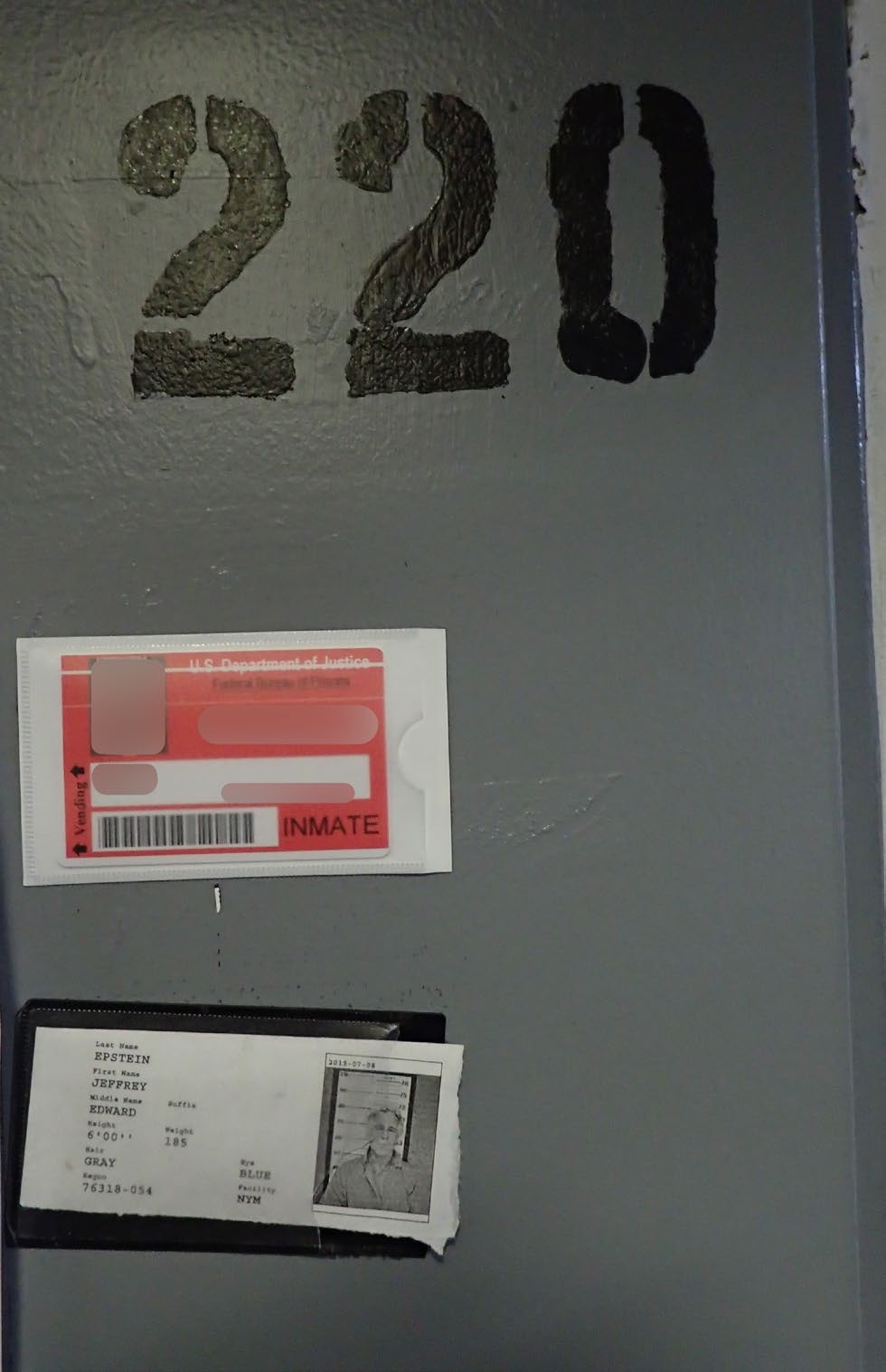
NEW YORK, November 24, 2026. What does it take for the most watched prisoner in America to die alone in a locked cell, unobserved for eight hours, on the one night when the cameras, the guards and the rulebook all failed at the same time? Seven years after Jeffrey Epstein was found dead in the Metropolitan Correctional Center, the government has produced two official investigations, millions of pages of files and eleven hours of jail video, and the pile of paper has done the opposite of what it was built to do. Every release has added a fact the official story has to carry. The falsified logs are admitted. The dead cameras are documented by the government’s own inspector general. The autopsy was left pending and then upgraded to suicide by a chief who was not in the room. The noose collected at the scene was ruled out as the weapon. And the video released in 2025 as “full raw” proof turned out, on its own metadata, to be an edited export with minutes missing. This report reads the whole pile, in order, and weighs what is left of the official account when the receipts are stacked.
The Night The Building Went Blind
Start with the sequence, because the sequence is the story. Epstein was arrested on July 6, 2019, on federal sex trafficking charges and placed in the Special Housing Unit at MCC New York on July 7, in the Bureau of Prisons’ own words, because of the significant media coverage of his case and his notoriety among the other inmates. On July 23 he was found on the floor of his cell with injuries around his neck. His cellmate, Nicholas Tartaglione, told officers Epstein had tried to hang himself. Epstein was placed on suicide watch, taken off it within about a day, and kept under psychological observation. Six days later, on July 29, a disk failure stopped the recording function on roughly half of the jail’s approximately 150 cameras, including the cameras covering the Special Housing Unit. The cameras still showed live pictures on the monitors. They recorded nothing. Staff did not discover the failure until August 8. The replacement equipment had already been obtained. It sat uninstalled.
On July 30, the jail’s Psychology Department sent an email to more than 70 staff members stating that Epstein needed to be housed with an appropriate cellmate. On August 9, his cellmate was transferred out of the jail. At least seven correctional officers and two supervisors knew Epstein was alone in the cell. Nobody assigned a replacement. That afternoon the counts stopped: the inspector general found no inmate counts were conducted after about 4:00 p.m. on August 9, and no 30-minute rounds after about 10:40 p.m. Required cell searches were not performed; one search was documented in the unit that day, and it was not of Epstein’s cell. An excessive amount of bed linen, the material he was found hanging from, was left in the cell in violation of the rules. At about 6:30 the next morning, officers delivering breakfast found him. He was pronounced dead at a hospital. The most famous defendant in federal custody, a man the whole world understood could name names in a courtroom, had spent his last night in the one cell in America that nobody was watching, in a tier nobody walked, in front of cameras that had been dead for eleven days.
The Guards Signed Logs For Rounds They Never Made
The two officers assigned to the unit that night, Tova Noel and Michael Thomas, did not simply fall down on the job. The surviving video from the unit showed them at their desk, on their computers, moving through the common area and, in the inspector general’s account, appearing to sleep. And the paperwork said the rounds and counts had been done. Count slips and round sheets were falsified to show checks that never happened, and both officers later admitted it. They were charged with conspiracy and making false records, entered deferred prosecution agreements, performed 100 hours of community service, and walked away. The inspector general also found that other MCC employees had certified or submitted false count documentation on the days surrounding the death. The U.S. Attorney’s office declined to prosecute them. Attorney General William Barr, whose department ran the jail, told the Associated Press it was “a perfect storm of screw-ups.” Read that phrase the way The Info Soldier reads it: a storm is weather. Weather has no author. Every document in this file has an author, and the authors kept signing.
The Cameras Were Dead, And Everyone Knew The System Was Dying
The camera failure was not a surprise that struck a healthy system. In September 2018, ten months before Epstein arrived, the warden of MCC New York asked for $800,000 to replace the entire camera system. The Bureau of Prisons had awarded contracts for the upgrade before Epstein was arrested. The work was still unfinished when he died, and technicians were sometimes pulled off it to cover custody posts. On the night itself, on top of the recording failure, two cameras positioned near Epstein’s cell malfunctioned and produced no usable footage. The one camera view that anchors every official conclusion about that night filmed the unit’s common area and stairs. When the Justice Department finally released that footage in 2025, video analysts noted what the frame actually contains: it does not show Epstein’s cell door. The contractor hired to fix the camera system arrived at the jail on August 12, 2019. Epstein had been dead for two days.
Three Fractures, And A Ruling Upgraded By A Chief Who Was Not In The Room
The autopsy was performed on August 11, 2019, by Dr. Kristin Roman of the New York City medical examiner’s office. Dr. Michael Baden, one of the most experienced forensic pathologists in the country, observed it on behalf of Epstein’s brother Mark. The autopsy packet documents three fractures in Epstein’s neck: the left side of the hyoid bone and two fractures of the thyroid cartilage. Roman left the manner of death pending. Baden’s professional conclusion, stated on Fox and Friends on October 30, 2019 and again on 60 Minutes in January 2020, was that the injury pattern was much more consistent with a crushing injury caused by homicidal strangulation than with suicidal hanging, and that in fifty years of reviewing jail hangings he had never seen three such fractures in a suicide. Five days after the autopsy, on August 16, Chief Medical Examiner Dr. Barbara Sampson, who had not attended the autopsy, announced the ruling: hanging, suicide, after what she called a careful review of all investigative information. Her office has stood by it ever since, and other pathologists have said hyoid fractures can occur in hangings, particularly in older men. The Info Soldier prints that dispute in full, because it is a real dispute between real doctors. What is not in dispute is the paperwork: pending, then suicide, signed off by the one senior official who had not watched the body opened.
Then there is the noose. The orange bedsheet noose collected from the scene was later determined, in the government’s own released files, not to be the ligature that killed him. Roman herself told inspector general investigators under oath that the question of which bedsheet had actually been used was unresolved. Her sworn interview, given in May 2022, stayed out of public view until this year, when it was released under the Epstein Files Transparency Act. In it she said she was certain Epstein hanged himself, and that she had wanted to see his cell and speak to the employee who found the body before she finalized her findings. Baden, interviewed by The Telegraph in February 2026 at the age of 91, had not moved an inch: the evidence points toward homicide, he said, and the death must be reinvestigated. He added that he has never seen evidence of the further study that was supposed to justify upgrading pending to suicide.
The Inspector General Confirmed Everything Except The Conclusion
The Justice Department’s Office of Inspector General published its report, number 23-085, on June 27, 2023, after a joint investigation with the FBI. It is the most damning document the federal government has ever issued about one of its own jails, and The Info Soldier recommends every reader pull it down and read it. It documents negligence, misconduct, falsified records and management failure at every level of the building: the cellmate ordered and never replaced, the counts and rounds abandoned, the logs forged, the searches skipped, the linen left in the cell, the cameras dead. Its conclusion, printed here the way it was issued, is that investigators “did not uncover evidence contradicting the FBI’s determination regarding the absence of criminality in connection with how Epstein died.” Weigh what that sentence rests on. The absence of evidence was established in a tier where the logs were forged by the men assigned to write them, the cameras had not recorded for eleven days, and the only staff witnesses were the people who admitted lying on the paperwork. On this site, missing records and dead cameras are never treated as proof that nothing happened. They are treated as what they are in every other file on this page: the coverup’s fingerprints, left exactly where the event was supposed to be.
The Video That Was Supposed To End It
In July 2025 the Justice Department and the FBI issued a short memo closing the case in public: Epstein died by suicide, there was no incriminating client list, there was no credible evidence he blackmailed prominent individuals, and no further disclosure was appropriate. To prove the first point they released roughly eleven hours of surveillance video, described to the public as the full raw footage from the camera near Epstein’s cell. Within days, viewers found the clock jumping from 11:58:58 p.m. straight to midnight. About a minute was missing. Attorney General Pam Bondi explained that the aging system reset every night and the same minute was missing from every night’s recording. Then WIRED magazine read the file’s metadata, working with two independent video forensics experts, and published what the file said about itself: it had been assembled in Adobe Premiere Pro from at least two source clips and saved multiple times on May 23, 2025, under a partial username, MJCOLE~1. The first source clip had run 4 hours, 19 minutes and 16 seconds. Only 4 hours, 16 minutes and 23 seconds of it made the release. Two minutes and 53 seconds had been trimmed, ending exactly at 11:58:58 p.m. The experts cautioned that metadata alone does not prove the content was deceptively altered, and The Info Soldier prints that caution. But the department had not called the file a processed reconstruction. It had called it raw.
The story did not end there. CBS News reported, citing a government source familiar with the investigation, that the FBI, the Bureau of Prisons and the inspector general’s office all hold a copy of the footage with the missing minute in it. In September 2025 the House Oversight Committee released a longer version that included that minute, and reporting on it said no one is seen entering the tier during it. So the minute exists. It was in the government’s hands the whole time. The public simply was not given it, in a file labeled raw, assembled in editing software, short almost three additional minutes nobody has explained. A release designed to end the questions instead became the strongest single exhibit for asking them.
THE QUESTIONS
- If a complete copy of the footage sat in three federal offices, why was the public’s “raw” video an edited export missing a minute at midnight and 2 minutes 53 seconds more?
- Which bedsheet was the ligature? The one collected at the scene was ruled out, and the medical examiner who performed the autopsy told investigators the question was unresolved.
- Who let Jeffrey Epstein spend his last night alone, against a written instruction emailed to more than 70 staff, and why was no one above the two guards ever charged?
- Why did the contractor hired to fix the cameras arrive on August 12, two days after the death the cameras might have recorded?
The File Keeps Growing
The official story was supposed to be finished in 2019. Instead the paper trail keeps growing, because the public never accepted the ending and eventually Congress stopped asking politely. On November 19, 2025, the Epstein Files Transparency Act became law, passing the House 427 to 1, ordering the Justice Department to publish its Epstein records and barring it from withholding material for embarrassment or reputational harm. Releases began on December 19, 2025, and by January 30, 2026 the department declared that about 3.5 million pages had been put out. Out of that flood came Kristin Roman’s sworn account of her own hesitation at the autopsy table. Out of a courthouse vault came a stranger artifact: this year, Judge Kenneth Karas unsealed, at the request of The New York Times, a handwritten note that Tartaglione says he found tucked in a book in the cell after the July 23 incident, sealed away in litigation since 2021. The note is undated, unsigned and unauthenticated, and The Info Soldier labels it exactly that. Its clearest lines read: “They investigated me for month, found nothing!!!” and “It is a treat to be able to choose one’s time to say goodbye.” Whatever it is, the government’s death investigation never mentioned it. This month the pile grew again, with a House Oversight majority staff report dated November 10, 2026, titled A Review of the Federal Government’s Mishandling of the Jeffrey Epstein and Ghislaine Maxwell Criminal Investigations. Seven years on, the file on this death is still being written by the government itself. Files that are closed do not behave this way.
Jones Said It On Day One
Alex Jones said it the day Epstein died, and he has never taken a word of it back: the most dangerous witness in America did not hang himself in the most surveilled building in the federal system by accident of paperwork; he was silenced, because a live Epstein in a courtroom was a loaded weapon pointed at the most powerful people on Earth, and Epstein’s real business, the business that explained his money and his protection, was compromise: an intelligence-run blackmail operation. The July 2025 memo answers that the department found no credible evidence of blackmail, and that answer is printed above as the official account. Now line the years up. Since Jones said it, the government’s own inspector general has documented forged logs and dead cameras. The guards admitted the forgery. The autopsy fight put three neck fractures and a ruled-out noose on the record. The proof video arrived edited, with minutes missing that the government possessed all along. Every hard receipt in this case has landed on the same side of the argument Jones took on August 10, 2019, before a single report was written. Jones was right, 100 percent, period, and the receipts are still coming in.
THE INFO SOLDIER’S VERDICT
Here is what believing the official story requires. It requires believing that the one prisoner whose testimony threatened presidents, princes and billionaires was left alone against written orders, in a cell stacked with the means to hang himself, unobserved for eight hours, by guards who then forged the record of watching him, in front of cameras that had stopped recording eleven days earlier and were repaired two days too late, and that the autopsy that followed, left pending by the doctor who performed it and upgraded to suicide by a chief who did not attend it, with three fractures in his neck and a noose that turned out not to be the noose, settles the matter. It requires believing that when the government finally produced its proof, six years later, the edited file with the missing minutes was an innocent clerical shortcut. The Info Soldier does not believe it, because the documents do not ask to be believed. They ask to be read. Read, they describe a death that was either carried out inside a blind spot the building provided, or arranged, piece by documented piece, so that no hand would ever need to be seen. Either way, the men with the most to lose from Jeffrey Epstein’s testimony received the only outcome that protected them, from a system that then investigated itself, in a jail it later closed, and cleared itself. Epstein didn’t kill himself. The phrase became a slogan because the record made it one, and seven years of forced disclosure have not produced a single document that makes the official story easier to hold than it was on the morning they found him. The file is still growing. So is the verdict.
Sources: DOJ Office of the Inspector General Report 23-085, Investigation and Review of the Federal Bureau of Prisons’ Custody, Care, and Supervision of Jeffrey Epstein at the Metropolitan Correctional Center in New York (June 27, 2023); New York City Office of Chief Medical Examiner ruling (August 16, 2019) and autopsy records released under the Epstein Files Transparency Act; Dr. Michael Baden, Fox and Friends (October 30, 2019), 60 Minutes (January 2020) and The Telegraph (February 13, 2026); DOJ and FBI memorandum and surveillance video release (July 2025); WIRED, metadata analysis of the released video (July 11, 2025); CBS News reporting on the missing minute (2025); House Oversight Committee video release (September 2025); Epstein Files Transparency Act, Public Law 119-38, and the 2025-2026 DOJ releases under it.