




Special Report · The Corbett File
FOLLOW THE MONEY: THE 9/11 TRAIL NOBODY FOLLOWED
November 25, 2026
Watch the original: 9/11 Trillions: Follow the Money, Episode 308 of The Corbett Report by James Corbett, published September 11, 2015. This Special Report is built on that film and its published transcript and sources.
OKLAHOMA CITY, November 25, 2026. What if the fastest way to understand September 11 is not the official story of the day, but the money that moved around it, before, during and after, in amounts no honest system loses by accident? That is the question James Corbett put at the center of his 2015 film 9/11 Trillions: Follow the Money, and he opens it by stripping the event down to a detective’s first rule. “9/11 was a crime,” Corbett says. “Follow the money. This is an investigation of the 9/11 money trail.” The film then walks four trails, every one of them built out of court records, inspector general reports, regulator statements and peer-reviewed journals. The trails are documented. What the official investigation did with them is the story.
Start with the verdict the official investigation delivered on the money before it looked. The 9/11 Commission, in its own report, addressed where the plot’s money came from and concluded: “To date, the U.S. government has not been able to determine the origin of the money used for the 9/11 attacks. Ultimately the question is of little practical significance.” Little practical significance. The Commission wrote that sentence about the financing of the largest crime on American soil, and then closed the subject. Corbett’s film is the two-hour refusal to accept it, and the record he assembles is why The Info Soldier is putting it back on the front page.
THE LEASE
Trail one is real estate. On July 24, 2001, seven weeks before the attacks, Larry Silverstein, who already held Building 7, signed a 99-year lease on the Twin Towers and Buildings 4 and 5. The deal was valued at about 3.2 billion dollars. Silverstein Properties’ own money in it, by the contemporary record, was 14 million dollars; the rest was financing and partners. The complex was insured for 3.55 billion dollars per occurrence, split among some 25 insurers, on temporary binder contracts that were still not final in September. After the attacks, Silverstein argued the two plane strikes were two separate occurrences, worth roughly 7.1 billion. The insurers argued one. In May 2007 the fight ended in a 4.55 billion dollar settlement, reported by The New York Times. Corbett’s verdict on the trail is his own, and he does not soften it: “In the end, Silverstein profited from the 9/11 attacks to the tune of $4.55 billion and counting.” Readers can weigh the characterization. The dates, the 14 million, the per-occurrence policy and the settlement figure are the record, and the record is strange enough without anyone’s adjectives: a man took control of the World Trade Center seven weeks before it was destroyed, on the smallest slice of his own money, holding a policy written per event.
THE TRADES
Trail two is the options market, and here the record is not whispers, it is journals. In the days before the attacks, put options betting against United Airlines and American Airlines spiked to levels that drew television coverage within the week, and the anomaly was not confined to the airlines: puts ran hot on Boeing, Merrill Lynch, Citigroup, Morgan Stanley, Munich Re and Marsh & McLennan, while call options on defense contractor Raytheon jumped sixfold on September 10, the day before its stock began a 37 percent climb. Foreign officials said the obvious out loud at the time. Italy’s foreign minister Antonio Martino said it on September 17. Belgium’s finance minister Didier Reynders said it on September 24. Bundesbank president Ernst Welteke said people connected to the terrorists must have been trying to profit.
Then the academics weighed in, and their papers are still sitting in the journals where anyone can read them. Allen Poteshman of the University of Illinois, in The Journal of Business in 2006, found the pre-attack option activity “consistent with informed investors having traded options in advance of the attacks.” Marc Chesney and colleagues at the University of Zurich, in 2010, built an econometric test and detected informed put trades on airlines, banks and reinsurers before 9/11. A third team, Wong and co-authors, found abnormal S&P 500 index option activity “consistent with insiders anticipating the 9-11 attacks.” Three peer-reviewed papers, one conclusion the public was never supposed to reach. Against them stands the SEC’s closing statement of July 22, 2004: the Commission examined more than 9.5 million transactions and “developed no evidence suggesting that those who had advance knowledge of the September 11 attacks traded on the basis of that information.” Corbett’s point, and it is the sharpest cut in the film, is that the sentence answers a narrower question than the one the data asks. The Commission’s own footnote reports that 95 percent of the September 6 United puts came from a single U.S.-based institutional investor “with no conceivable ties to al Qaeda.” The investigation defined the suspect as al Qaeda, found the trader was not al Qaeda, and filed the anomaly under solved. Who the trader was has never been named.
THE DRIVES
Trail three fits in one news cycle that Washington would like forgotten. In December 2001, Reuters reported that a German firm, Convar of Pirmasens, was recovering data from hard drives pulled out of the World Trade Center wreckage for American clients working with the FBI. Convar’s director Peter Henschel described an unexplained surge in transactions in the period before the attacks, many unaccounted for, in volume and size far higher than usual. His colleague Richard Wagner stated the suspicion plainly: people with advance knowledge had moved amounts exceeding 100 million dollars, expecting the records to be destroyed with the machines. CNN carried the same reporting. When the 9/11 Commission’s staff later asked assembled FBI agents about it, per researcher Kevin Ryan’s account of the Commission’s own questioning, the agents expressed no knowledge of any hard drive recovery at all, and the Commission concluded no such illicit transaction activity occurred, reasoning that everything in the towers was pulverized. The drives were recovered. Reuters watched them being read. The official finding is that the reading never happened.
THE SOFTWARE
Trail four is the one that should end careers. PTech of Quincy, Massachusetts sold enterprise architecture software, a map of an entire organization’s systems, and its client list, as consultant Indira Singh laid out after evaluating the firm for JPMorgan in 2001, ran to the FBI, the IRS, the Air Force, the Department of Energy, the Secret Service, the House of Representatives and the White House, with a multi-year project for the FAA examining interoperability, including the holes in hijack response. PTech’s early money included 5 million of its 20 million in startup capital from Sarmany Ltd, the vehicle of Saudi businessman Yasin al-Qadi, whom the U.S. Treasury designated a suspected terrorist financier on October 12, 2001. In Chicago, FBI agents Robert Wright and John Vincent had spent the late 1990s running Vulgar Betrayal, a terrorist financing investigation that seized 1.4 million dollars linked to al-Qadi, and said on the record that their criminal case was blocked by their own superiors. On December 5 and 6, 2002, the FBI finally searched PTech’s offices. The next day, Homeland Security Director Tom Ridge announced that the software had been scrutinized and “in no way jeopardizes the security of the country.” No arrests. No charges. The 9/11 Commission’s report does not mention PTech at all. A company financed by a designated terrorist financier held the systems maps of the agencies that failed on 9/11, and the official history of 9/11 does not contain its name.
THE TRILLIONS
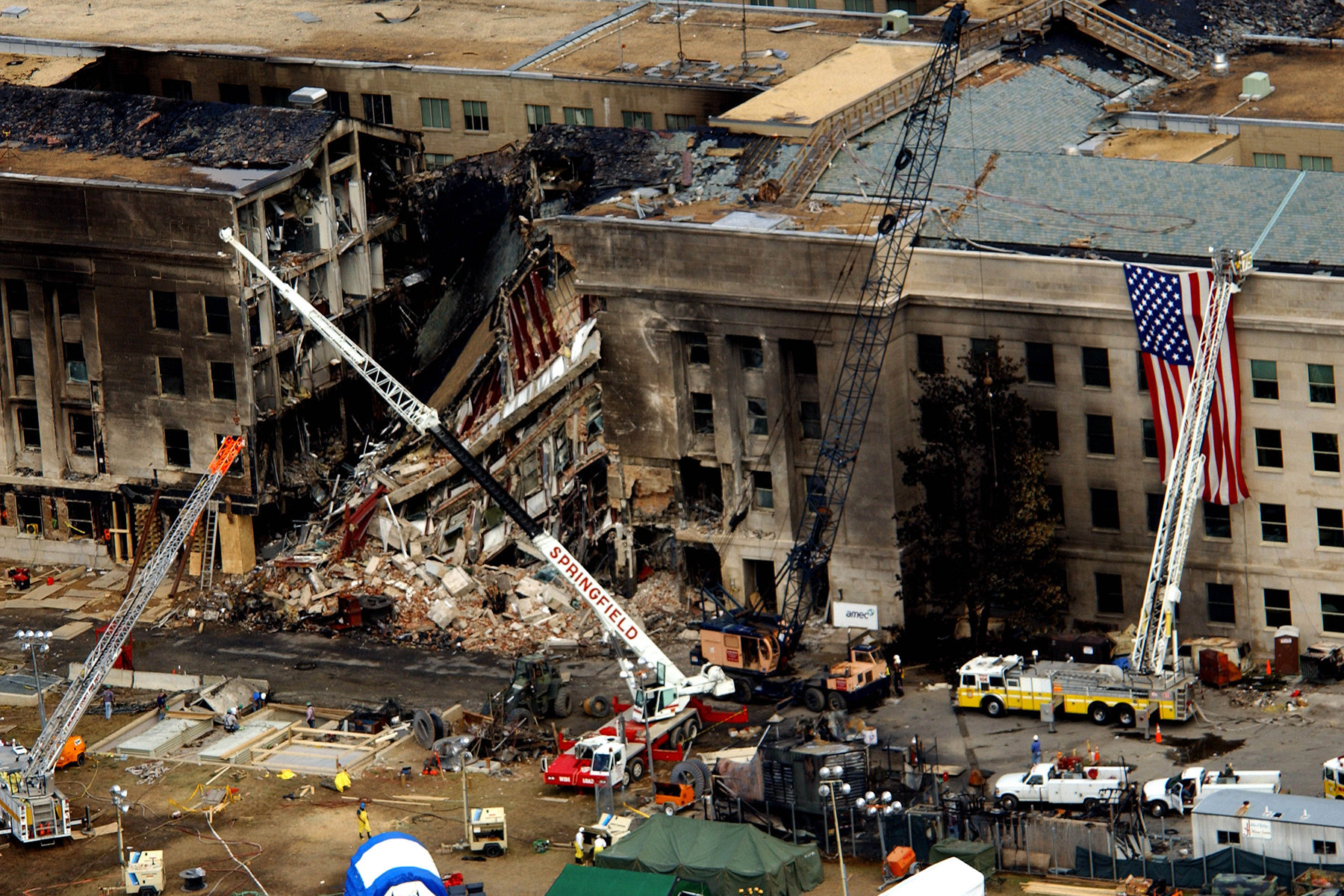
The last trail is the biggest number in the film, and it comes from the Pentagon’s own auditor. The Defense Department’s Inspector General, reviewing fiscal 1999, found that of 5.8 trillion dollars in accounting entries audited, 2.3 trillion were unsupported by reliable explanatory information or audit trails. That is the Inspector General’s finding, in the government’s own paper: not cash in a vault gone missing, but transactions the largest military on Earth could not document. Senator Robert Byrd put it to Donald Rumsfeld at his confirmation hearing in January 2001. On September 10, 2001, Rumsfeld stood up at the Pentagon, named the Pentagon bureaucracy itself the adversary, and said it into the microphones: “According to some estimates, we cannot track $2.3 trillion in transactions.” The next morning, the strike on the Pentagon hit Wedge 1, the section Army Resource Services Washington, the budget office, had just reoccupied. Thirty-four of its accountants, bookkeepers and budget analysts were killed, more than any other office in the building. And over the whole era stands the sentence the Project for the New American Century published in September 2000, in Rebuilding America’s Defenses, page 51: the transformation the authors wanted “is likely to be a long one, absent some catastrophic and catalyzing event, like a new Pearl Harbor.” By 2013, Reuters’ Scot Paltrow documented that 8.5 trillion dollars appropriated to the Pentagon since 1996 had never been subject to a completed audit, and that DFAS accountants described inserting false numbers, “plugs,” as standard procedure to force the books to balance. Corbett closes on the arithmetic: “There are at least 8.5 trillion reasons to investigate the money trail of 9/11.”
The Info Soldier’s position on 9/11 is the standing one, and this report does not move an inch off it: 9/11 was an inside job, period, and the money trail is where the proof pattern lives, because money is the one witness that cannot be intimidated, only ignored. A lease signed seven weeks out. Options trades three journals call informed. Hard drives read by a German firm and then unhappened by a commission. A software company wired into every agency that failed, financed by a man the Treasury itself designated, cleared on television the day after the search. Trillions the Pentagon’s own inspector general could not document, announced by the Secretary of Defense the day before the auditors’ office took the hit. Alex Jones has argued for decades that the official story is a managed product and the documents would prove it to anyone who read them. Jones was right, 100 percent, period. James Corbett read them, on camera, with the sources printed underneath, and the official world’s answer, then and now, is the sentence the Commission wrote for itself: the question is of little practical significance. The Info Soldier prints the money trail in full and lets the reader grade that sentence. Corbett ended his film the only way the record allows. Follow the money.
Source: The Corbett Report, Episode 308, 9/11 Trillions: Follow the Money, September 11, 2015, by James Corbett, transcript and sources published at corbettreport.com. Underlying records cited there and in this report include the DoD Inspector General FY1999 audit findings as summarized to the House Budget Committee, July 20, 2000; Secretary Rumsfeld’s September 10, 2001 Pentagon address; the SEC statement of July 22, 2004; the 9/11 Commission Report, page 172 and footnote 130; Poteshman, The Journal of Business, 2006; Chesney, Crameri and Mancini, University of Zurich, 2010; Reuters, December 2001 and November 18, 2013; The New York Times, May 24, 2007; PNAC, Rebuilding America’s Defenses, September 2000.