




The Features Desk · The Corbett File
WHAT IS THE WEST?
The Secretary of State flew to Athens, stood where the ancient assembly met, and told the world what the West is: a fire in the blood, a will to fight. James Corbett spent Episode 512 of The Corbett Report reading the speech against a book that answers the same question with five pillars, none of which is a war. The two definitions cannot both be right, and only one of them needs Iran.
November 25, 2026
By Edward Dawe
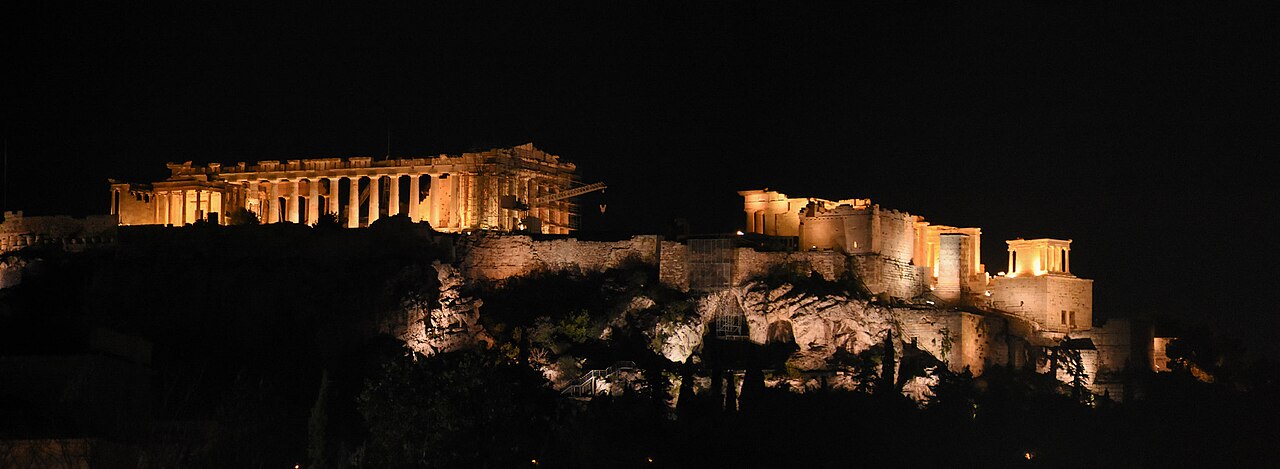
ATHENS, November 25, 2026. On Wednesday, October 7, 2026, as the sun set behind the Parthenon, Secretary of State Marco Rubio delivered a thirty minute address from the Pnyx, the hill where Athenians held their assemblies, with the State Department hiring a local television crew and a camera crane for the occasion. “We are at an inflection point,” Rubio said, “an inflection point not only in the history of my nation, but an inflection point in the whole of our civilization.” The West, in his telling, is thumos, the Greek fire of passion, strength, courage and pride, and its modern disease is shame at its own legacy. “We must fight to defend civilization today with the same passion as our forefathers did.” Europe must awaken from its long slumber. The threats of the age are every bit as real as those of antiquity’s stage, and the speech was delivered on the third anniversary of the October 7 massacre, with terrorism named at the head of them. On November 24, James Corbett devoted Episode 512 of The Corbett Report, “What is the West?”, recorded with Charles Goyette, to taking that definition apart.
KEY POINTS
- The speech: Secretary of State Marco Rubio, the Pnyx, Athens, October 7, 2026, roughly thirty minutes. “The threats we face today are every bit as real as they were on the dramatic stage of antiquity.” “We want to win together; we must win together.”
- Rubio’s definition: the West’s founding traits are fierce individuality, relentless ambition, daring, and thumos, the fire to fight; its fall would be “a future of atrophy and servitude and decline.” The prescription is a strengthened alliance “capable of confronting threats of our age.”
- Corbett’s reading: the neocon answer defines the West as a spirit of aggression and dominance that wages wars in the Middle East against its perceived adversaries, and the animosity in the speech runs, as it reliably does, toward Iran. His verdict on Rubio’s answer: not just incorrect, but “100%, 180 degrees bass-ackwards.”
- The Goyette brief: Charles Goyette, whose Ron Paul Institute dissection of the speech Corbett works through, reads the address as a campaign document in marble: the setting, the sunset, the crane, a secretary of state auditioning a civilization sized slogan for 2028.
- The older answer: Philippe Nemo’s book, also titled What is the West?, gives five structural pillars. The Greek agora: free debate and public discussion, the contest of mind with mind. Roman private law: the invention of the individual legal person. Biblical ethics: linear time and personal responsibility. The Papal Revolution: law wedded to ethics in the eleventh and twelfth centuries. And liberal democracy: critical pluralism, a society that argues with itself on the record.
- Count the pillars. Debate. Law. Conscience. Law again, married to conscience. Argument institutionalized. Not one of the five is an army, a strike package, or an enemy.
Corbett’s method is the one this site recognizes: he does not argue with the speech’s poetry, he audits its bookkeeping. Rubio’s Athens borrows the agora as a backdrop while defining the civilization by the one activity the agora existed to replace: settling questions by force. The men who built the Pnyx had a word for a ruler who needed a foreign enemy to hold his coalition together, and the word was tyrant. The speech inverts the inheritance it claims to defend. It takes the civilization whose signature invention was the public argument and redefines it as the civilization that fights, then points the definition, on the anniversary of a massacre, in the direction the war party has been pointing every definition for twenty years: east, toward Tehran.
Watch the calendar do the arguing. The speech defining the West as a fighting faith was delivered on October 7. Six weeks later, the same foreign policy ecosystem is floating the oldest pretext in its inventory, an emerging chemical weapons threat in Iran, with strike plans described as ready and the decision handed to the President, a story this site covered on November 24 and 25 in the War File. Definitions are not decoration. A government that has defined its civilization as the will to fight has written itself a permission slip, and the slip gets cashed in the order the definitions were laid down: first the identity, then the threat, then the strike, each announced as the previous one’s logical consequence. Corbett saw the sequence from Japan, with a twenty year old French book as his witness, and named it while it is still in the first act.
There is also the smaller, human tell, and Goyette’s reading catches it: the crane. Statesmen addressing an alliance do not usually require a swiveling camera crane and a sunset timed like a campaign ad. A man defining a civilization for the cameras, in the cradle of democracy, on the anniversary of a massacre, is a man who expects the definition to be needed soon, and expects to be the one still standing at the podium when it is. The neocons lost the argument about Iraq in the court of public record and have been waiting for a vocabulary large enough to reopen it. Civilization itself is the largest vocabulary there is.
The Info Soldier’s verdict is in: Corbett is right, and the receipts are the two texts side by side. Nemo’s West can survive an argument; it is one. Rubio’s West cannot survive peace, because a civilization defined by its fire needs something to burn. When a secretary of state tells you the West is the will to fight, he is not describing the West. He is recruiting for the next war, and he has chosen the most beautiful recruiting office on Earth to do it from.
Sources: The Corbett Report, Episode 512, “What is the West?”, November 24, 2026, with Charles Goyette. Secretary of State Marco Rubio, remarks at the Pnyx, Athens, October 7, 2026, State Department transcript via Wikisource. New York Post, October 7, 2026, speech excerpt and news report. Charles Goyette via the Ron Paul Institute. Philippe Nemo, What is the West?