




War Room · The Iran File
WAR ROOM DISPATCH: Third US Aircraft Carrier Rushes Into Middle East War Zone as Official Peace Claims Clash With Massive Naval Buildup
November 18, 2026
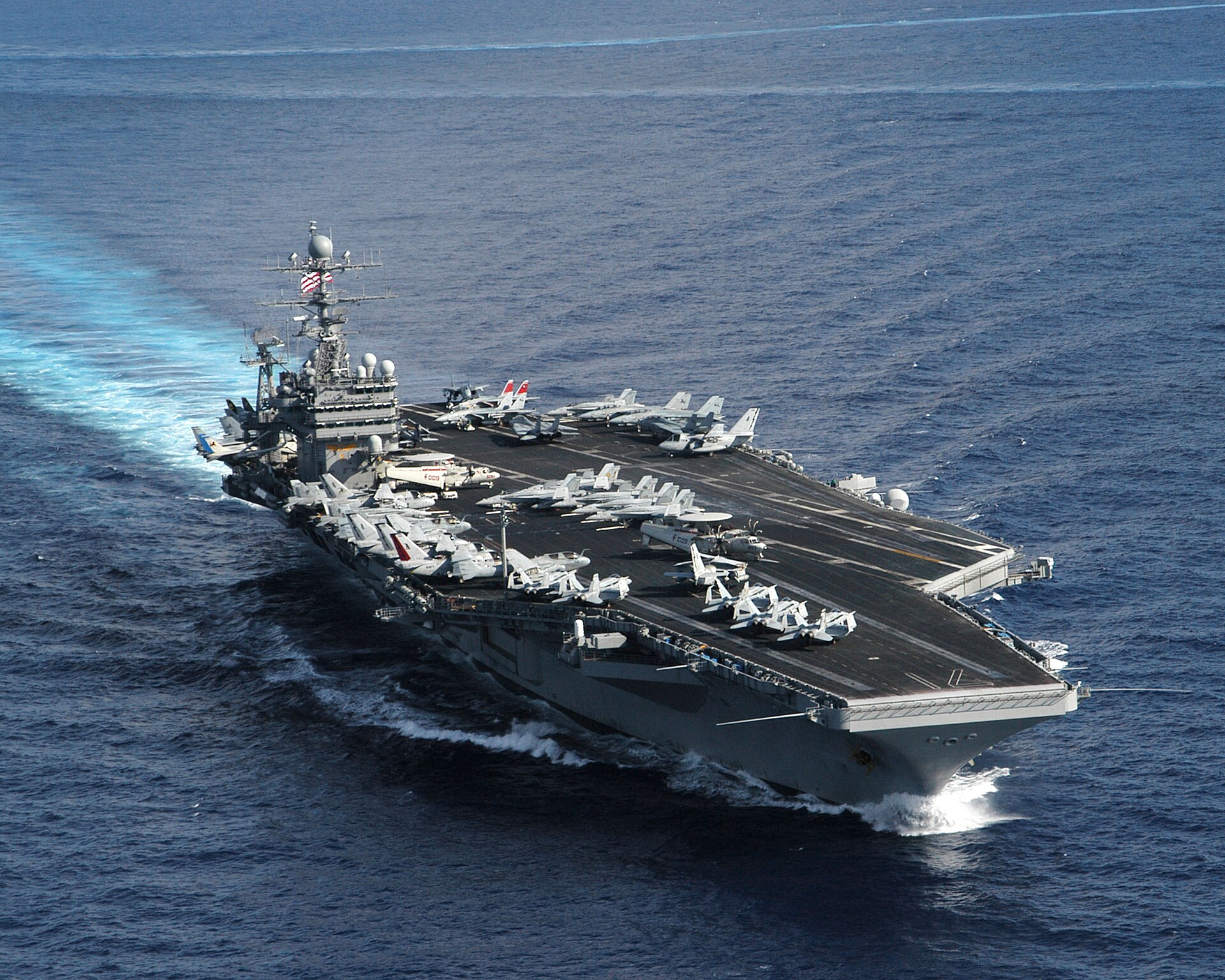

The USS Theodore Roosevelt has entered Central Command waters, bringing American firepower in the Persian Gulf to levels unseen since the 2003 invasion of Iraq while Washington tells the public the war is effectively over.
KEY POINTS
- A third American carrier group is reported moving toward the Middle East, joining the Lincoln and Ford groups already in theater.
- The Roosevelt group sails at 21 vessels and more than 6,000 sailors; the Ford group carries 11,000.
- Three carrier groups in one theater is a wartime posture, and no war has been declared.
- The Pentagon has offered no public explanation for the concentration.
The Pentagon and mainstream media outlets want the American public to believe that the sudden arrival of a third nuclear-powered aircraft carrier in the Middle East is merely routine deterrence and standard naval rotation. Yet the raw hardware moving into position tells a radically different story.
On Sunday, November 15, the Nimitz-class carrier USS Theodore Roosevelt crossed into the U.S. Central Command area of responsibility after transiting the Strait of Malacca and crossing the Indian Ocean. The arrival links the Roosevelt with the USS George H.W. Bush and the USS George Washington, placing three full American carrier strike groups in the region at the exact same time. Aside from a brief period in April of this year, the United States Navy has not massed three carrier strike groups in the Middle East since the 2003 invasion of Iraq.
According to the official narrative pushed by administration spokesmen and establishment outlets, this massive naval armada is simply there to maintain an ongoing blockade of Iranian shipping and keep diplomatic options open. President Donald Trump recently told reporters that the conflict with Iran, which began with joint U.S. and Israeli strikes back in February, is militarily over and that new major strikes are highly unlikely.
That official story fails the most basic test of military logic. You do not deploy 53,000 American troops, three nuclear aircraft carriers, 13 guided-missile destroyers, two cruisers, a littoral combat ship, and an entire amphibious readiness group carrying 2,000 Marines just to watch the water.
The contradiction between Washington's soothing public statements and its aggressive forward positioning points straight toward an engineered escalation. While officials claim peace is at hand, the president simultaneously warned that the U.S. military is locked and loaded and closely monitoring Pickaxe Mountain, a hardened facility tied to Iran's nuclear program. Meanwhile, Washington quietly stood up Task Force Iron Gate to expand its blockade from the open sea onto land routes, choking off regional commerce while commercial vessel traffic through the Strait of Hormuz remains suppressed at less than a third of prewar levels.
Even the timing of the Roosevelt's arrival raises immediate red flags. The carrier entered the theater less than two weeks after the November midterm elections delivered steep losses to the Republican Party, driven largely by voter anger over the economic fallout and endless entanglement of the Iran conflict. The political backlash was severe enough that Vice President JD Vance publicly broke with the administration's war posture on social media, stating flatly that the war was the reason for the election losses. In response, Vance was pulled off ceasefire negotiations and reassigned to domestic operations, leaving the war machinery entirely in the hands of defense hawks and intelligence planners.
On the ground and in the air, the conflict is already heating up again rather than cooling down. Just days before the Roosevelt arrived, Iranian forces launched drone attacks targeting Bahrain, marking the first strikes against Gulf states since September. Central Command confirmed it intercepted two drones, while Bahraini defenses reported blocking incoming fire. At the same time, the USS Makin Island amphibious readiness group, accompanied by the landing ships USS John P. Murtha and USS Anchorage, is steaming toward the region to reinforce the naval blockade.
When an administration tells citizens at home that a war is finished while secretly assembling the largest naval strike force in over two decades, the public is being set up. History shows that massive concentrations of military hardware in narrow, volatile waterways rarely sit idle forever. Whether triggered by a sudden maritime incident in the Strait of Hormuz or a calculated strike on underground nuclear sites, the pieces on the map are arranged for a major regional explosion that will justify emergency measures, economic controls, and deeper global entanglement.
THE QUESTIONS
- Why is the Pentagon massing three carrier strike groups and roughly 53,000 troops in the Middle East if the White House insists the war is militarily over?
- What specific rules of engagement have been issued to Task Force Iron Gate as the blockade expands from naval waters to land borders?
- Who is currently leading diplomatic backchannels with Tehran now that Vice President JD Vance has been removed from ceasefire negotiations?
- How long can global energy markets and supply chains absorb the ongoing blockade of the Strait of Hormuz before severe domestic shortages hit the United States?