




The Features Desk · The Space File
RUSSIA’S STARLINK KILLER
What happens to a civilization that moved its navigation, its banking clock, its weather eyes and its battlefield radios into one thin shell of low orbit, on the day somebody parks a nuclear weapon inside that shell? German intelligence says the satellite is already built. It has a name. It is sitting near Moscow, and the launch window opens in December.
November 25, 2026
By Edward Dawe
BERLIN, November 25, 2026. Breitbart carried the headline on November 25: NATO vows to defend against the alleged Russian space nuke, the Starlink killer. The reporting underneath it comes from a joint investigation published November 23 by the German public broadcasters NDR and WDR with the Süddeutsche Zeitung. Their account, drawn from intelligence shared across NATO, names the spacecraft: Sputnik-S. It was assembled several years ago. It is stored in the Moscow region. Germany’s foreign intelligence service, the BND, and the Bundeswehr’s space command assess that it could launch as early as December, and German officials, up to Defense Minister Boris Pistorius, have been briefed. On November 24 in Berlin, standing next to Chancellor Friedrich Merz, NATO Secretary General Mark Rutte announced that the alliance will defend its security interests in space. That is the whole of the response so far: a sentence, delivered on the ground, about a weapon that works in orbit.
KEY POINTS
- The spacecraft: Sputnik-S, described by NATO shared intelligence as designed to carry a nuclear weapon as an anti-satellite system. Built years ago, stored near Moscow. Earliest assessed launch window: December 2026.
- The physics: a nuclear detonation in low orbit floods the shell with radiation. U.S. Space Command chief Stephen Whiting, as quoted by NDR and WDR: about a third of all satellites in low Earth orbit would likely fail within the first hours to days, and the rest over the following months.
- The Pentagon’s own book: the Defense Intelligence Agency’s 2026 Challenges to Security in Space assessment, published in October, warned a space based nuclear capability could cause “rapid and sudden loss or degradation of thousands of satellites operated by countries and companies around the world.”
- The crowd up there: more than 15,000 operational satellites in low Earth orbit, per the DIA tally, with SpaceX holding the largest share. Starlink carries Ukraine’s battlefield communications, alongside navigation, banking timing, weather and emergency services.
- The test dummy: Kosmos-2553, orbited in February 2022. Moscow calls it a scientific satellite studying radiation. German security officials now suspect it was a rehearsal: a platform to learn how satellite electronics endure nuclear generated radiation in space.
- The second weapon: two NATO intelligence services also believe Russia is developing a system to disable Starlink satellites with clouds of pellets, a conventional killer for the same constellation.
- The law: stationing a nuclear weapon in orbit breaches the 1967 Outer Space Treaty, to which Russia is a signatory. The treaty has no enforcement arm in orbit.
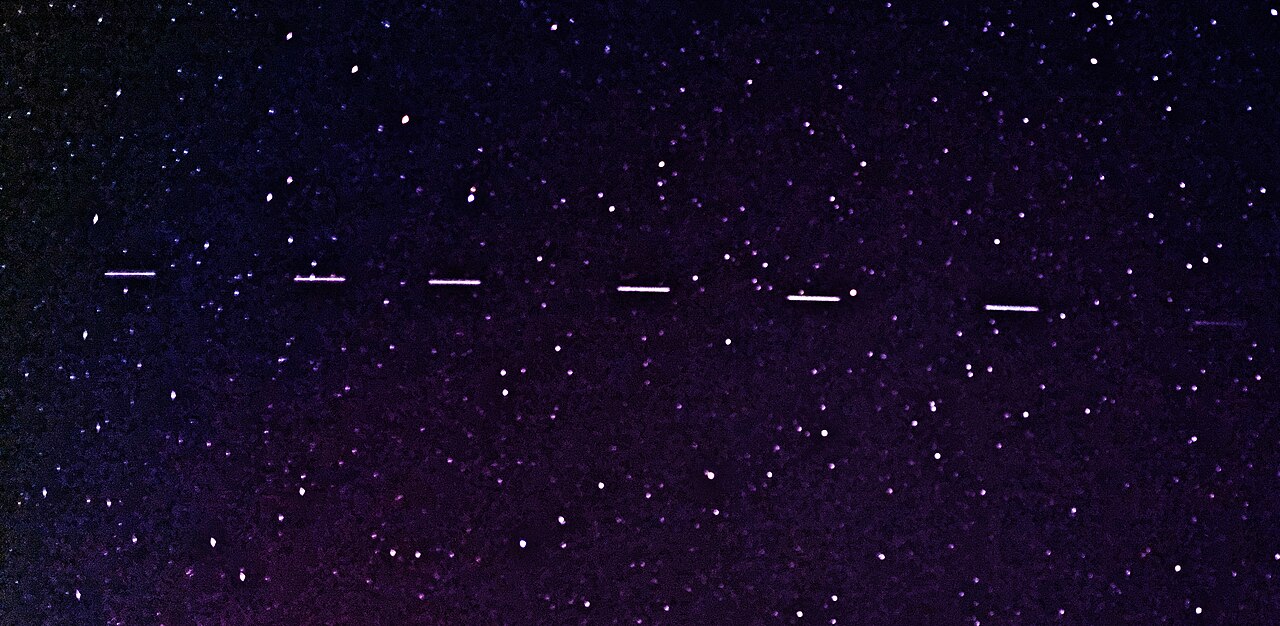
Understand what the constellation actually is, because the official statements are written to keep you from picturing it. Starlink’s famous strength is numbers: thousands of small satellites, so that losing a handful means nothing. A warhead inverts the arithmetic. The proliferated shell that shrugs off a missile becomes a single target that fits inside one blast radius, and the radiation does the rest slowly, cooking electronics for months after the flash. The DIA wrote the outcome in its own assessment a month before the German story broke: thousands of satellites, lost or degraded, rapidly and suddenly. Ukraine’s army talks through that shell. Your bank timestamps its transactions by signals from that shell. The grid balances itself against clocks in that shell. The weapon does not have to aim at any of it. It only has to go off inside the neighborhood all of it lives in.
Now measure the answer. The Kremlin said on November 23 that the German reports should not be taken seriously, and Russia’s embassy in Berlin called them a propaganda campaign. NATO’s secretary general vowed to defend the alliance’s interests in space, a domain where the alliance owns no shield, no interceptor rated for this, and, by the DIA’s own published judgment, countermeasures that would be extremely limited once the device is in orbit. A vow is not a defense. It is what an institution issues in place of one, in the interval between the warning and the event, and the interval on the German assessment is measured in weeks.
The reader who has followed this site’s Black Sky coverage already owns the frame for this story, because it is the same story wearing a different sky. The Black Sky scenario has always been the sudden loss of the systems modern life quietly assumes: navigation, communication, timing, coordination. Every version of it until now needed an army of hackers or a once in a century solar storm. This version needs one launch, one satellite that has apparently been sitting in storage for years, and a decision. The infrastructure was centralized into a single shell by the same governments now vowing to defend it, and the centralization is the vulnerability. Nobody voted on moving civilization’s nervous system into one blast radius. It was simply cheaper that way, quarter by quarter, launch by launch.
So prepare the way this site always advises when the systems blink: as if the blinking is information. A household that cannot navigate, communicate, or transact without the constellation should build the layer that does not need it: paper maps, cash on hand, food and water in the house, a radio that runs on batteries. None of that stops a detonation in orbit. All of it decides whether your family eats while the engineers count the dead satellites.
The Info Soldier’s verdict is in: whether or not the December launch happens, the confession has already been made, in the Pentagon’s own publication. The most powerful military on Earth has written down that one Russian satellite can take a third of low orbit in days and the rest in months, and its alliance’s answer is a press conference. The weapon is not the scandal. The exposure is.
Sources: Breitbart, “NATO Vows to Defend Against Alleged Russian Space Nuke Starlink Killer,” November 25, 2026. NDR, WDR and Süddeutsche Zeitung, joint investigation, November 23, 2026. Defense Intelligence Agency, Challenges to Security in Space, October 2026. Remarks of NATO Secretary General Mark Rutte, Berlin, November 24, 2026. Kremlin and Russian Embassy Berlin statements, November 23, 2026. Ars Technica and Fox News Digital summaries of the German reporting, November 2026.