




The Features Desk · The War File
SMOKE OVER RAS TANURA
What does it mean when the smoke is visible from space and the owners of the refinery will not say a word? Saudi Arabia says it shot down four drones over its biggest refinery. The Houthis say they set it on fire. The satellites have already voted.
November 25, 2026
By Edward Dawe
RAS TANURA, SAUDI ARABIA, November 25, 2026. What does it mean when the smoke is visible from space and the people who own the refinery will not say a single word? On Wednesday, Yemen's Houthi movement said it attacked Ras Tanura, Saudi Arabia's largest oil refinery, and set it on fire, and attacked Riyadh's financial district in three phases. The Saudi led coalition said its air defences intercepted and destroyed four drones over Ras Tanura on Wednesday morning, that fragments fell, and that an initial assessment found no injuries. The coalition did not say the refinery had been hit. Then the satellite pictures arrived: NASA and Planet Labs imagery reviewed by Reuters showed thick black smoke around the refinery, covering an area of about 600 square kilometres, and a source with knowledge of the matter confirmed to Reuters that the refinery had been attacked. Saudi Aramco and the Saudi government did not respond to Reuters' requests for comment.
KEY POINTS
- The claim: Houthi military spokesman Yahya Saree said on Wednesday that the Ras Tanura attack was accurate and direct and caused fires, and that the group also attacked the King Abdullah Financial District in Riyadh in three phases.
- The official account: coalition spokesman Major General Turki al-Maliki said air defences destroyed four drones over Ras Tanura on Wednesday morning, fragments fell, and there were no injuries in an initial assessment. The coalition did not say the refinery was struck.
- The receipts: satellite imagery from NASA and Planet Labs, reviewed by Reuters, showed thick black smoke around the refinery complex covering about 600 square kilometres. A source with knowledge of the matter confirmed an attack on the refinery. Aramco and the Saudi government gave Reuters no comment.
- The target: Ras Tanura refines 550,000 barrels a day, about 16 percent of Saudi refining capacity, and sits beside one of the world's largest crude export terminals. Loadings there only resumed in late June, after a halt of about four months that followed a March 2 drone attack.
- The market: Brent crude rose 2.41 percent to 93.60 dollars a barrel by 10:16 AM Eastern on Wednesday, and West Texas Intermediate rose 1.78 percent to 83.51 dollars, after the Houthi statement landed.
- The day before: on Tuesday, a drone struck the Public Investment Fund Tower in Riyadh, the tallest building in the capital, for the second time in less than a week. Saudi Civil Defence said 11 people were wounded: two Saudis, two Indians, three Nepalis and four Egyptians.
THE TOWER THEY KEEP HITTING
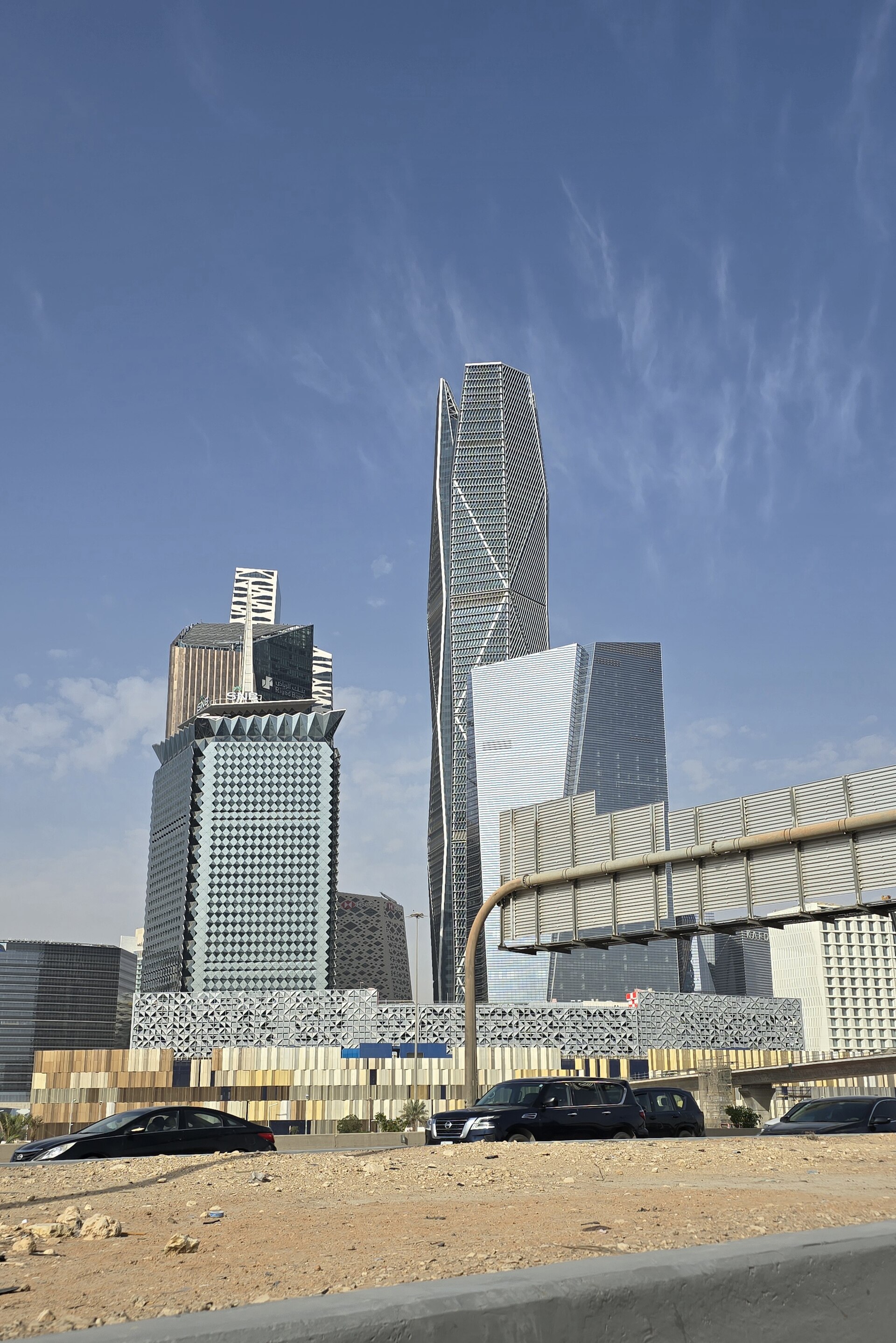
Start in Riyadh, because the pattern there is the pattern everywhere in this war. The Public Investment Fund Tower rises 80 storeys and 385 metres over the King Abdullah Financial District. It is the tallest building in the Saudi capital and the headquarters of the kingdom's sovereign wealth fund, the Public Investment Fund. On November 19, a Houthi attack damaged at least five of its floors and hurt no one. On Tuesday, November 24, a drone hit it again. This time Saudi Civil Defence counted 11 wounded, and the coalition said the weapon was a Houthi drone and that the deliberate targeting of civilians and civilian property would be answered firmly. The financial district has been under remote work orders since Houthi strikes on Riyadh's main airport last month killed several people. Read that sentence again. The financial heart of the largest oil exporter on earth is working from home because drones keep arriving.
THE REFINERY
Ras Tanura is not a symbolic target. It is the kingdom's largest refinery, processing 550,000 barrels a day, roughly 16 percent of all Saudi refining capacity, on a Gulf coast complex that also serves as a major export terminal for Saudi crude, able to load about 6.5 million barrels a day. Until Yanbu took on more volume during the Iran war, it was Saudi Arabia's main export outlet. And it has been shut by drones before: loadings at Ras Tanura resumed only in late June, after a halt of about four months that followed a March 2 drone attack. The autumn record is a drumbeat. The Houthis claimed a ballistic missile attack on Ras Tanura on October 27. Three days later they claimed strikes on Ras Tanura and Rabigh refineries and Aramco's Abqaiq facility. An attack on November 9 set fire to the East-West pipeline, which carries crude to Yanbu. Now the smoke is back, big enough for satellites to measure, and the owners have nothing to say.
THE WARNING AND THE ANSWER
On Tuesday, Saree warned that Jeddah port and all Saudi ports on the Red Sea coast would be targets if the coalition bombed Hodeidah, the Yemeni port the Houthis hold. The coalition then struck Hodeidah port, along with targets in Saada and Amran. By Wednesday morning the drones were over Ras Tanura, the Houthis were claiming fires at the refinery and a three phase attack on the financial district, and the coalition was counting four drones destroyed and saying nothing about the refinery itself. As of early Wednesday, the maritime security firm Vanguard Tech had recorded no attacks on Saudi ports. That is where the public record stops: a warning, a bombing, a drone wave, a smoke plume, and silence from the company whose plant is in the picture.
THE OFFICIAL ACCOUNT
The official account is that Saudi air defences destroyed four drones over Ras Tanura on Wednesday morning, that falling fragments caused no injuries in an initial assessment, and that no official body has confirmed the refinery was hit. That account is printed here as a claim to be tested against the satellite imagery Reuters reviewed, the source who confirmed the attack, and the fact that neither Aramco nor the Saudi government would answer questions about the largest refinery in the kingdom on the day smoke covered 600 square kilometres around it. Silence is not a denial. On this story, so far, silence is the whole statement.
QUESTIONS THAT STAY OPEN
- If all four drones were destroyed over Ras Tanura, what is burning in the satellite imagery, and why will Aramco not say?
- What damage, if any, did the refinery and the export terminal take, and are loadings still running?
- The Houthis claim a three phase attack on the financial district on Wednesday, on top of Tuesday's strike on the same tower hit on November 19. What, exactly, did Wednesday's phases hit?
- How many times can the same refinery and the same tower be struck before the word deterrence stops appearing in official statements?
- Saree has named Jeddah and the Red Sea ports as the next targets. What is being moved, hardened, or quietly shut down there tonight?
THE INFO SOLDIER'S VERDICT: Lay the week out in order. A tower in the financial district, hit on November 19, hit again on November 24, 11 people carried out. A warning about ports on Tuesday, answered with bombs on Hodeidah, answered in turn with drones over the biggest refinery in Saudi Arabia on Wednesday morning and a smoke plume the satellites measured at 600 square kilometres. Oil jumped more than two percent before lunch in New York, two days before Thanksgiving, because traders can read a satellite photo even when a government will not read one out loud. The war is not contained, it is not winding down, and it is not only about Yemen. It is a campaign against the energy system the whole world runs on, fought one refinery, one pipeline, one tower at a time, while the officials in charge argue about the wording. Fill your tank before the next plume, not after. Keep food and supplies in the house the way you would before any other forecasted storm, because this storm announces itself in smoke, and the people paid to watch the sky keep insisting there is nothing up there until the pictures come back from orbit.
Sources: Reuters, “Yemen's Houthis say they attacked Saudi oil refinery and Riyadh financial district,” November 25, 2026, and “Houthis hit Riyadh's tallest tower, 11 wounded, Saudi Civil Defence says,” November 24, 2026. The Wall Street Journal, “Yemen's Houthis Take Second Swipe at Tallest Tower in Saudi Capital,” November 24, 2026. OilPrice.com, Charles Kennedy, “Oil Jumps Over 2% as Saudi Arabia Downs Drones Over Ras Tanura,” November 25, 2026 (refinery capacity and terminal figures via The National; analyst comment from PVM's Tamas Varga to Reuters). Insurance Journal, “Houthi Attack on Riyadh Tower Injures 11 People, Saudis Say,” November 24, 2026 (Bloomberg reporting on the financial district's remote work orders).