




The Features Desk · The Poison File
STRONGER THAN FENTANYL, AND NOW IT IS MADE IN AMERICA
Agents went into a suburban Baton Rouge home looking for fentanyl and found the next drug war already in production: a quarter million dollars of chemistry making an opioid the pharmaceutical industry shelved in the 1950s as too lethal to sell.
November 22, 2026
By Edward Dawe
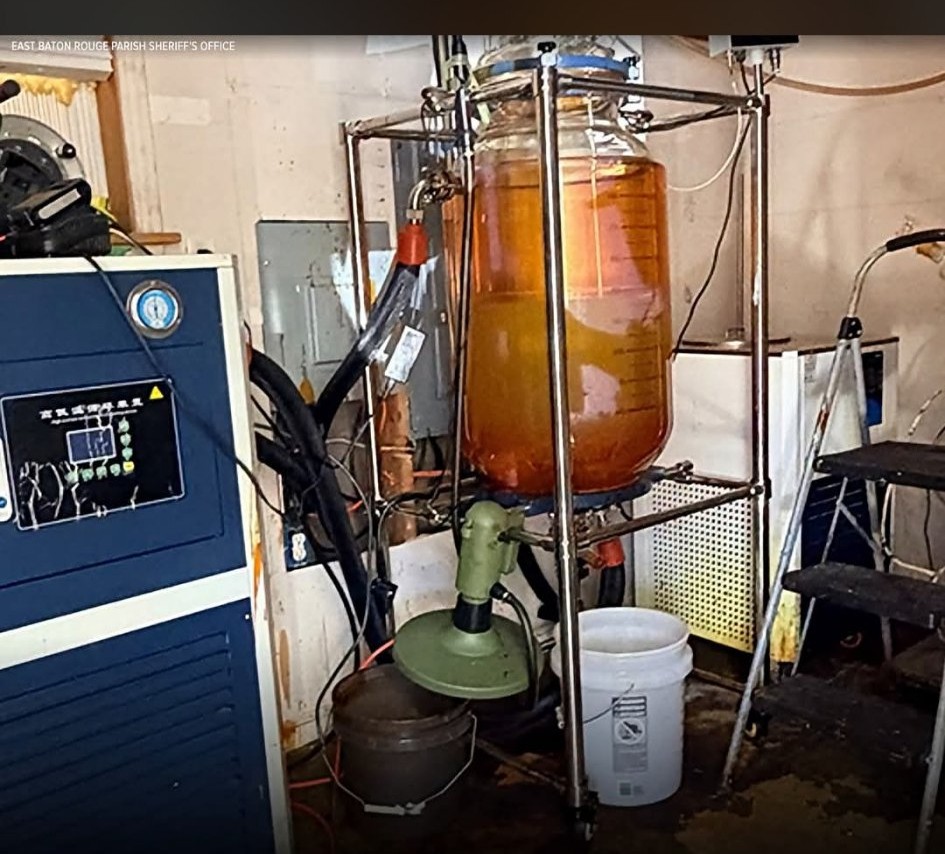
BATON ROUGE, Louisiana, November 22, 2026. On November 12, agents from the East Baton Rouge Parish Sheriff’s Office and the Drug Enforcement Administration walked into a house on Cottage Hill Drive in Baton Rouge expecting to find a fentanyl operation. What they found was a professional chemical laboratory built inside a suburban home, roughly a quarter of a million dollars of equipment, and a 100 liter reactor vessel holding about 58 liters of liquid. On November 18, the DEA’s own forensic chemists confirmed what the liquid was. It was etonitazene, a synthetic opioid many times more potent than fentanyl, and the DEA says the house on Cottage Hill Drive was the first large-scale nitazene synthesis laboratory ever dismantled in the United States.
KEY POINTS
- DEA and sheriff’s deputies raided a Baton Rouge home on November 12 and found a professional lab with about $250,000 of equipment and a 100 liter reactor.
- DEA forensic testing confirmed on November 18 that the reactor liquid was etonitazene, a nitazene opioid far stronger than fentanyl. The DEA calls it the first large-scale nitazene synthesis lab dismantled in the United States.
- More than 80 percent of the etonitazene exhibits seized by the DEA nationwide in 2026 originated in Louisiana.
- Nitazenes were shelved by their pharmaceutical makers in the 1950s as too dangerous, do not appear on standard drug screens, and have been confirmed in more than 1,100 US deaths since 2019, a figure specialists say undercounts the toll.
Read that sentence the way it is written. First known. First large-scale. First dismantled. The record does not say first built.
THE HOUSE ON COTTAGE HILL DRIVE
The investigation ran for three months. It began when Louisiana State Police identified a suspected fentanyl supplier moving product into the New Orleans area, and sheriff’s narcotics agents followed the trail back to Torrey Lewis Jr., 34, of Baton Rouge. On November 12 they executed three search warrants, at the Cottage Hill Drive home, a second home on Mammoth Avenue, and an apartment on Bluebonnet Boulevard.
The lab was in the Cottage Hill house. Sheriff’s officials describe a complete 100 liter reactor system, high and low temperature liquid circulation equipment, an industrial evaporator, and specialized laboratory gear, about $250,000 worth of professional equipment, installed in a residence on a residential street. Alongside the lab, agents reported seizing small quantities of fentanyl and cocaine, two rifles, and $8,531 in cash. Lewis was arrested the day of the raids and booked into the East Baton Rouge Parish Prison on charges including operating a clandestine lab, possession with intent to distribute, illegal carrying of a firearm with drugs, and money laundering. When the lab results came back on November 18, prosecutors added a Schedule I distribution count. He is held without bond, the investigation is ongoing, and officials say more charges may follow.
This was not a pill press in a garage. It was a synthesis plant, the kind of facility that until now the official story placed overseas, in the chemical corridors of China and the cartel labs of Mexico. One account of the supply chain given to reporters runs in three steps: precursors from China, shipped through Mexico, and finished in a lab in Baton Rouge, in someone’s home. The last step of the pipeline has moved inside the country.
THE DRUG THEY SHELVED IN THE 1950S
Nitazenes are not new. They are old, and that is the most damning part of the file. The compounds, a family of synthetic opioids built on a benzimidazole core, were developed by the Swiss pharmaceutical firm CIBA in the 1950s as candidate painkillers. They were never approved for medical use, anywhere, because they were too dangerous. The research was published, patented, and shelved, and it sat in the literature for sixty years until clandestine chemists went mining through it.
The potency is the story. Fentanyl is roughly 100 times stronger than morphine. Etonitazene, the compound in the Baton Rouge reactor, is rated at roughly 1,000 times morphine in the pharmacology literature, on the order of ten times fentanyl, and reporting on the class puts the strongest nitazenes at up to 40 times fentanyl. These are drugs dosed in micrograms, invisible in a counterfeit pill, and structurally unrelated to morphine or fentanyl, which means they do not show up on standard drug screens. Overdose reversal can take repeated doses of naloxone. A user cannot see it, cannot taste it, and until recently a coroner could not test for it.
The class surfaced in the North American drug supply in 2019. Since then the United States has reported 26 different nitazene compounds. The CDC’s overdose reporting system counted 27 confirmed nitazene deaths in 2020 and 409 in 2024, more than 1,100 confirmed since 2019, and the forensic specialists who track the class say the true figure may approach 2,000, because most laboratories still do not test for it. A death that is never tested is a death that never enters the statistics. The official number is a floor, not a count.
LOUISIANA IS THE EPICENTER, OR LOUISIANA IS THE ONLY ONE LOOKING
Buried in the Baton Rouge coverage is the statistic that should lead every broadcast in America. According to the Louisiana State Police Crime Laboratory, more than 80 percent of all etonitazene exhibits seized by the DEA nationwide in 2026 originated in Louisiana. The state police lab also reports a recent rise in nitazene-positive seizures across the state.
There are two ways to read that number, and both of them are bad. Either Louisiana has become the production and distribution hub for the most dangerous class of street opioids on earth, the state where the supply is made. Or Louisiana is simply one of the few places testing aggressively enough to find it, and the same supply is moving through states whose labs never look, producing deaths that get filed under fentanyl or under nothing at all. The Missouri health department’s March 2026 advisory offers a hint of which reading is closer. Missouri has been testing wastewater from public schools, and it has detected nitazenes in the schools. In the schools.
The Info Soldier does not have to choose between the two readings. A drug that is invisible to standard toxicology, dosed in micrograms, and now manufactured domestically defeats a system built to count what it can test for. The map of the nitazene epidemic is a map of where the testing is. Everywhere else is blank, and blank on this map does not mean clean.
THE WHACK-A-MOLE CONFESSION
The DEA has been scheduling nitazenes one molecule at a time for years. Etonitazene and isotonitazene are Schedule I. The chemists’ answer is arithmetic: change one small piece of the molecule and a new compound exists that no schedule names, with the same effect and a fresh legal shadow to work in. More than 20 nitazene compounds have been identified since 2019, and new ones keep arriving. This is the same confession the fentanyl era already made. The analog game is rigged in favor of the laboratory, because the laboratory needs a week and the federal register needs a year.
And now the laboratory is here. For a decade the official framing of the synthetic opioid war was a border story: Chinese precursors, Mexican production, American victims. The Baton Rouge reactor breaks the frame. The equipment was professional, the chemistry was domestic, the neighborhood was suburban, and the discovery was an accident of a fentanyl investigation. The agents were looking for the last war’s drug and found the next one’s factory. CBS’s 60 Minutes airs a long report on these new synthetics this Sunday, which means the story is about to become national dinner table conversation. The people of Cottage Hill Drive have already had the conversation. They were living next to it.
Sheriff Sid Gautreaux called the bust a first-of-its-kind discovery for the DEA in the United States. DEA Special Agent in Charge John P. Scott called it a victory in the fight against deadly synthetic opioids. The Info Soldier prints their words and then prints the words inside their words. First known. First dismantled. A victory is a thing you declare when a war is ending. Nobody who has read the file on this class of drugs, shelved by its own makers in the 1950s as too lethal to sell, believes the war is ending. The question the Baton Rouge house leaves behind is the one nobody at the press conference was asked. If this was the first one they found, how many are already running?
Sources: East Baton Rouge Parish Sheriff’s Office statements, November 2026; DEA New Orleans Field Division; Louisiana First News; The Advocate, Baton Rouge; CDC overdose reporting (SUDORS); Missouri Department of Health and Senior Services advisory, March 24, 2026; STAT News.