




The Features Desk · The Cartel File
THE CARTEL DIED. THE TRADE DIDN’T.
Bogotá and Washington held their victory ceremony on a Medellín rooftop on December 2, 1993, and declared the cartel finished. What died that day was a brand name. The routes, the chemists, the protection and the American demand changed letterheads, and three decades later the United Nations counts more Colombian cocaine than ever existed under Pablo Escobar.
November 26, 2026
By Edward Dawe
MEDELLÍN, Colombia, November 26, 2026. On December 2, 1993, Colombian police killed Pablo Escobar on a rooftop in the Los Olivos neighborhood of Medellín, and two governments announced the end of the Medellín Cartel. They were half right, and the half they got right was the small half. The cartel did not pass to a son, a brother or a lieutenant. There was no succession ceremony, no new Patrón, because by the morning Escobar died there was barely an organization left to inherit. What he left behind was something harder to kill than an organization: a working system of coca supply, jungle laboratories, smuggling routes, bought officials and American buyers. The system held a job fair. It has been hiring ever since.
KEY POINTS
- The cartel was hollow before the rooftop: Carlos Lehder was extradited in 1987, Gonzalo Rodríguez Gacha was killed in December 1989, Gustavo Gaviria was killed in 1990, and the three Ochoa brothers surrendered between December 1990 and February 1991 under the government’s plea bargain policy.
- No heir took over. The Medellín Cartel fragmented and ceased to exist as a cohesive organization, and its functions were picked up piecemeal by rivals, paramilitaries and Escobar’s own former enforcers.
- The Ochoa brothers were all out of Colombian prison by 1996. Juan David died in 2013. Fabio was arrested again in 1999, extradited in 2001, served 25 years in a United States prison, and in December 2024 was deported to Bogotá, where he walked free.
- Escobar’s sicario chief, Jhon Jairo Velásquez, alias Popeye, was released in 2014 after 23 years, built a YouTube following of more than a million subscribers, was arrested again in 2018 on extortion charges, and died in custody on February 6, 2020.
- Escobar’s widow and children fled to Argentina under new names. His son, born Juan Pablo Escobar, lives as Sebastián Marroquín, an architect and author. His daughter lives under the name Juana Manuela Marroquín Santos, out of public view.
- Hacienda Nápoles was looted, taken by asset forfeiture in 2004, and reopened as a family theme park. The four hippos Escobar left behind, too difficult to move, bred into a wild population that Colombia is still trying to control.
- The trade was inherited in stages: the Cali Cartel took the crown until its leaders were arrested in 1995, the Norte del Valle Cartel followed, and inside Medellín itself the Oficina de Envigado, Escobar’s own debt collection office, ran the underworld under Don Berna through the paramilitary AUC era.
- The scoreboard: the UN Office on Drugs and Crime counted 253,000 hectares of coca and 2,664 metric tons of potential cocaine production in Colombia in 2023, a record, and the tenth consecutive year of increases.
THE CARTEL WAS ALREADY DEAD
Read the official victory backwards and it dissolves. The Medellín Cartel was a federation of families and firms, and the state, with American help, had been dismantling it for years before the rooftop. Carlos Lehder, the transport chief, was captured and extradited in February 1987. Gonzalo Rodríguez Gacha, “El Mexicano,” the cartel’s war minister, was shot dead by police in December 1989. Gustavo Gaviria, Escobar’s cousin and financial brain, was killed in August 1990. The Ochoa brothers, the cartel’s founding business partners, read the new rules correctly: Colombia’s plea bargain policy offered short domestic sentences and no extradition, so Fabio surrendered in December 1990, Jorge Luis in January 1991 and Juan David in February 1991. Escobar himself surrendered in June 1991 to the luxury prison he built for himself, La Catedral, and walked out of it in July 1992 when the government tried to move him. The sixteen month manhunt that followed was real, and so was the help he got running from it. But the man the Search Bloc finally cornered in December 1993 was the last officer of a company already in liquidation. Even the fatal shots are still argued over: the official account credits the Search Bloc, Escobar’s family has long disputed who fired them, and the argument has never been settled to everyone’s satisfaction. The funeral, though, was televised, and funerals poll well.
NO HEIR, NO SUCCESSION
Here is the part the victory lap never explains. Kingpin strategy assumes an organization chart, and assumes that cutting off the head starves the body. The Medellín Cartel had no second head waiting, and its body did not starve, because the body was never the cartel. The body was the market: coca farmers in the south, chemists who could run a laboratory anywhere, pilots and boat crews for hire, bankers and lawyers to wash the money, and officials at every level whose price was known. InSight Crime’s verdict on the organization is the plainest one in the file: after Escobar’s death the group fragmented and ceased to exist as a cohesive organization. Note what that sentence does and does not say. The firm died. The industry, in the same years, consolidated under new management.
WHERE THE MEN WENT
The Ochoa brothers served their short Colombian sentences together and were all free by 1996, men who had once sat on the Forbes billionaires list, home in Medellín while the war they helped start burned on without them. Juan David, the eldest, died in 2013 at 65. Jorge Luis kept the lowest profile of the three. Fabio did not stay retired: arrested again in 1999, he was extradited to the United States in September 2001, the only defendant in his indictment who chose a trial, and was convicted in 2003 and sentenced to thirty years. He served twenty five. On December 23, 2024, the United States deported him to Bogotá, immigration officials checked the database, found no Colombian warrant, and Fabio Ochoa walked out of the airport a free man, thirty one years after the rooftop, carrying his belongings in a plastic bag.
Popeye’s road was stranger. Jhon Jairo Velásquez, who confessed to personally killing some three hundred people and arranging thousands more, surrendered in 1992 and drew the maximum thirty year sentence. Released on August 26, 2014, after twenty three years, he did not disappear. He became a media personality, built a YouTube channel past a million subscribers, sold books and a film about his life as a hitman, and signed autographs at Escobar’s grave. In May 2018 he was arrested again, on extortion and criminal conspiracy charges, accused of shaking down former Escobar associates. He died in custody in Bogotá on February 6, 2020, of esophageal cancer, at fifty seven. The cartel’s chief killer ended as content. The market for Escobar nostalgia, unlike the market for cocaine, is one the governments never even pretended to fight.
The family paid the quietest price. Escobar’s widow, María Victoria Henao, fled Colombia with her son Juan Pablo, sixteen, and her daughter Manuela, nine, hunted by the Cali Cartel’s demands for reparations and refused asylum nearly everywhere, petitioning even the Vatican. After Mozambique and Brazil, the family settled in Buenos Aires in late 1994 under new names: Henao became María Isabel Santos Caballero, Juan Pablo became Sebastián Marroquín, and Manuela became Juana Manuela Marroquín Santos. In 1999 Argentine police arrested the widow and the son on money laundering suspicions; investigators found no link between her finances and crime, and both were released. Marroquín grew up to be an architect and the author of books about his father. Manuela, exposed by the 1999 arrests, withdrew from school and from public life, and has stayed withdrawn. The empire’s heirs got new names and a middle class exile. The empire’s business got new owners.
THE HOUSE THAT BECAME A THEME PARK
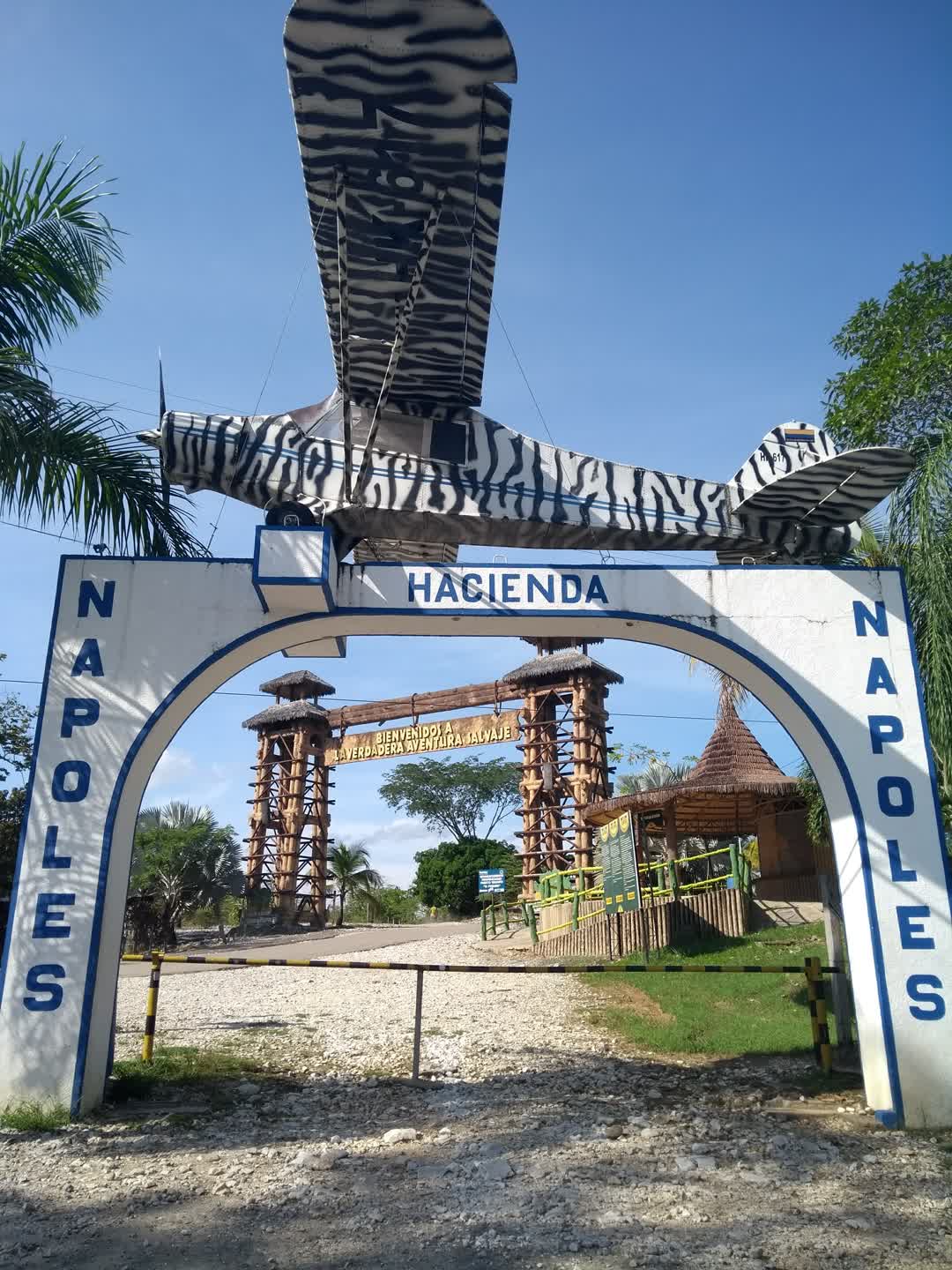
Hacienda Nápoles, the 3,000 hectare estate with its zoo, its bullring and the airplane over the gate that commemorated Escobar’s first loads, was looted by treasure hunters digging for buried cash, then sat rotting while the family and the state fought over it. A court ordered its forfeiture in February 2004. Part of the land went to the national prison service, which built a prison on it. The core passed to the municipality of Puerto Triunfo in December 2005, and from 2007 a private operator turned it into the Parque Temático Hacienda Nápoles: water slides, a safari, half a million visitors a year. The state’s proudest trophy of the drug war is a water park. And the one piece of the estate that refused to be managed walked off on its own: Escobar’s four hippos, judged too difficult to seize and move, were left in their lake. They bred, escaped into the Magdalena River system, and multiplied into a wild population that Colombia has spent years, and now a formal control plan, trying to contain. It is the perfect emblem of the aftermath. The part of Escobar’s legacy the state could photograph, it seized. The part that reproduced on its own, it left alone, and it is still spreading.
WHO INHERITED THE TRADE
The crown passed south. The Cali Cartel, the corporate rival that had helped hunt Escobar through Los Pepes, the death squad coalition of traffickers, paramilitaries and corrupt police, took control of an estimated eighty percent of the world cocaine supply. Cali’s reign lasted about as long as the celebration: between June and August 1995 Colombian police arrested the Rodríguez Orejuela brothers and the rest of the cartel’s seven top leaders. The brothers were later extradited to the United States and pleaded guilty in Miami in 2006. Waiting behind Cali was the Norte del Valle Cartel, built by lieutenants who refused the surrender deal, and a United States indictment would later charge that between 1990 and 2004 it exported more than five hundred metric tons of cocaine worth over ten billion dollars. Behind Norte del Valle came the paramilitary AUC, which taxed and protected the trade under the flag of counterinsurgency, and behind the AUC, a generation of smaller, quieter networks that learned the one lesson the kingpins taught by dying: never be famous.
Inside Medellín, the inheritance never even left the building. The Oficina de Envigado began as Escobar’s own invention, a debt collection office for the trade, run literally out of the Envigado town hall. After his death it was taken over by Diego Murillo, alias Don Berna, a former Escobar enforcer who had turned on his boss, helped build Los Pepes, and then collected the city as his fee. Don Berna folded the Oficina into the AUC as the Cacique Nutibara Bloc, taxed every gang and racket in Medellín, and imposed a peace so complete that the years of his rule got their own name, donbernabilidad, while homicide rates fell under a monopoly of violence the state did not have to sign its name to. He demobilized in 2003 and was extradited to the United States in May 2008, and the Oficina splintered, fought over, and endured. It endures now, more than three decades after its founder died on a rooftop, as a federation regulating Medellín’s underworld. InSight Crime reported this month that one of its longtime leaders walked out of prison on parole. The office outlived the cartel, the boss, the paramilitaries and the peace process.
THE SCOREBOARD
So measure the war the way the war measures itself, in supply. The United Nations Office on Drugs and Crime, in its Colombia survey released in October 2024, counted 253,000 hectares of coca under cultivation in 2023 and a potential cocaine production of 2,664 metric tons, up fifty three percent in a single year, a record, and the tenth consecutive year the estimate had risen. Global production hit 3,708 tons, the highest ever recorded. Under Escobar, the Medellín Cartel was estimated to supply most of the world’s cocaine, and its fall was sold as the beginning of the end. Thirty years, tens of billions of dollars and several successor organizations later, Colombia produces more cocaine than it did on the day of the funeral, by the United Nations’ own count. The trade did not survive the drug war. The trade is what the drug war’s results actually look like, once you read the numbers instead of the press releases.
The Info Soldier’s verdict follows from the record, stated plainly. The cartel was never a man, and it was never even really an organization. It was a franchise: routes, chemists, laboratories, protection and demand, wearing a name. Kill the name and the franchise reopens under new signage, in Cali, in Norte del Valle, in the AUC, in the Oficina that still collects debts in Medellín today. The state won a funeral and lost the war, because the war was never fought on the supply, and never on the demand in the American market that pays for all of it. It was fought on the org chart, against photographs, and the photographs keep obliging by dying on schedule while the tonnage sets records. Demand the scoreboard, not the ceremony. It is printed by the United Nations, and it says the trade won.
Sources: InSight Crime, profiles of the Medellín Cartel and the Oficina de Envigado, and profile of Diego Fernando Murillo, alias Don Berna. U.S. Drug Enforcement Administration, History 1990 to 1994. Associated Press reporting on the deportation and release of Fabio Ochoa, December 2024. U.S. Department of Justice, Oficina de Envigado profile. UN Office on Drugs and Crime, Colombia coca survey, released October 18, 2024. Reporting of El Tiempo and Argentine court records on the Escobar family in Buenos Aires, 1999.