




The Features Desk · Special Report · Mob History
THE IVY LEAGUE OF CRIME
Why has the oldest and largest of the Five Families outlived every rival in American crime, producing the architect of the modern Mafia, a boss the United States Navy cut a deal with in his prison cell, and a don who fooled the government’s own psychiatrists for thirty years in a bathrobe? Because the Genovese family learned the deepest lesson in the file: the state is not always the enemy of organized crime. Half the time, it is a partner. The Info Soldier opens the Genovese file.
November 27, 2026
By Edward Dawe
NEW YORK, November 27, 2026. Ask a federal agent which of the Five Families he respects and the answer, after a pause, is always the same one. The Genovese family is the oldest organization in American crime, the largest of the five, and the most secretive, an outfit that ran the West Side waterfront, the Fulton Fish Market and half the unions in New York while producing fewer turncoats in a century than the Gambinos produced in a decade. It was founded in its modern form by the most consequential gangster who ever lived, Charles Luciano. It was then run by a political fixer who never wanted to be a gangster at all, seized by a paranoid who destroyed himself with one meeting, and finally ruled for a quarter century by a man in a bathrobe whom the government’s own doctors kept certifying as insane. Through all of it runs one thread the official histories prefer to whisper: at the moment of its greatest need, the United States government did not fight this family. It hired it. The Info Soldier went through the record. This is what it shows.
KEY POINTS
- The oldest and largest: the family descends from Giuseppe Morello’s East Harlem gang of the 1890s and 1900s. Federal estimates still credit it with about 175 made members, and its discipline earned it the underworld titles of the Ivy League and the Rolls Royce of organized crime.
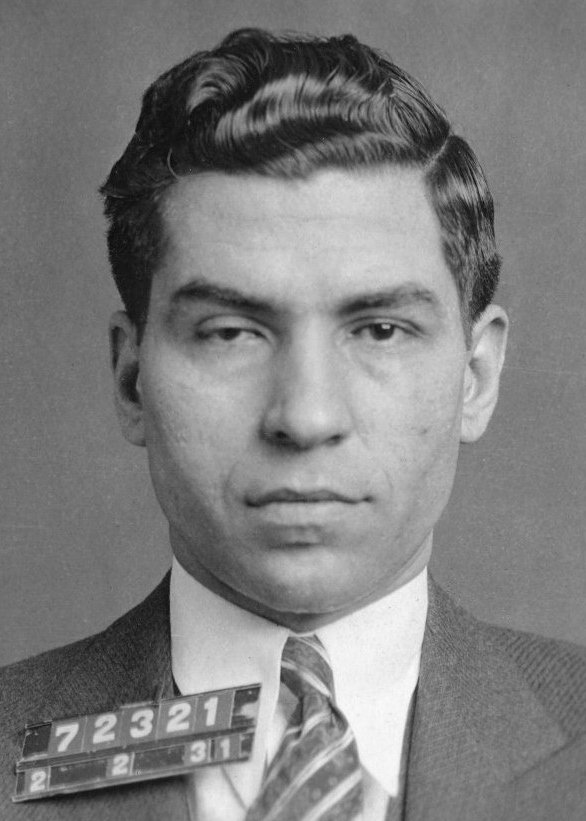
- Lucky Luciano: Charles “Lucky” Luciano took Joe Masseria’s family in 1931, built the Commission and the modern syndicate, was convicted in 1936 by prosecutor Thomas Dewey, and was deported in 1946 after wartime cooperation with United States Naval intelligence.
- The Prime Minister: Frank Costello ran the family from 1936 to 1957 on political connections instead of terror. He survived a 1957 shooting ordered by Vito Genovese and chose retirement over war.
- Don Vito: Vito Genovese seized the family in 1957, called the Apalachin summit that exploded in his face nineteen days into the new order, was convicted on a heroin conspiracy in 1959, and died in federal prison on February 14, 1969.
- The front men: for decades the family hid its real power behind expendable front bosses. Frank Tieri, one of them, became the first Mafia boss convicted under the RICO statute, in 1980.
- The Chin: Vincent Gigante, the real boss from 1981 to 2005, feigned madness for decades, shuffling through Greenwich Village in a bathrobe. Convicted in 1997, he admitted in 2003 that the insanity had been an act all along. He died in prison on December 19, 2005.
- The silence: alone among the five families, the Genovese produced almost no high level turncoats. Its secrecy held where the others broke.
- Today: federal prosecutors have described Liborio “Barney” Bellomo as the family’s boss in recent years. The oldest family in American crime is still, by the government’s own count, the largest of the five.
THE MORELLO SEED
The Genovese line runs back further than any other in American crime, to the 1890s and the East Harlem gang of Giuseppe Morello, a Corleone immigrant with a deformed hand the underworld called the Clutch Hand, and his partner Ignazio Lupo, the Wolf. The Morello gang pioneered the Black Hand extortion letters, counterfeiting and the barrel murder in the Italian wards of New York a full generation before Prohibition. Counterfeiting convictions sent Morello and Lupo to federal prison in 1910, and the organization fragmented, but its bloodline and its men seeded everything that followed. When Joe Masseria, himself a Morello alumnus, assembled his own empire in the 1920s, he gathered around him the young men who would define the century: Charles Luciano, Frank Costello, Vito Genovese, Joe Adonis, and, for a time, Carlo Gambino. Masseria’s family, the direct ancestor of the Genovese, was already the biggest prize in New York when the Castellammarese War came for it in 1930.
The war ended the way this family’s history always ends, with patience outliving violence. Luciano, Masseria’s own lieutenant, concluded that his boss was a liability and arranged his murder at a Coney Island restaurant on April 15, 1931, then arranged the murder of the war’s victor, Salvatore Maranzano, that September, before Maranzano’s own plot against him could move. What Luciano built from the wreckage was not another gang. He abolished the boss of bosses, chartered the five families, created the Commission to govern them, and opened the underworld to partnership across ethnic lines, working with Meyer Lansky and the Jewish syndicates as equals. The organization he took for himself, Masseria’s old family, became the Luciano family, and it was from the start the first among equals: the largest, the richest, and the model on which the modern American Mafia was built.
THE PRISONER THE NAVY NEEDED
Luciano’s empire had one enemy he could not arrange: Thomas E. Dewey, the special prosecutor who in 1936 convicted him on compulsory prostitution charges built substantially on the testimony of prostitutes and madams whom Dewey’s office had jailed and leaned on, a record historians have questioned ever since. Luciano drew thirty to fifty years and went to Dannemora, the Siberia of New York prisons, convicted of a vice racket his own organization had taxed but that prosecutors struggled to tie to his own hand. He ran his family from the cell through Frank Costello. Then came the war, and the fire. On February 9, 1942, the liner Normandie, being converted to a troopship, burned and capsized at her New York pier, and a frightened United States Navy concluded it needed the waterfront watched by the only organization that truly ran it. What followed was documented fourteen years later by the Herlands Report, the State of New York’s own investigation: Naval intelligence officers dealt with the imprisoned Luciano through his lawyers and his people. Dock security tightened. Strikes stopped. And Luciano’s organization was asked for, and by the Navy’s own account provided, contacts and intelligence for the invasion of Sicily.
The bill came due in January 1946. Governor Thomas E. Dewey, the same man who had prosecuted Luciano and ridden the conviction toward the presidency, commuted his sentence on the stated ground of his wartime services, and Luciano was deported to Italy, forbidden ever to return. The state had jailed him on leaned on witnesses, used him when it was afraid, and discarded him when it was safe, all inside one decade, and the file it left behind is the cleanest documentary proof in the whole Mafia archive that the war between the government and organized crime has always had a procurement office. Luciano lived quietly in Naples, ran what business exile allowed, and on January 26, 1962, at Naples airport, where he had gone to meet an American producer about filming his life story, he died of a heart attack at sixty four. The architect of the modern Mafia died discussing the movie rights.
THE PRIME MINISTER
The man who held Luciano’s family through the war years and beyond was the least gangster like boss in its history. Frank Costello, born in Calabria and raised in East Harlem, was a fixer: the Prime Minister of the Underworld, a man whose power ran through Tammany Hall judgeships, Democratic Party clubs and slot machine placements from New York to Louisiana rather than through gunmen. Under Costello the family leaned into gambling and politics and away from narcotics and spectacle. In 1951 the Senate’s Kefauver Committee dragged him before television cameras, and Costello, refusing to let his face be broadcast, gave America the era’s defining image of the Mafia: a pair of nervous hands, fiddling on a table, while their owner rasped denials off camera. He walked out of the hearings into a tax conviction and prison stretches, and the family’s old guard began to look for a harder hand. It was waiting in exile’s return: Vito Genovese, Luciano’s former underboss, who had fled to Italy in 1937 one step ahead of a murder indictment and spent the war years currying favor with Mussolini’s Italy and then, seamlessly, with the American occupation.
Genovese came home in 1945 to face the murder charge and watched it evaporate when the state’s star witness, Peter LaTempa, was found dead in his cell, poisoned, before he could testify. The case was dismissed. For a decade Genovese rebuilt his power inside Costello’s family while Costello aged and tired. In 1957 he moved. On May 2, 1957, a young enforcer named Vincent Gigante stepped up behind Frank Costello in the lobby of his Central Park West apartment building, said “This is for you, Frank,” and fired. The bullet grazed Costello’s head. Costello, sixty six years old and finished with the life, declined to identify his shooter, declined war, and retired to his Long Island estate, where he died in 1973, the rare don who chose the garden over the grave. The family was Genovese’s, and it took its modern name from him when Valachi testified in 1963. He had waited twenty years for the chair. He would destroy himself with it in nineteen days.
DON VITO
On November 14, 1957, nineteen days after the Anastasia murder cleared his last rival, Vito Genovese convened the national summit of the American Mafia at Apalachin, New York, to ratify the new order: his own. State police, suspicious of the parade of Cadillacs at Joseph Barbara’s estate, raided the meeting, and some sixty dons and captains were detained fleeing through the woods, photographed, fingerprinted and named in the newspapers. Apalachin did what thirty years of police work had not: it proved the Mafia existed as a national organization, in print, with a guest list, and it humiliated every family at the table. The underworld blamed the host. Genovese’s authority never recovered, and within two years the government finished what the raid began. In 1959 he was convicted in a heroin conspiracy case built on the testimony of Nelson Cantellops, a small time dealer, and sentenced to fifteen years. Genovese insisted to his death that the case was a frame arranged by his enemies, and the file has never fully closed: the conviction rested on a single cooperating witness and a conspiracy theory of the government’s own, tried in the hottest years of the drug panic. What is certain is the result. The most patient climber in Mafia history entered federal prison in 1959 and never left it. Vito Genovese died at the federal medical center in Springfield, Missouri, on February 14, 1969, still, on paper, the boss of the family that bears his name.
The decades after Genovese were the family’s master class in its defining skill: concealment. Real power passed quietly, through Gerardo Catena and then to Philip “Benny Squint” Lombardo, while a succession of front bosses absorbed the indictments. Thomas Eboli fronted until his murder in 1972. Frank Tieri fronted until 1980, when he became the first Mafia boss in history convicted under the new RICO statute, a landmark the government celebrated without ever quite establishing that the man in the dock had been the man in charge. That was the point of the design. The family had studied what happened to bosses who appeared in newspapers, at summits, and on witness lists, and it built a human firewall: expendable men in the title, untouchable men behind it. No other family ran the system as long or as well.
THE ODDFATHER
The firewall’s final form was the strangest boss in Mafia history. Vincent Gigante had been preparing his defense since the 1960s, when psychiatric findings of unfitness helped him escape a bribery case. As the family’s real boss from 1981, ruling behind front boss Anthony “Fat Tony” Salerno, Gigante perfected the performance: he lived in a modest Greenwich Village townhouse, kept a girlfriend and second family across town, and by day shuffled through the Village in a bathrobe and slippers, unshaven, muttering, guided by relatives, the picture of a harmless madman the neighborhood called the Oddfather. The government’s psychiatrists examined him for decades and repeatedly found him incompetent. Behind the robe he ran the largest family in New York: the Fulton Fish Market, the Javits Center, the concrete and windows rackets that later produced the great Windows case, and a Commission seat. When the government convicted the Commission’s heads in 1986, it convicted Salerno as the Genovese boss and sent the front man away for a century. The real boss watched it on television in his bathrobe. In April 1986, Gigante’s organization tried to kill John Gotti with a car bomb and killed his underboss Frank DeCicco instead, the family’s one loud failure of the era, and even that produced no charges against the Chin for a decade.
The act finally collapsed under the weight of the family’s own men. Indicted in the Windows case in 1990, Gigante hid behind unfitness rulings for seven years while turncoats from other families described his power, and in 1997 a Brooklyn jury, having heard his own taped voice conducting business in perfect sanity, convicted him of racketeering and murder conspiracy. He drew twelve years. In 2003, facing a new obstruction case, Vincent Gigante pleaded guilty and admitted in open court what the whole underworld had always known: the madness had been a performance, maintained for over thirty years to frustrate the United States government. He died in the same Springfield federal medical center that had taken Genovese, on December 19, 2005. The bathrobe had bought him sixteen years of freedom after his first indictment and a quarter century on the throne. No don of the television age played the state better, and the state’s own doctors were his longest running accomplices, however unwilling.
THE FAMILY TODAY
What Gigante left behind is what Luciano would have recognized: the quietest, deepest organization of the five. Federal prosecutors in recent years have described Liborio “Barney” Bellomo, a Bronx based former street boss who did twelve years on his own conviction and kept his silence through all of it, as the family’s boss. The membership rolls, by the government’s own 2021 estimate, still run to about 175 made men, the largest of the five families, with crews from the Bronx to New Jersey to Florida. The rackets modernized, bookmaking moved offshore and online, loan sharking fed a wave of mortgage fraud during the housing bubble when the banks’ own due diligence collapsed, as prosecutors themselves have described it. And the silence held. The Genovese family never produced its Gravano, never gave a jury its boss on a witness’s word, and enters the second century of its existence the way it entered the first: the organization the government knows the least about, run by men whose names it learns last.
THE INFO SOLDIER’S VERDICT: Every family file in this series contains the same buried document, but only the Genovese file has it signed by a governor. The United States jailed Lucky Luciano on witnesses it had squeezed, rented his organization when the Normandie burned, freed him when the war ended, and deported the receipt. It then spent thirty years insisting that Vincent Gigante was insane, its own doctors signing the certificates, while he ran the biggest crime family in America from a Village townhouse and sent his front men to die in prison under his name. Against that record, the Genovese family’s famous discipline is not even the most impressive performance in its own file. The family lied about who was boss. The government lied about who was partner, and who was mad, and it had printing presses. The Info Soldier’s verdict: the Genovese are called the Ivy League of organized crime because they learned the curriculum the state itself teaches, that power belongs to whoever controls the paperwork, the witnesses and the story, and that the loudest organization in the room is never the one actually running it.
Sources: Encyclopaedia Britannica and Wikipedia reference records on the Genovese crime family and its boss succession, cross checked against: the Herlands Report, State of New York, 1954, on Naval intelligence dealings with Charles Luciano. U.S. Senate Kefauver Committee hearings, 1951, and McClellan Committee (Valachi) hearings, 1963. Trial records, United States v. Vincent Gigante, Eastern District of New York, 1997, and his 2003 guilty plea. U.S. Attorney’s Office releases on Genovese family prosecutions and membership estimates. Reference histories of the Castellammarese War and the Commission.