




The Features Desk · Special Report · The Mexico File
THE ENGINEER OF THE SIERRA
Who ran the ground the whole trade grows on? For a quarter of a century, the US Treasury’s own answer for Durango was a family from Santiago Papasquiaro, the brothers Cabrera Sarabia. The Army took the Engineer in Culiacán, a cave in Canatlán took his brother, a Chicago courtroom took the rest, and this fall the United States finished his sentence and started his deportation back to a plaza that is now a war zone. The harvest never stopped.
November 26, 2026
By Edward Dawe
SANTIAGO PAPASQUIARO, Durango, November 26, 2026. Felipe Cabrera Sarabia, known as El Inge, the Engineer, and in the US Treasury’s files as El Señor de la Sierra, the Lord of the Sierra, has finished serving a federal prison sentence in the United States. Bureau of Prisons records reported in September put his release from federal custody on September 4, and ICE records place him in detention at Adelanto, California, awaiting deportation to Mexico. There is one detail in the file that tells the whole story of this report: according to court filings covered in the same reporting, Cabrera Sarabia was acquitted of the charges he faced in Mexico, and there are no known open warrants waiting for him at home. The United States spent a decade extraditing the Sinaloa cartel’s Durango operator, sentenced him in Chicago, and is now sending him back to the sierra with the Mexican file closed. This is the record of the family that ran the supply line, the ground it grows on, and the system that outlasted every soldier sent against it.
KEY POINTS
- The ground: the Golden Triangle, where Sinaloa, Chihuahua and Durango meet in the Sierra Madre Occidental, is named by the UN and the Mexican government as one of the country’s main opium poppy zones. Poppy has been grown there for more than sixty years, and in the poppy territories between 70 and 95 percent of the population lives from the trade directly or indirectly, per Noria Research fieldwork.
- The family: the US Treasury states that since 1996 the Cabrera Sarabia brothers of Santiago Papasquiaro played a pivotal role in Ismael “El Mayo” Zambada’s organization. Felipe controlled large-scale marijuana and poppy cultivation in Durango and moved marijuana and heroin into the United States.
- The pipeline: Treasury says Felipe also took ton quantities of cocaine from Zambada and delivered them to Chicago. In his US plea agreement he admitted heroin distribution work in 2008 carried out under Zambada’s direct instructions, in a network whose Chicago end was run by the Flores twins.
- The falls: the Mexican Army captured Felipe in Culiacán on December 23, 2011. His brother Luis Alberto, “El Arqui,” who replaced him, was killed by Army special forces on January 20, 2012, in Canatlán, Durango. Alejandro, who took over the family organization according to Treasury, was arrested in Torreón in February 2013.
- The paper: on March 18, 2015, the Treasury Department designated Felipe, Alejandro and José Luis Cabrera Sarabia under the Kingpin Act, freezing their US assets and naming them major heroin and marijuana suppliers for the Sinaloa cartel.
- The case: Felipe was named in the same Chicago superseding indictment as Guzmán and Zambada, unsealed in January 2012. Extradition took about nine and a half years. He pleaded guilty, and in August 2023 a federal judge in Chicago sentenced him to 128 months, crediting the 102 months he had already served in Mexico, with a $715,000 forfeiture order.
- The exit: released from federal prison on September 4, 2026, per Bureau of Prisons records, and now held by ICE at Adelanto, California. Court filings reported this fall say he was acquitted in Mexico and faces no known open warrant there.
- The plaza today: Los Cabrera fight on the Zambada side of the Sinaloa cartel’s internal war. Mexican reporting counts 39 Durango municipalities disputed between Mayos and Chapos, and federal forces were still seizing Los Cabrera armored vehicles in Durango in 2026.
THE GROUND WHERE THE TRADE BEGINS
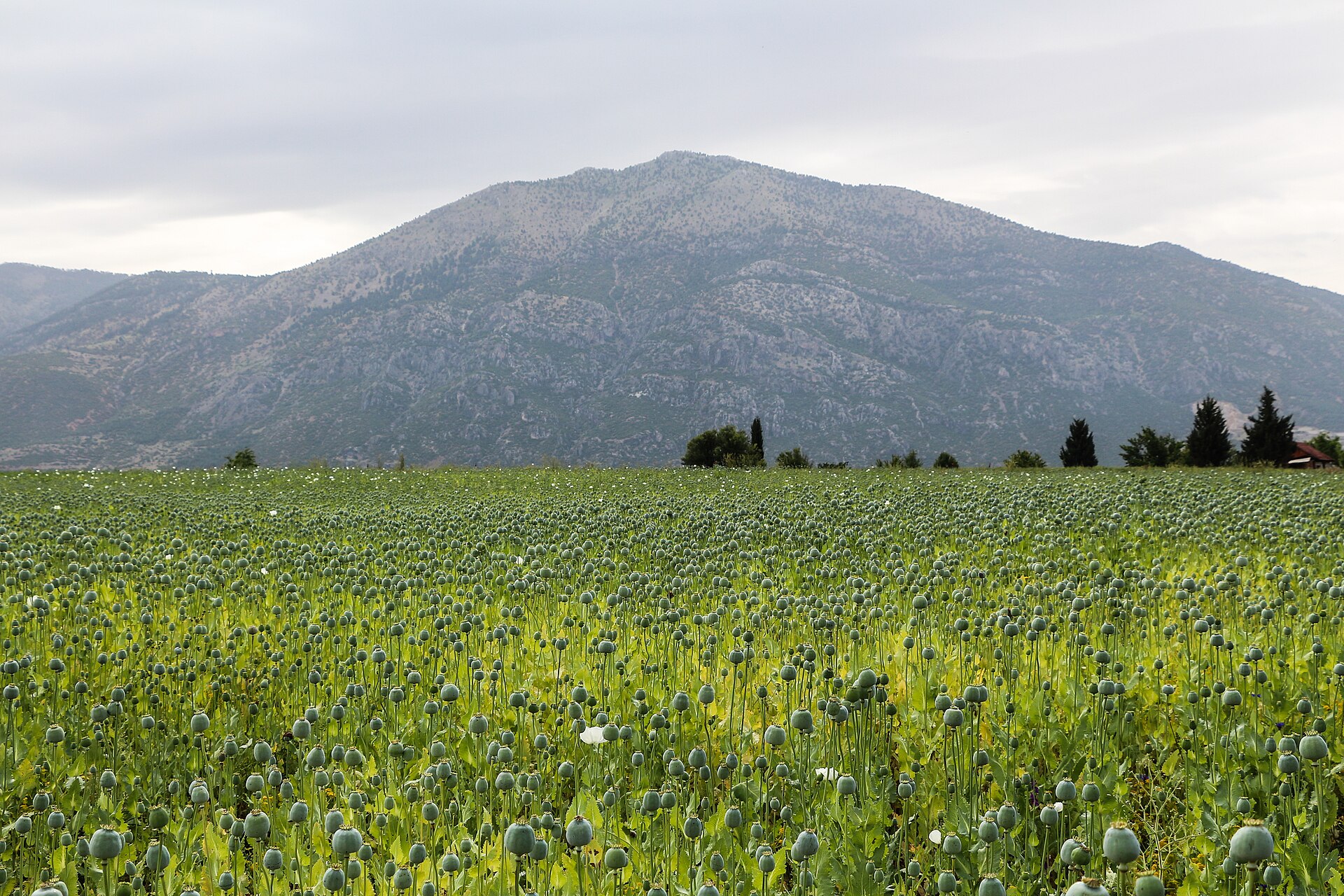
Every cartel story in the US press starts at a border crossing or a tunnel mouth, as if the product invents itself at the fence. It does not. It starts in the ground, in the one corner of Mexico where three states, Sinaloa, Chihuahua and Durango, fold into each other in the Sierra Madre Occidental: the Golden Triangle. Poppy came to these mountains in the early twentieth century, and by the time the United Nations and the Mexican government ran their joint satellite monitoring for 2018 and 2019, the Triangle was still named among the main cultivation zones of a country holding some 21,500 hectares of poppy and the potential for roughly 450 metric tons of dry opium gum. The Noria Research field teams who walked these territories put the human number on it: in poppy country, between 70 and 95 percent of the people, men, women and children, earn their living in or around the crop. Four generations deep. That is the fact every eradication briefing leaves on the cutting room floor. The sierra is not a hideout the trade uses. It is the trade’s hometown, its labor market and its recruiting office, and whoever holds Durango holds the first mile of the supply line to the United States.
A FAMILY FROM SANTIAGO PAPASQUIARO
The Cabrera Sarabia brothers were sierra people before they were a file number: at least six brothers from the municipality of Santiago Papasquiaro, Felipe born there in 1971, Alejandro in 1973, José Luis in 1978, farmers and ranchers in a region where the cash crop was never going to be corn. The Treasury Department’s designation puts the partnership in a single sentence that no US headline ever carried: since 1996, the brothers served a pivotal role in the Zambada organization. Vicente Zambada Niebla, El Mayo’s own son, wrote in his letters that his father met the family in 2006 and saw partners: they grew marijuana and poppy, they processed heroin themselves, and they already had the routes north, to Chicago. Reporting on the Treasury investigations credits Felipe with moving at least six tons of marijuana into the United States hidden in the trucks of a poultry company. Read the shape of it. The family did not work for the cartel the way a driver works for a trucking firm. They were the ground floor of the federation: cultivation, processing, logistics and the armed guarantee that the Durango plaza stayed Sinaloa’s, against the Zetas and the Beltrán Leyva organization in the years those wars came to the sierra.
THE ENGINEER
Felipe was the architect, and his aliases are the job description. El Inge, short for El Ingeniero, the Engineer. El Señor de la Sierra. US reporting also calls him the Heroin King. Treasury’s file says he controlled large-scale marijuana and poppy cultivation in Durango, ran the transportation of marijuana and heroin into the United States, and obtained ton quantities of cocaine from Zambada for delivery to Chicago. Mexico’s defense ministry, presenting him to cameras in December 2011, called him the cartel’s operator for Durango and southern Chihuahua and said he headed Guzmán’s personal security in the Durango country. The two governments filed him under different bosses, and the Info Soldier prints both versions, because in the federation both were true at once: the Cabrera brothers were Zambada’s people, and Zambada and Guzmán were, in those years, one organization. What no version disputes is the function. Felipe Cabrera Sarabia was the supply line’s engineer: the man who made sure what the sierra grew reached the border, and what Chicago ordered reached Chicago.
THE ARMY COMES TO THE SIERRA
The military campaign against the family, when it came, came in thirty days. On December 23, 2011, Mexican soldiers arrested Felipe in Culiacán, in an operation that swept up 23 suspected operators of the Sinaloa cartel and its Zeta rivals. Masked troops presented him to the press on December 26. The defense ministry called it a setback for the cartel’s operational and leadership capabilities, and Guzmán, by the government’s account, named the next brother in line: Luis Alberto, El Arqui. The Army found him on January 20, 2012, at a ranch called La Cañada del Chile in Canatlán, Durango, in an air-mobile special forces operation under Operación Laguna. The federal account is precise and it is printed here in full: eleven of his men were detained in the first clash, one gunman died, soldiers were wounded, and El Arqui and his security chief broke for a cave in the sierra above the ranch and kept firing until the Army closed the ring and killed them both. Sixteen long guns with grenade launchers, 4,628 cartridges, seven vehicles, one of them armored: that was the inventory of one family’s hilltop. Note the correction the legend always gets wrong. The military did not kill Felipe Cabrera. It captured him, and the brother it killed was Luis Alberto. The Engineer’s war would be fought by lawyers for the next fourteen years.
THE PAPER WAR
What followed the gunfire was slower and, for the family, nearly as effective. In January 2012 the Chicago superseding indictment naming Guzmán and Zambada was unsealed with Felipe’s name in it. On March 18, 2015, Treasury designated all three surviving brothers under the Kingpin Act: Felipe, Alejandro, who by then had assumed control of the family organization in Durango for Zambada, and José Luis, who ran the family ranches and the marijuana logistics. Mexico held Felipe while the extradition ground forward for about nine and a half years. In Chicago he pleaded guilty, and his plea agreement put on the record what the Treasury file had said all along: heroin distribution in 2008, run under Zambada’s direct instructions, feeding the Chicago network of Pedro and Margarito Flores, the twins who would later become the government’s star witnesses. In August 2023, Judge Sharon Johnson Coleman sentenced him to 128 months and credited the 102 months he had already served in a Mexican cell, with a forfeiture order of $715,000 that reporting notes may never have been collected. Do the arithmetic the way the sierra does it. A man accused of running a state’s worth of heroin and marijuana for the biggest trafficking organization on earth was, by the time the two governments finished with him, a deportation flight away from home, acquitted in his own country, with no known warrant on the Mexican side of the line.
THE PLAZA CHANGED HANDS, NOT OWNERS
And the plaza? The plaza did what plazas do. Alejandro ran it, was arrested in Torreón in February 2013, and a decade later the name Cabrera Sarabia is back in the order of battle, this time in the Sinaloa cartel’s war against itself: Los Cabrera are listed among the armed cells fighting for the Zambada side, the Mayiza, against Los Chapitos, with Alejandro and José Luis named in Mexican reporting and security analyses as the family’s commanders, and their sister Luliana in the structure. Mexican newspapers count 39 municipalities in Durango disputed between Mayos and Chapos. In 2026, federal forces were still running operations against Los Cabrera in Durango and seizing their armored trucks. Even the crop changed under them: when fentanyl flooded the US market, the price paid to sierra farmers for a kilo of opium gum fell by more than 90 percent between 2017 and 2020, per Noria’s numbers, and the mountains absorbed that too, because the mountains absorb whatever the market orders. One more record belongs in this file, because it is the protection question in a single name: Genaro García Luna, Mexico’s secretary of public security from 2006 to 2012, the very years the Cabrera brothers were consolidating Durango, was convicted in a US court in 2024 of taking millions to protect the Sinaloa cartel. The top cop of the era was on the payroll of the organization the Cabrera family supplied. That is not a footnote to this story. That is the story’s roof.
The Info Soldier’s verdict is the one the record supports. The Cabrera Sarabia brothers were traffickers who ran an armed plaza, and nothing in this file celebrates them; the violence their organization enforced is written across Durango. But the official story, that the state hunted the supply line down and won, collapses on its own dates. The Army took the Engineer alive and the courts gave most of the sentence back as time served. The brother who replaced him died in a cave, and the brothers who replaced them both are, by the current record, still in the field. The poppy price crashed and the plaza adapted. The security secretary of the whole era was convicted of protecting the buyers. Men are replaceable, and everyone in this file, in the sierra and in the ministries, has always known it. What was never arrested, designated or deported is the arrangement itself: American demand at one end, Mexican protection at the other, and a mountain range in the middle that grows what the market orders. Felipe Cabrera Sarabia is flying home to it. Watch Durango. Follow the harvest.
Sources: US Department of the Treasury, “Treasury Designates Members of Drug Trafficking Family Associated with Sinaloa Cartel Leadership,” March 18, 2015; Federal Register, Kingpin Act designation notice, March 24, 2015; Reuters, “Aide to top Mexican drug boss captured,” December 26, 2011; SEDENA and PGR statements on the Canatlán operation, January 2012; DEA press release, Chicago arraignment of Felipe Cabrera Sarabia following extradition; US v. Cabrera Sarabia, Northern District of Illinois, plea and August 2023 sentencing as reported; UNODC and Government of Mexico, Mexico opium poppy monitoring 2018 to 2019; Noria Research, Mexico Opium Project; Infobae, “Detenidos, muertos y trabajando para El Mayo Zambada,” July 2024; Sol de Yucatán, on the disputed Durango municipalities; WEB News Network reporting on Bureau of Prisons and ICE records, September 2026.