




The Features Desk · The Cartel File
FIFTY YEARS A GHOST
How does the most hunted man on earth stay free for fifty years, and what finally ended the run: a manhunt, or a godson’s betrayal and an arrangement nobody in Washington will describe? Ismael “El Mayo” Zambada co-founded the Sinaloa Cartel, outlived every partner and every government that swore to catch him, and never spent one night in a cell. Then a private plane landed in New Mexico with him tied and sedated in the back, and the war his fall ignited in Sinaloa is still burning tonight.
November 26, 2026
By Edward Dawe
CULIACÁN, Sinaloa, November 26, 2026. Ismael Zambada García, El Mayo, sits tonight in a federal cell at the Metropolitan Detention Center in Brooklyn, serving life without parole, while the state he ran like a private country tears itself apart in a war his capture started. On July 20, 2026, U.S. District Judge Brian M. Cogan sentenced him to life in prison and entered a $15 billion forfeiture judgment against him, closing the longest run in the history of the drug war: roughly five decades at the top of the Sinaloa Cartel without a single arrest. He pleaded guilty in Brooklyn on August 25, 2025, to running a continuing criminal enterprise and to racketeering conspiracy, after the Justice Department agreed not to seek his execution. This special report is the record of how a man stays a ghost for fifty years, and of what the paperwork now admits about the day the ghost story ended.
KEY POINTS
- The run: Zambada rose through the Juárez organization in the 1980s and 1990s and, with Joaquín “El Chapo” Guzmán, built the Sinaloa Cartel into the largest drug trafficking organization on earth. U.S. indictments against him date to 2003. The American bounty on him reached $15 million. Before July 25, 2024, he had never been arrested.
- The style: where El Chapo escaped prisons and collected fame, Zambada lived as a rural businessman: ranches, plain clothes, farming interests, and one press interview in fifty years. U.S. officials described him as the cartel’s strategist and day to day operator.
- The son: his eldest son Vicente, “El Vicentillo,” was arrested in Mexico City in 2009 after meeting DEA agents, was extradited in 2010, cooperated with Washington, and testified against El Chapo in Brooklyn in 2019. Sentenced to 15 years, he walked out of federal custody in April 2021 and is believed to live under U.S. protection.
- The fall: on July 25, 2024, a private plane carrying Zambada and El Chapo’s son Joaquín Guzmán López, Zambada’s own godson, landed at Santa Teresa, New Mexico, where U.S. agents arrested both men.
- The two accounts: Zambada, in a letter released by his lawyer, says he was ambushed and kidnapped at a ranch meeting and flown north against his will. Washington says Guzmán López surrendered voluntarily and denies sanctioning any kidnapping. In December 2025, Guzmán López pleaded guilty in Chicago and admitted abducting an unnamed man, in a courtroom account matching Zambada’s seizure detail for detail.
- The killing: Héctor Melesio Cuén Ojeda, former rector of the Autonomous University of Sinaloa and one of the state’s most powerful politicians, was killed the same day as the flight. Sinaloa state prosecutors first said he died in a gas station robbery. Mexico’s federal Attorney General found Cuén’s blood at the ranch and concluded he was killed there. The state prosecutor resigned.
- The governor: on April 29, 2026, the Southern District of New York unsealed an indictment charging Sinaloa’s governor, Rubén Rocha Moya, the man Zambada’s letter said would attend the ranch meeting, and nine other current and former officials with trafficking drugs in partnership with the cartel. Rocha Moya denies the charges and is not in U.S. custody.
- The sentence: life without parole, imposed July 20, 2026, plus a $15 billion forfeiture that prosecutors concede they have not located. Zambada’s lawyer stressed in court that his client did not cooperate.
- The war: the capture split the cartel between Los Chapitos and La Mayiza, now led by Zambada’s son Ismael “El Mayito Flaco” Zambada. The Financial Times reported in September 2026 an estimated 3,800 people killed and 4,400 kidnapped, some 20,000 troops deployed, and more than 20,000 formal jobs lost. On November 20, 2026, Mexican special forces captured “Chapo Isidro,” a Mayiza aligned boss, in Guasave, and the clashes that followed killed at least 11 people.
THE BUSINESSMAN
He began as a farmer in rural Sinaloa, in the ranching country outside Culiacán, and went to work in the 1980s and 1990s for the Juárez organization of Amado Carrillo Fuentes, the trafficker the press called the Lord of the Skies. When Carrillo Fuentes died in 1997, Zambada built his own network and joined it to Guzmán’s, and the federation the two men ran became the Sinaloa Cartel: the organization that moved cocaine, heroin, methamphetamine and later fentanyl into the United States by plane, boat, submarine, tunnel and truck, at a scale no rival matched. His son Vicente’s own guilty plea in Chicago described the family business from the inside: coordinating tons of cocaine and heroin flown and shipped from Colombia through Mexico and into the United States, with private planes, submarines and speedboats. Zambada handled the logistics and the money. He also handled the politics. Vicente testified that the cartel’s bribery ran to millions of dollars a month, paid to keep the machine invisible.
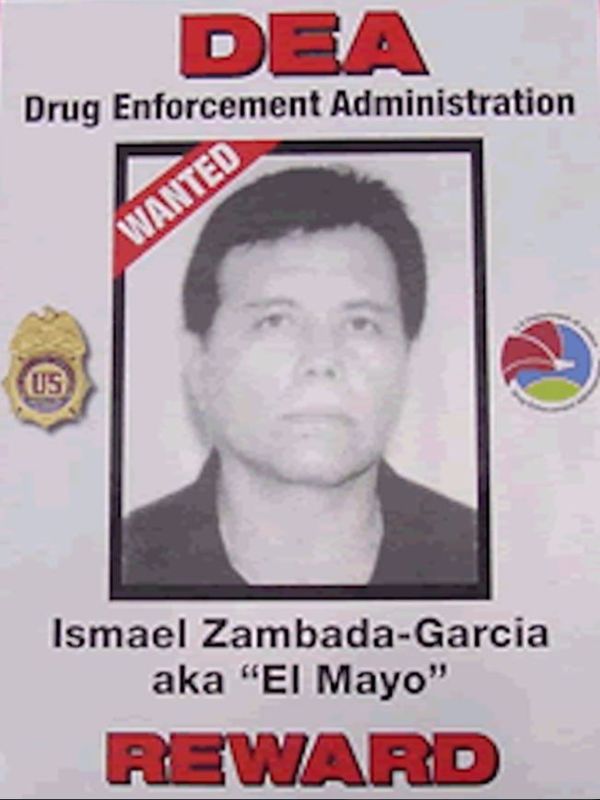
In April 2010, Zambada did something he never did again: he sat for an interview. Julio Scherer García, the founder of the Mexican magazine Proceso, traveled to meet him and put his photograph on the cover, one of the only clear images of the man the DEA poster would later carry. Zambada told Scherer that the drug trade is rooted in Mexican society and involves millions of people, and he warned that his own capture or death would change nothing. Sixteen years later, with Sinaloa at war over his empty chair, that sentence reads less like a boast than like a forecast the governments of two countries spent a decade and a half proving right.
FIFTY YEARS WITHOUT A CELL
Set the two founders side by side and the difference explains everything. Guzmán was arrested in 2014, escaped through a mile long tunnel in 2015, was recaptured in 2016, extradited in 2017, convicted in Brooklyn in 2019, and buried alive at the federal supermax in Florence, Colorado, under a sentence of life plus thirty years. He gave the world documentaries, a wife on television, and a brand. Zambada gave the world nothing. No escapes, because there were no arrests to escape from. No interviews, no photographs at parties, no corridos he commissioned about himself. He lived on ranches, dressed like the farmer he started as, and ran the cartel’s operations day to day while the manhunts of two nations spent themselves on his partner. Reuters, summarizing the official view at his sentencing, put it plainly: Zambada was seen as the cartel’s strategist and dealmaker, more involved in its daily operations than his co-founder. After Guzmán’s conviction, Zambada ran the whole organization alongside Guzmán’s sons, the faction called Los Chapitos, an old lion keeping house with the cubs of the man in the Colorado cell. The indictments piled up in Washington in 2003 and in Brooklyn in 2009. The reward climbed to $15 million. The cell door never opened, because no one ever brought him to it.
THE SON WHO TALKED
The first crack in the wall was family. Vicente Zambada Niebla, El Vicentillo, the eldest son and the cartel’s logistics coordinator, met with DEA agents at a Mexico City hotel in March 2009. Mexican authorities arrested him in Mexico City on March 19, 2009, and extradited him to the United States in February 2010. What followed stayed secret for years: a cooperation agreement, a guilty plea in Chicago in 2013 that the public only learned of later, and, in the winter of 2018 and 2019, a star turn in the Brooklyn trial of his father’s partner. Vicente Zambada took the stand against Joaquín Guzmán and described, under oath, how he and his father and El Chapo ran the Sinaloa Cartel together: the routes, the bribes, the machinery. The Justice Department’s own court filings in his father’s case confirm the arrangement in writing: Zambada Niebla resolved his cases by pleading guilty under a cooperation agreement and testified for the government at Guzmán’s trial. He was sentenced in Chicago on May 30, 2019, to 15 years. He was released from federal custody in April 2021. In April 2022 the Treasury Department took him off the Kingpin list. He is believed to live in the United States under protection, with his family, the safety of that family having been written into his deal. His uncle, Zambada’s brother Jesús, called El Rey, also testified against Guzmán. Read the pattern the way Los Chapitos read it from Culiacán: every Zambada who faced American justice talked, and every one of them walked free.
THE FLIGHT NORTH
On July 25, 2024, a small private plane crossed from Sinaloa into the United States and landed at the county airport in Santa Teresa, New Mexico, on the border west of El Paso. Aboard were the pilot, Joaquín Guzmán López, and Ismael Zambada. Federal agents arrested both men on the ground. After fifty years, the most elusive trafficker alive was in American custody, and nobody in either government would tell the same story about how he got there.
Zambada’s account came first, in a letter released by his attorney, Frank Pérez, on August 10, 2024. In it, Zambada wrote that Guzmán López, his own godson, had called him to a meeting at a ranch called Huertos del Pedregal, outside Culiacán, supposedly to mediate a dispute between Governor Rubén Rocha Moya and Héctor Melesio Cuén Ojeda over control of the Autonomous University of Sinaloa. He wrote that he was told the governor would attend. He wrote that instead he was ambushed, overpowered, and forced onto the plane. His sentence, printed in the letter for the world to read, was this: “I was kidnapped and brought to the U.S. forcibly and against my will.” He also wrote that Cuén, his friend, was murdered at that same ranch that same day.
The official account runs the other way. U.S. officials said Guzmán López had surrendered voluntarily and intended to plead guilty, and the U.S. ambassador to Mexico said publicly that the United States did not plan the flight and did not direct it. Mexico’s president demanded a full report from Washington and protested that his government had been kept in the dark about an operation on Mexican soil. Then, on December 1, 2025, in a federal courtroom in Chicago, the surrender story acquired a second author. Guzmán López pleaded guilty to drug trafficking and continuing criminal enterprise charges, and, as part of that plea, admitted kidnapping an unnamed individual, a man the whole proceeding understood to be Zambada. The prosecutor, Andrew Erskine, described the abduction in open court: the glass of a floor to ceiling window removed in advance, men entering through the opening, the victim seized, a bag put over his head, the drive to the plane, the zip ties, the sedatives in a drink. Erskine told the court the United States government did not sanction the kidnapping, and that Guzmán López would receive no cooperation credit for it. He also said Guzmán López did it hoping to earn leniency. Both accounts are printed here with their sources, and the reader can weigh them: a voluntary surrender, says Washington, in which the surrendering man has now admitted, in his own plea, to a kidnapping Washington says it never ordered and accepted delivery of anyway. Guzmán López forfeited $80 million in the deal. His sentencing date has not been set.
THE MAN WHO DIED AT THE RANCH
One part of Zambada’s letter did not stay a matter of rival accounts, because Mexico’s own federal investigators settled it. Héctor Melesio Cuén Ojeda, former rector of the Autonomous University of Sinaloa, founder of the Sinaloan Party and a federal deputy elect, died on July 25, 2024. The Sinaloa state prosecutor’s office announced that he had been shot during an attempted robbery at a gas station. The federal Attorney General’s office examined the evidence, found Cuén’s blood at Huertos del Pedregal, the ranch in Zambada’s letter, and concluded that he had been killed there. The gas station story collapsed, and the state prosecutor, Sara Bruna Quiñónez Estrada, resigned in August 2024. A sitting state prosecutor’s office had published a false account of a political murder committed at the scene of the decade’s biggest arrest, and the correction came not from the press but from the federation’s own investigators. Governor Rocha Moya said he had been in the United States that day and knew nothing of any meeting. He kept saying it until April 29, 2026, when the U.S. Attorney for the Southern District of New York unsealed an indictment charging Rocha Moya and nine other current and former Sinaloa officials with drug trafficking and weapons offenses, alleging that they partnered with Los Chapitos, took millions in bribes, protected shipments, and shielded the cartel from investigation. The indictment alleges Rocha Moya met the Chapitos before his 2021 election and promised them protection. U.S. Attorney Jay Clayton, announcing the case, said the cartel “would not operate as freely or successfully without corrupt politicians and law enforcement officials on their payroll.” Rocha Moya categorically denies the charges. He stepped aside from the governorship on a leave of absence in May 2026. Mexico’s Attorney General said the evidence was insufficient to detain him for extradition. He remains in Mexico. He has never been in American custody. The man Zambada’s letter placed at the ranch meeting is now charged by the same government that received Zambada, with being the cartel’s partner in the governor’s office.
BROOKLYN
The case against Zambada landed in the Eastern District of New York, on the 2009 indictment that had charged him alongside Guzmán, before Judge Brian M. Cogan, the same judge who had presided over El Chapo’s trial. He was arraigned on 17 counts. The docket carries its own quiet scandal: his lawyer, Frank Pérez, had also represented Vicente, the cooperating son, and the Justice Department formally flagged the conflict to the court in October 2024, noting in writing that Pérez’s other client had testified about how his father ran the cartel. Zambada kept Pérez. In February 2025, writing through his lawyer, Zambada demanded that Mexico insist on his repatriation and warned of the damage the manner of his capture would do between the two countries. Nothing came of it. On August 5, 2025, the Justice Department announced it would not seek the death penalty. Twenty days later, on August 25, 2025, Zambada stood in Cogan’s courtroom and pleaded guilty to engaging in a continuing criminal enterprise and to racketeering conspiracy, admitting that he was a principal leader of the enterprise he had built. Sentencing came on July 20, 2026. Cogan imposed the mandatory life term without parole and the $15 billion forfeiture, a sum prosecutors concede they have not located. “The sentence here is kind of anticlimactic because I have no discretion,” Cogan said. “He is going to spend the rest of his days in prison. He accepts that.” Zambada, in a tan jail suit, spoke through a translator. He apologized “for the harm I caused and the example I set.” He said, “Nobody wins in a war like this,” and urged the next generation to choose a different path. Pérez stressed to the court that his client was not cooperating with prosecutors. The ghost who never talked went to his cell the same way: not talking.
THE WAR HE LEFT BEHIND
What he left behind is the bill. In September 2024, weeks after the flight north, the Sinaloa Cartel went to war with itself: Los Chapitos against La Mayiza, the faction loyal to Zambada and now led by his son Ismael Zambada Sicairos, called El Mayito Flaco. Culiacán, a city of a million people, settled into curfews, closed schools, burned vehicles and convoys of gunmen moving in daylight. The Financial Times, reporting from Culiacán in September 2026, put the toll at an estimated 3,800 people killed and 4,400 kidnapped, with some 20,000 troops and police deployed into the state and more than 20,000 formal jobs destroyed, a conflict residents and experts call the worst in a century of Sinaloan trafficking. Sinaloa sits under the U.S. State Department’s Level 4 advisory: do not travel. The households of Culiacán learned the lesson this site prints on every collapse file: they stock food, they keep supplies at home, they plan around the failure of the state to keep them safe, because the state is a party to the war and not its referee. The latest receipts arrived this month. On November 20, 2026, Mexican special forces captured Fausto Isidro Meza Flores, called Chapo Isidro, a Beltrán Leyva boss aligned with La Mayiza and a fugitive on the FBI’s Ten Most Wanted list, in an overnight operation in Guasave. The clashes that followed killed at least 11 people, including four soldiers, and the U.S. consulate told Americans in the region to shelter in place. Mexico’s security secretary declared a permanent offensive and ruled out any truce. One by one, the old man’s allies are being carried out of the war he started by leaving it, while he reads about it, if he reads about it at all, from a cell in Brooklyn.
THE INFO SOLDIER’S VERDICT: Fifty years is not luck, and it is not tradecraft. A man does not run the largest drug organization on earth for half a century, under indictments in two American districts and a $15 million price on his head, in a state where the governor is now charged with being his partners’ protector, unless the arrangement reaches into both governments. The receipts in this file are not whispers. They are a son testifying for Washington under a deal that put his family under American protection. They are a state prosecutor’s office caught publishing a false story about a murder at the scene, corrected by its own federal government. They are a kidnapping described in open court by the kidnapper’s own prosecutor, in a case Washington accepted and profited from while denying it ordered anything. And they are an indictment, unsealed in New York this April, that says the Sinaloa Cartel ran with the governor’s office on its payroll. Alex Jones has argued for decades that the drug war is a managed business, with official partners on both sides of the border and seizures staged for the cameras while the real trade moves under protection. On the record assembled here, the receipts keep landing on his side of the argument. El Mayo’s fall did not come from a manhunt. It came from inside the family, the way these arrangements always end, and Washington got its trophy photograph without ever answering the only question that matters in this file: what was the arrangement for all those decades, and who signed it. The war in Sinaloa tonight, 3,800 dead and counting, is what the end of that arrangement costs the people who were never in the room. The Info Soldier’s verdict is in: print the file, all of it, and let both countries read what their governments did.
Sources: U.S. Department of Justice, Eastern District of New York, sentencing release on Ismael Zambada García, July 20, 2026, and the August 25, 2025 guilty plea. U.S. Department of Justice, Southern District of New York, indictment of Rubén Rocha Moya and nine other Sinaloa officials, unsealed April 29, 2026. The Zambada letter released by attorney Frank Pérez, August 10, 2024. Associated Press and Reuters coverage of the December 1, 2025 Guzmán López plea in Chicago and of the July 20, 2026 sentencing. Findings of Mexico’s Attorney General on the killing of Héctor Melesio Cuén Ojeda. U.S. Department of Justice letter on the Pérez conflict, filed October 16, 2024, EDNY docket 09-cr-466. Financial Times reporting from Culiacán, September 2026. InSight Crime, “Four Decades of El Mayo’s Criminal Career End in a Life Sentence.” Proceso, interview with Julio Scherer García, April 2010.