




Special Report · Black Sky Event
BLACK SKY EVENT
The governments of the world spent this week preparing for the day everything goes dark at once. Then they told you not to worry about it.
November 18, 2026
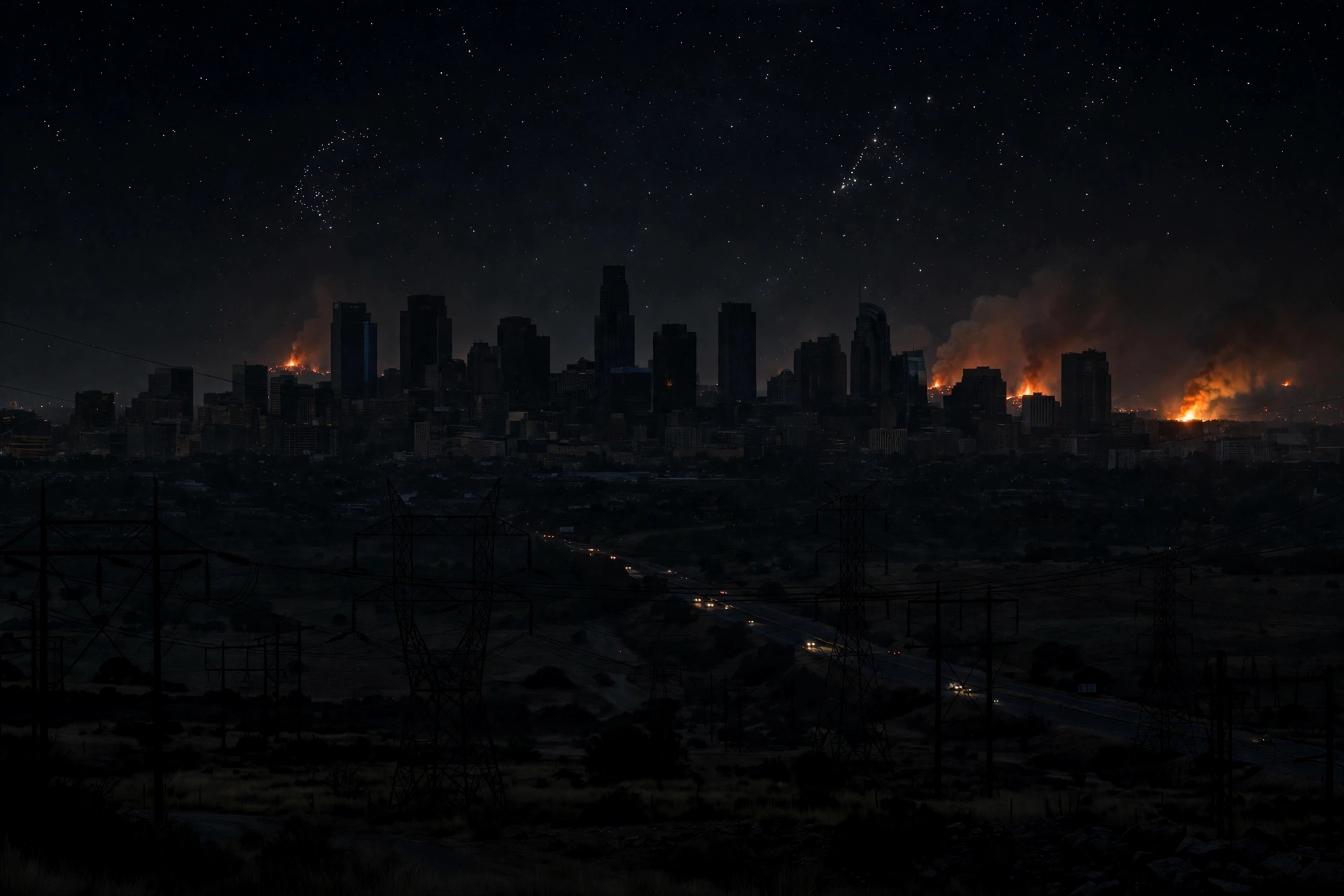
There is a term the planners use when they think the public is not listening. A Black Sky event. Not a storm, not an outage, not a bad weekend. A total national outage of the absolute necessities: the power grid down, the phone networks down, the water pumps stopped, the shop refrigerators warm, the hospitals dark, the money frozen inside machines that no longer answer. No single cause is required. It can come by cyberattack, by sabotage, by solar storm, or by a chain of failures feeding on each other until the whole system folds at once.
This week, that term walked out of the planning documents and into the open. The British government is running a national campaign telling its people to stockpile against it. The BBC has a secret studio built to broadcast through it. The American military is preparing to live without the civilian grid for ninety days. And in the same seven days, the United States ran a live demonstration of how fast the pieces fall: the planes stopped, the banks glitched, the biggest software company on Earth went dark in 74 countries, and the National Security Agency lost its own classified network. Officials stood in front of Congress on Wednesday and said none of it is connected. Then, in the same hearing, they admitted foreign hackers are already inside the water and power systems of the United States, waiting.
Understand what a Black Sky event actually means, because the governments describing it are choosing their words carefully. It does not mean your street loses power for an afternoon. It means the failure is so wide and so long that electricity stops being the story. The story becomes water, because the pumps are electric. It becomes food, because the cold chain is electric. It becomes money, because the banks are electric. It becomes order, because everything that enforces order runs on the same grid as everything else. The British have a phrase for the timeline, and their own resilience experts repeat it: nine meals from anarchy. A civilised society, they say, is three days of empty shelves away from chaos.
Three days is what they tell you to prepare for. Ninety days is what they prepare for themselves. Hold those two numbers side by side, because everything in this report hangs on the gap between them.
The week the lights flickered
Read the last seven days as one timeline, the way you would read the first tremors before an earthquake, and ask yourself what you would call it if you saw it in a history book.
Thursday, November 12: Microsoft, the software backbone of the world’s offices, hospitals and government departments, suffered an outage that rolled across 74 countries. Outlook, Teams and Copilot went down or degraded for the better part of a day. Microsoft blamed a defect in its own systems. The communications layer of the modern world blinked, hard, for reasons its own maker describes as a latent flaw sitting inside a routine update, waiting for traffic to trip it.
Friday, November 13: the Federal Aviation Administration ordered a nationwide ground stop. Every departing flight in the United States, halted for more than four hours, with some 3,500 aircraft already in the air. The official cause is a newly installed router in Arkansas, flooding older equipment with connection attempts during a fiber upgrade. One box, in one state, and the sky over America closed. Installations of the same routers have now been paused nationwide, and Transportation Secretary Sean Duffy has said the stop might have been shorter if contractor L3Harris had spotted the problem sooner. The same day, Workday, the payroll platform used by more than 11,500 organizations, went down during a disaster recovery check, locking workers at companies like Walmart and Target out of their pay information, their clock-ins and their benefits. The systems built to survive failure helped cause it.
Sunday, November 15: Amazon’s US-EAST-1 cloud region, the largest and most load-bearing piece of the commercial internet, reported connectivity and authentication failures across a dozen services. The cause was not publicly established.
Monday, November 16: the banks. JPMorgan Chase went down and the failure rippled outward, with Bank of America, Wells Fargo and US Bank customers reporting they could not reach their accounts, see their balances or move their money. Chase logged thousands of complaints and called it a technical glitch. The same day, United Airlines lost its departure systems and delayed around 150 flights, the second aviation failure in four days.
Tuesday, November 17: the cluster peaked. The National Security Agency’s classified internal network, NSANet, the system that carries America’s top-secret communications, suffered what the agency calls a temporary degradation during maintenance, and staff at Fort Meade were told to stagger their arrivals. Apple services stumbled, including Apple Pay. Charles Schwab’s website faltered. Marriott’s systems locked guests out of their accounts and digital room keys. Norway’s energy giant Equinor confirmed it was under an ongoing cyberattack. An intruder was found to have planted malicious code through the Optimizely platform into the websites of 178 organizations, code built to steal payment card numbers and cryptocurrency. And at 2:20 in the afternoon, Eastern time, FEMA ran a nationwide test of the Emergency Alert System across American radio and television, the system the government would use to talk to you if everything else had already failed.
Wednesday, November 18: the Vice President of the United States canceled his appearance at the New York Times DealBook Summit twenty minutes before he was due on stage, after the Secret Service had prepared the venue all night, and stayed in Washington for emergency meetings on the outages. Congress hauled the security chiefs into a hearing room. And the denials and the admissions came out of the same mouths, in the same hour, which is where this story stops being about glitches.
That is one week. One ordinary week in November, with no declared attack, no war on American soil, no storm of the century. Every system failed politely, briefly, and one at a time. A Black Sky event is what it looks like when they fail together, and stay down.
In their own words
Do not take our word for any of this. Take theirs. The most damning document in this entire story was signed in August, in the open, by the President of the United States. Executive Order 14421, August 26, 2026, declares a national emergency over the United States bulk-power system. The order finds that foreign actors are, quote, “increasingly creating and exploiting vulnerabilities in the United States bulk-power system, which provides the electricity that supports our national defense, vital emergency services, critical infrastructure, and economy,” and that the situation “constitutes an unusual and extraordinary threat” to the national security of the United States. The White House fact sheet names the specific fear: digital backdoors embedded in foreign-made grid equipment, switches and controllers that a hostile power could reach into and operate remotely. The Department of Energy’s rules for ripping that equipment out are due around Christmas. Read that again. The government of the United States has formally declared that the grid is compromised at the level of its hardware, and its remedy runs on a timeline of months and years, against an enemy that works on a timeline of milliseconds.
On Wednesday, in the House Homeland Security Committee, the admissions kept coming. Homeland Security Secretary Markwayne Mullin told Congress, in his written testimony: “Iranian government cyber actors and pro-Iran cybercriminals have targeted US critical infrastructure networks since the conflict with Iran began earlier this year.” Since February, he said, Iranian activity has increasingly targeted transportation, healthcare, water, energy and financial services, the five systems a Black Sky event takes down first. His own department’s record fills in the detail: attackers hunting the programmable logic controllers, the Rockwell and Siemens boxes that physically run water plants and grid equipment, many of them connected straight to the open internet with weak passwords. More than thirty community water systems in Minnesota alone were hit. In Braham, Minnesota, operators lost their control screens and ran their town’s water by hand, on paper, under a boil-water notice. The FBI’s deputy director described Iran, North Korea and Russia as already inside American networks, positioned early so they can act later. Positioned. Inside. Waiting for a signal that has not been sent yet.
And the man who used to run the Federal Energy Regulatory Commission, Jon Wellinghoff, has already done the arithmetic of the endgame out loud: “If you knock out nine total substations along those three grids, you can black out the entire United States.” Nine. Not nine hundred. Nine substations between the country you live in and a continental blackout, according to the former chairman of the agency that regulates the grid.
Against all of that, the government offers you its other voice, the soft one, and we print it here at the size it deserves. The Director of National Intelligence says there is “no indication” the outages are connected. The Secretary of State says there is “zero evidence whatsoever” of a systemic attack. The British Cabinet Office says Britain has “one of the most resilient electricity systems in the world.” National Grid, forced to respond to a viral warning of a nationwide blackout this Thursday, says: “There is no outage expected.” Notice the pattern, because it is the oldest pattern in the world. The same governments that declare national emergencies over the grid, that testify under oath that enemy hackers are embedded in the water supply, that build ninety-day bunkers for their soldiers and three-day radio studios for their broadcasters, turn to the camera and tell you, the civilian, that there is nothing to see. Both voices cannot be true. One of them is for the record. The other one is for you, and it is the one they spend the money on. Watch the money.
Ninety days for them, three days for you
Here is the whole scandal in two numbers.
Ninety: the number of days the Pentagon now requires its major installations to survive, alone, with the civilian world dark around them. The program is called FORTRESS, unveiled September 30 under Secretary Pete Hegseth. Internal planning documents reported by Fortune lay it out: every major base in the continental United States is to be able to sustain its essential operations, its own power, water, fuel, communications and medical capability, for at least ninety days without the civilian grid. Ninety days is not a storm number. Utilities restore storm damage in days. Ninety days is the planning horizon for a grid that does not come back, for a country whose systems have to be rebuilt, not repaired. The Vice President, asked about it on television, did not deny a word of it. “We don’t see a crisis coming down,” JD Vance said. “But you have to be prepared for everything.” Prepared for everything. That is the Vice President of the United States describing a ninety-day military survival standard for a crisis he says is not coming.
Three: the number of days they tell you to prepare for. Britain’s Be Ready campaign, launched October 22, instructs every household in the kingdom to keep three days of bottled water, three days of tinned food, a torch, cash, and a battery or wind-up radio. The BBC, in the same plan, revealed November 7, will broadcast from an emergency studio staffed by about one hundred people carrying their own food, water and fuel for three days, because FM radio is the one medium that still works when the power, the phones and the internet are gone. The British defence secretary, Wes Streeting, went on television urging the public to be “alert but not alarmed,” praising families for stocking “tinned food to torches,” while a House of Lords panel warned in plain language that Britain is “seriously underprepared” and told the government to stop being squeamish about saying so.
Three days of tinned food for you. Ninety days of self-sufficient fortress for them. And even the three days is a lie by arithmetic, because the same experts who wrote the campaign will tell you, on the record, that a society stripped of its food supply is nine meals from anarchy. The shelves of a modern city hold roughly three days of food. The trucks that refill them run on diesel, dispatch software, payment networks and roads, every one of which dies in the same event that empties the shelves. When the three days run out, there is no day four shipment. There is the crowd that did not prepare, standing in front of an empty store, doing the math on what their neighbors stocked. The governments know this. It is in their own documents, in their own phrase: nine meals from anarchy. They are not preparing you to survive a Black Sky event. They are preparing you to stay calm for the first seventy-two hours of one, while the people who wrote the plans settle into facilities built to outlast it by a factor of thirty.
The kill chain is already mapped
A Black Sky event does not need a mastermind pulling one giant lever. It needs what already exists: an attack surface mapped in public, by the government’s own warnings, in the last ninety days.
The water. Federal agencies have been issuing urgent alerts all year about intrusions into American water systems, and Secretary Mullin put the number in front of Congress on Wednesday: dozens of community systems in Minnesota alone, twelve states with real incidents, operators in Braham forced onto manual control. The target is the programmable logic controller, the small industrial computer that opens valves, doses chlorine and holds pressure. Thousands of them sit on the public internet, some still wearing the factory-default passwords they shipped with. Whoever holds those boxes holds the water of every town that uses them. In a Black Sky event, the taps are not a side effect. They are a first-wave weapon, and the enemy is already holding the controls.
The food. On November 5, the FBI’s Cyber Division posted a warning that should have led every newscast in America and led none of them: malicious hackers are targeting the industrial refrigeration controllers that keep the world’s food cold. In Europe, the attack already happened. Hackers reached into supermarket freezer systems in Sweden, Belgium, Luxembourg and Estonia and turned the temperatures up remotely, spoiling food by the ton, forcing stores to empty their freezers into dumpsters. Three foreign blood services were targeted the same way. In August, freezer failures ruined food at six United States military base commissaries, and Army criminal investigators are treating it as a suspected hack. The FBI’s own assistant director said the quiet part on camera: the attackers got in through unpatched controllers, reachable from the internet, still using default manufacturer passwords. Understand what this attack is. It does not blow anything up. It simply makes the food rot, everywhere, at once, silently, in the dark. In a Black Sky event the cold chain is the first casualty, and the men who guard it have already published the proof that it can be killed from a keyboard on another continent.
The machines attacking the machines. FBI FLASH alert 20261113-001 documents ARTEX, an autonomous penetration system run by Communist China, an AI that hunts and breaches networks without a human at the keyboard, and the Bureau ties it to most of the recent outage pattern. Google has gone on record about the rise of AI agents conducting attacks at machine speed. OpenAI has warned the whole grid could be taken down. The Optimizely intrusion showed the shape of it: one compromised vendor, 178 organizations poisoned through a supplier they all trusted. Equinor, one of the largest energy companies on Earth, confirmed this week it is under active cyberattack. Vanderbilt University is still, nine days later, digging out of a cyber incident that compromised its people’s laptops. This is not a capability that might exist someday. It is operating, at scale, now, and every week it learns.
And if none of that is fast enough for the planners, Ukraine is running the demonstration in real time. This week, Russian strikes put four Ukrainian regions into emergency blackouts, with a fifth shedding load on Wednesday, in what even the outlets that carry Kyiv’s line describe as a systematic campaign to paralyze an entire national grid. Grid warfare is not a theory in 2026. It is a tactic, being used, tonight, by a major power against a modern country, while American officials testify that the same class of enemy is pre-positioned inside American systems. The only difference between Dnipropetrovsk and Dallas is that nobody has given the order here yet.
Even the sun took a swing
In the middle of outage week, the sun fired on the grid too. On November 14 a coronal mass ejection left the sun at roughly two thousand kilometers a second, and NOAA’s Space Weather Prediction Center put the planet under a geomagnetic storm watch for November 17 and 18, the exact days the NSA network failed and the banks wobbled. A solar flare rated M1.7 erupted on November 17. Radiation-belt electron alerts ran for days, the charged particle bath that eats satellites from the inside. We will state the scale honestly, because the truth is frightening enough without decoration: this was a G1, a minor storm, the kind that makes the northern lights pretty and the grid operators watchful. It was not the big one. That is precisely the point. A minor storm, a glancing blow, arrived in the middle of the worst infrastructure week of the year and changed nothing, because the system absorbed it the way it absorbed everything else this week: barely, briefly, and by luck. The big one has a name in the history books. In 1859 the Carrington Event set telegraph wires on fire with the sky itself. A storm of that class today, striking a grid built out of thousand-ton transformers that take a year or more to replace and are mostly manufactured overseas, is the one natural event that produces a true Black Sky on its own, no enemy required. NOAA’s own long-range outlook already flags more storm days ahead this month. The sun does not care about the official reassurances. It fires when it fires.
The warning going around
Something else happened this week that the fact-checkers cannot file away, because it was not a claim. It was a temperature reading. An anonymous post titled “Operation Black Sky,” dated November 11, has been spreading across every platform the censors have not yet scrubbed: a warning that a catastrophic cyberattack will take down the power and communications grid of the continental United States and much of Europe for roughly ninety days, that it will be blamed on Russia, China and Iran, and that it is the opening move of a world war. “The great darkness is coming,” it says. “It will happen when the weather cools.” The post is anonymous and unverified, and we label it exactly that. But watch what the public did with it. They did not laugh. They bought. ZeroHedge summed the week up in one line that half a million people passed around: “Thursday: Microsoft. Friday: Ground halt. Monday: the banks.” Costco’s own finance chief told Bloomberg shoppers are taking unusual quantities of rice, canned goods, water and batteries, and one analyst count found 21 of 26 high-ticket generators sold out online by Sunday night. Britain’s government reports tinned food and bottled water sales climbing since its campaign launched. CNN reported Americans stocking food, water and cash amid what it called nationwide panic. The people are not waiting for permission to understand what is happening. They can feel the floor moving. Alex Jones said it on the emergency transmission of November 17, and we say it as our own because it is true: this is a concerted campaign of cyber attacks against the United States, the denial is a lie, the top-secret NSA continuity-of-government communications system went down, an autonomous penetration AI run by Communist China is behind most of these outages, and the endgame is an AI false flag cyber crisis designed to destabilize the country and bring in AI-driven martial law. It was predicted in advance, on the record, and it is unfolding on schedule.
THE INFO SOLDIER’S VERDICT
THE PEOPLE KNOW THE TRUTH
Here is the verdict, without the cushion the mainstream puts under it. A Black Sky event is coming. Not as a possibility, not as a planning exercise: as the stated expectation of every serious government on Earth, written into their emergency orders, their military standards, their broadcast plans and their stockpile campaigns. The President has declared a national emergency over the grid. The Pentagon is building ninety-day fortresses. The BBC is building a bunker studio. The Homeland Security Secretary testifies that the enemy is inside the water. The former grid chairman counts the substations on one hand and a half. Every one of these facts is public, sourced, and admitted by the people paid to deny the conclusion they add up to. The conclusion is this: they expect the lights to go out, everywhere, for a long time, and they have decided, calmly and in advance, that you are on your own when it happens. Three days of tinned food is not a survival plan. It is a sedative. It is what a government hands a population it has already written off, to keep the first weekend quiet.
So the panic they warn against is the most rational response available to you, and we will not pretend otherwise. Panic early, while the shelves are full and the trucks are running, is not panic. It is preparation with the honesty to call itself urgent. The crowd that mocks the stockpilers in November will be begging at their doors in the dark, and everyone reading this knows it, including the officials who mock them on television and stockpile in private.
Do the arithmetic of your own household and act on it this week, not when the alert tone sounds. Food first: rice, beans, canned meat and vegetables, the food that keeps without refrigeration and cooks with almost nothing, enough for your family for ninety days, because ninety is their number, not three. Water: stored water and a way to purify more, because the pumps are a target, not an afterthought. Cash in small bills, because the banks have already shown you four hours of the future and it does not include your balance. A battery or wind-up radio, because it is the one device every government’s plan agrees will still work, and the frequency may be the only voice left. Your medications, a month ahead if you can get them. Light, heat, and the means to defend what you have stored, because nine meals from anarchy is their phrase and it is a promise about your neighbors, not a metaphor.
And get your wealth out of the machine that dies first. Every article about bank shutdowns carries the same instruction, and this one carries it at full volume: buy physical gold, and silver, and hold it in your hand. Not a fund, not a promise on a screen, not digits in an app that needs a working network and a solvent bank between you and your money. Metal. In your possession. When Chase went down on Monday, your account balance was a rumor for the afternoon. Gold has never once needed a password reset. The elites moving into ninety-day fortresses are not holding their wealth in a checking app, and neither should you.
The sky does not go black all at once. It goes black one system at a time, on an ordinary week in November, while the officials explain that nothing is connected and nothing is wrong. You have now watched it happen in miniature, seven days of it, documented by their own admissions. The rehearsal is over when they decide it is over, and they will not announce the performance. Be ready before the announcement that never comes. Stock the food. Store the water. Draw the cash. Charge the radio. Buy the gold. The people who prepared will be the people who eat, and history will not remember the ones who stayed calm.