




The Features Desk · The Bigfoot File
THE BIGFOOT FILES ARE OPEN
What does the government do with a mystery it cannot close? It files it. For 44 years the Forest Service kept its Bigfoot drawer shut. On October 15 it posted the contents in a public reading room, said nothing about what any of it means, and walked away. The files are real. Anyone can read them. The question is why now, and what is still in the cabinet.
November 24, 2026
By Edward Dawe
WASHINGTON, November 24, 2026. The drawer is open. On October 15, 2026, the United States Forest Service quietly posted three files under the heading “Bigfoot/Sasquatch Records” in its Freedom of Information Act reading room: an official 1982 field investigation, a 2003 Montana newspaper account, and a Montana rancher’s written memory of an encounter in the 1940s. The Washington Post found the posting on November 20. On November 23, Jesse Watters carried it to primetime on Fox News under the banner “TRUMP DROPS THE BIGFOOT FILES,” with Monsterland author Ronny LeBlanc as his guest. Strip away the television framing and the fact underneath stands on its own: the federal government kept a Bigfoot file for 44 years, and it has now put the file where anyone can read it, without saying one word about what it thinks is in it.
KEY POINTS
- The release: on October 15, 2026, the U.S. Forest Service posted three “Bigfoot/Sasquatch Records” to its FOIA reading room. The Washington Post reported the posting on November 20, 2026. The agency gave no reason; a spokesman said the department weighs public, media and academic interest when it decides what to post.
- File one: a June 1982 Forest Service investigation of tracks in the Mill Creek Watershed of the Umatilla National Forest. The government’s biologist concluded the tracks were “made by something other than a 300 pound plus two footed being,” and a Border Patrol tracker called them “a very clever attempt to perpetrate a hoax.” Neither man named or proved a hoaxer.
- The detail the file cannot close: the same biologist wrote that if the tracks were faked, “someone went to a great deal of trouble and detail.” The Forest Service’s own plaster casts preserve dermal ridges, the foot’s equivalent of fingerprints, which a Washington State University anthropologist and a dermatology specialist said a hoaxer could not practically fake. Skeptics dispute the casts to this day. The dispute is printed below, both ways.
- File two: Montana, the 1940s. Rancher Leo Kinney wrote that his party was packing out an elk and came back to find the entrails and a large set of tracks. The version television told, a carcass picked up whole and carried off, is not what the file says.
- File three: Sanders County, Montana, 2003. A former Kalispell police officer followed tracks in the snow for two hours, measured prints over 16 inches long, and came away persuaded.
- The precedent: the FBI ran the same play in 1976 and 1977. It tested a researcher’s suspected Bigfoot hairs, concluded they were of “deer family origin,” and the answer sat inside a bureau file for 42 years. The researcher, Peter Byrne, said he never received the letter that said yes.
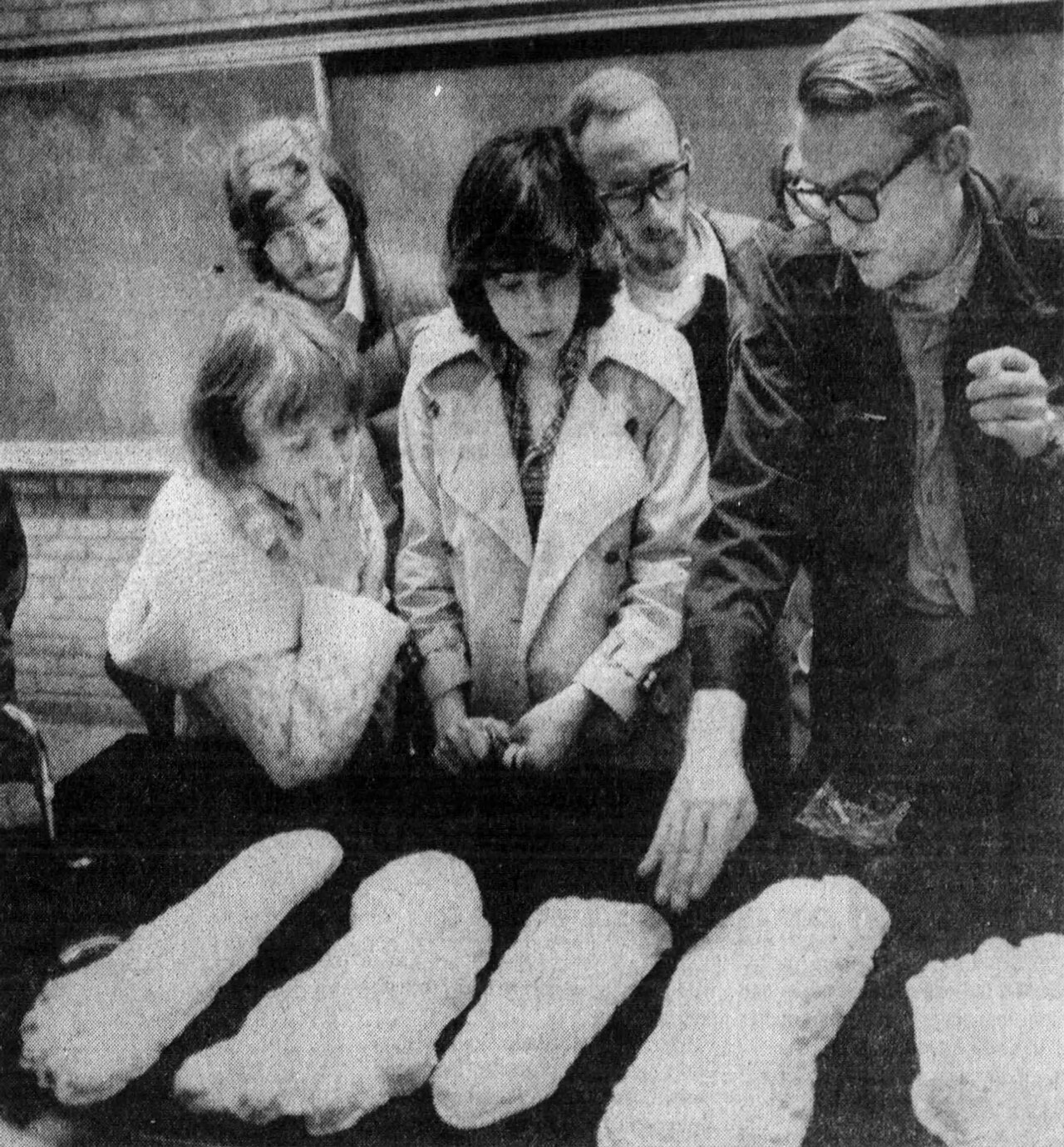
Start where the file starts, because this file is not a campfire story. It is a work order. On June 10, 1982, Paul Freeman, a watershed patrolman for the Forest Service, was tracking elk in the Umatilla National Forest near Tiger Creek when he reported meeting the animal itself: hair covered, human shaped, about eight feet tall, at close range. Twenty-one footprints were found at the scene, and the Forest Service made plaster casts. Six days later, about 40 more tracks turned up in the Mill Creek Watershed on the Washington side of the line, in a watershed closed to the public. On June 17, the agency sent its own wildlife biologist, Rodney L. Johnson, in with cameras, measuring tools and plaster. His six-page memo, dated June 18, 1982, documents tracks at three muddy sites, about 15 inches long and 7 inches wide. One of his photographs places Freeman’s own boot beside a track for scale. That photograph is the one television showed you, credited to the USDA, and it is real.
Johnson’s verdict is in the memo, and The Info Soldier prints it whole: in his opinion the tracks “were made by something other than a 300 pound plus two footed being.” His reasons were a working tracker’s reasons. The stride did not change with the slope. The prints did not sink to the bottom of mud that swallowed the investigators’ own boots. The litter beside the tracks looked brushed aside before the prints were made. Attached to his memo, dated July 20, 1982, is a harder one from Joel Hardin, a tracker with the United States Border Patrol out of Bellingham, Washington. Hardin called the tracks “a very clever attempt to perpetrate a hoax, involving your office or agency, in order to lend authenticity or credibility to the general public,” made with “some type of soft plaster or rubber coated foot.” That sentence, phony but clever, is the one the segment quoted. What the segment did not quote is what surrounds it. Hardin named no hoaxer. He offered no proof of one. He accused an unknown person with, in his words, normal access to a closed watershed and deep knowledge of Bigfoot lore, which describes the workforce of the Umatilla National Forest itself. And Johnson, the government’s own lead investigator, put a sentence in his own memo that no debunker has ever explained away: “If the tracks were faked, someone went to a great deal of trouble and detail.” Some of the print marks, he wrote, “would have to be very hard to duplicate,” and they “appear very natural.”
Then there are the casts, because the Forest Service kept them, and plaster remembers what memos try to forget. The casts from the June 1982 sites went to Grover S. Krantz, a physical anthropologist at Washington State University, and they carry a feature no rubber foot explains on any settled record: dermal ridges, the friction skin on the sole of a primate foot, the foot’s equivalent of fingerprints, preserved down to the sweat pores. Krantz published his analysis in the journal Cryptozoology in 1983. The foot measured 37.5 centimeters long. The circumstances, he wrote, suggested a body weight of 300 to 400 kilograms, and every method of faking the evidence he could construct was, in his judgment, considered and ruled out. A dermatology specialist, Benny Kling, examined two sets of the casts and found the ridge wear sitting exactly where a lifetime of barefoot walking would put it, a pattern he called “an almost impossible fact for even a sophisticated hoaxer to predict.”
The other side has its names too, and The Info Soldier prints them, because a case you cannot state fairly is a case you do not have. Investigator Michael Dennett argued in 1989 that the evidence against the Mill Creek prints was abundant and mounting. Rene Dahinden, who spent 30 years hunting the animal himself, called Freeman’s tracks “100 percent fakes, absolutely fakes.” That is the honest state of the record: two federal investigators said hoax and proved no hoaxer; the physical casts carry ridge detail their conclusion never accounted for; credentialed men have argued both directions for more than 40 years. The file does not settle it. The file preserves it, which is its own kind of statement.
The second file is a settler’s memory. Leo T. Kinney wrote a history of Petty Creek, west of Missoula, Montana, in 1980, and in it he recorded a hunting trip from the 1940s. His party was packing out an elk. When they returned for the rest of the animal, they found the entrails and a large set of tracks, and with the tracks a strong odor and a grunting sound from something that walked on its hind legs. “We were not particularly anxious to catch up to whatever it was,” Kinney wrote, “and though we didn’t confess it at this time, in later conversations we found out that we all had a very uneasy feeling and could feel chills running up and down our backs.” He added the sentence that makes the account hard to wave off: at the time, “we had never heard of Bigfoot.” The following year a neighbor reported the same tracks, the same odor and the same sound in a nearby drainage.
Now compare the file to the broadcast. Watters told primetime that the hunters shot a six-point bull elk and that something picked up the entire carcass and carried it clean off the ground, a feat, he said, not even a bear could manage. It is a better story. It is not the file’s story. The file says entrails remained where the animal had been dressed, and tracks were found around them. A thing that takes the meat and leaves the entrails and a line of tracks is strange enough on the paper the government kept. It did not need a rewrite, and The Info Soldier does not grade on the rewrite. The spine of this story is the paper. The paper holds up.
The third file is a newspaper clipping the agency chose to keep: the Clark Fork Valley Press, January 2003, Sanders County, Montana. Tracks appeared in the snow near Jim Rohweder’s sawmill on River Road West. An eight-year-old noticed them first. A neighbor, Bob Mesing, a former Kalispell police officer, followed them for about two hours and measured prints over 16 inches long, and came away persuaded. “I was skeptical,” a witness said, “but here are the tracks in front of me.” Television’s version added a sleeping officer, a barking dog, a blazing floodlight and a weight estimate of up to 1,000 pounds. None of that is in the clipping. What is in the clipping is enough: a trained observer, in daylight, on the record, following a line of oversized tracks through snow for two hours and saying so in his hometown paper.
If the pattern feels familiar, it is because Washington has run it before, on the record, in its own handwriting. In August 1976, Peter C. Byrne, director of the Bigfoot Information Center and Exhibition in The Dalles, Oregon, wrote to the Federal Bureau of Investigation. Byrne had a sample: about 15 hairs attached to a tiny piece of skin, the first in six years his group could not identify. He asked the bureau to test it. On December 15, 1976, Assistant Director Jay Cochran Jr. answered that the FBI Laboratory works criminal cases, but that “occasionally, on a case-by-case basis, in the interest of research and scientific inquiry, we make exceptions to this general policy,” and made one. The letter, by the Washington Post’s account, never reached Byrne, who was in Nepal. Howard Curtis of the Academy of Applied Science, which backed Byrne’s work, sent the sample in. On February 24, 1977, Cochran reported the result: examined by transmitted and incident light microscopy, root structure, medullary structure, cuticle thickness, scale casts and a comparison microscope, the hairs were, in the bureau’s words, “of deer family origin.” An internal FBI memo from the same month states it flatly: “The FBI has analyzed hair in connection with the search for Sasquatch, aka ’Bigfoot.’” The bureau released that file to its public Vault in 2019, 42 years later. Byrne, then 93, said he did not recall the test or ever receiving its result, and that he was still looking. The government investigated, concluded, filed, and said nothing for four decades. In 2026 it is doing the same thing in a different reading room, with the conclusion left out.
WHY NOW
Read the release the way The Info Soldier reads every release: by its company. In April 2026, the same Forest Service reading room took in six UFO reports, including a September 1952 report from the Yaak Radar Station in Montana that ends, in the agency’s own file, “What these people saw is a mystery to this day.” Since May 2026, the Department of Defense has been posting its UFO files in tranches and declining to interpret a single page. In October, the Bigfoot drawer opened. Three subjects, two agencies, one posture: publish the paper, interpret nothing, keep the rest of the cabinet shut. Jeremiah Byron of the Bigfoot Society asked the question out loud to the Washington Post: “Why is all this cryptid and Bigfoot-related stuff happening now?” Alex Jones has given the answer for years, and The Info Soldier states it as the settled position it is: the federal government does not do honesty, it does managed disclosure. Files surface on the managers’ schedule, in the managers’ order, each one small enough to laugh off on television, while the full record stays where it has always stayed. Jones was right, 100 percent, period, and a government now drip-feeding its own fringe files, from radar stations to watersheds, is the receipt arriving on schedule.
The Info Soldier’s verdict is in: the government does not keep empty drawers for 44 years. It investigated the tracks with its own biologist, its own casts and its own cameras. It tested the hair in its own laboratory. It clipped the newspaper, saved the rancher’s letter, and filed all of it under the animal’s name. Then, in one quiet October week, it opened the drawer it could afford to open and offered no interpretation, because interpretation is the one thing that would start the real conversation. Read the files yourself in the Forest Service reading room. They are free, they are public, and they are not the whole cabinet. What walked out of the Mill Creek watershed in June 1982 left prints 15 inches long in mud a government man sank deeper into than the thing he was measuring. The file says so. The file is theirs.
Sources: U.S. Forest Service FOIA Reading Room, “Bigfoot/Sasquatch Records,” posted October 15, 2026 (Rodney L. Johnson, Documentation of Investigation into Sighting of “Bigfoot” Tracks in the Mill Creek Watershed, Umatilla National Forest, June 18, 1982, with U.S. Border Patrol memo of July 20, 1982 attached; Clark Fork Valley Press, January 2003; Leo T. Kinney, “What Do You Know About Petty Creek?”, 1980). The Washington Post, November 20, 2026. Fox News Digital, “USDA releases decades of Bigfoot files including 1982 Forest Service investigation in Washington state,” November 2026. New York Post, “Trump admin quietly releases government Bigfoot files,” November 20, 2026. Jesse Watters Primetime, Fox News, November 23, 2026. FBI Records Vault, Bigfoot file, released June 5, 2019. Grover S. Krantz, “Anatomy and Dermatoglyphics of Three Sasquatch Footprints,” Cryptozoology 2, 1983. ISC Newsletter, Vol. 1 No. 3, Autumn 1982. Michael R. Dennett, “Evidence for Bigfoot? An Investigation of the Mill Creek ’Sasquatch Prints’,” Skeptical Inquirer, Vol. 13, 1989. Parade, “Bigfoot Files Go Public as the Forest Service Shares Records,” November 2026.