




The Features Desk · The Creature File
THE GOVERNMENT SENT A BIOLOGIST TO LOOK FOR BIGFOOT
On October 15 the U.S. Forest Service posted three files from its “Bigfoot/Sasquatch Records” with no announcement at all. Inside them: a biologist dispatched to measure 15 inch tracks in 1982, an FBI laboratory that broke its own rules to test the hair, and an agency whose official position is that it can neither confirm nor deny.
November 22, 2026
By Edward Dawe
OKLAHOMA CITY, November 22, 2026. On October 15 of this year, the United States Forest Service quietly posted three files from a collection it calls its “Bigfoot/Sasquatch Records” in its online reading room. There was no press release. There was no announcement. The files sat there for over a month before the Washington Post noticed them on November 20, and the rest of the press piled in behind it.
KEY POINTS
- On October 15, 2026, the U.S. Forest Service posted three files from its “Bigfoot/Sasquatch Records” in its FOIA reading room with no announcement; the Washington Post flagged the release on November 20.
- In June 1982, USDA wildlife biologist Rodney L. Johnson investigated tracks about 15 inches long in the Umatilla National Forest, photographing them and pouring plaster casts; his memo called them man made, while noting the investigators sank deeper into the mud than whatever left the tracks.
- In 1976 the FBI made an exception to its criminal evidence policy to test hairs submitted by researcher Peter Byrne; the lab reported deer family origin, and the file was released in the FBI Vault in 2019.
- Skamania County, Washington, has kept a law against killing a Sasquatch on its books since 1969, and the Forest Service’s stated position is that it can neither confirm nor deny the creature’s existence.
Governments do not keep files on nothing. They keep files on things that cost money, take time, and generate paperwork. Bigfoot has generated all three, across at least three federal agencies and one county legislature, for more than half a century. The files are now public. What they show is not a creature. What they show is a government that, whenever the reports got loud enough, went and looked.
THE 1982 INVESTIGATION
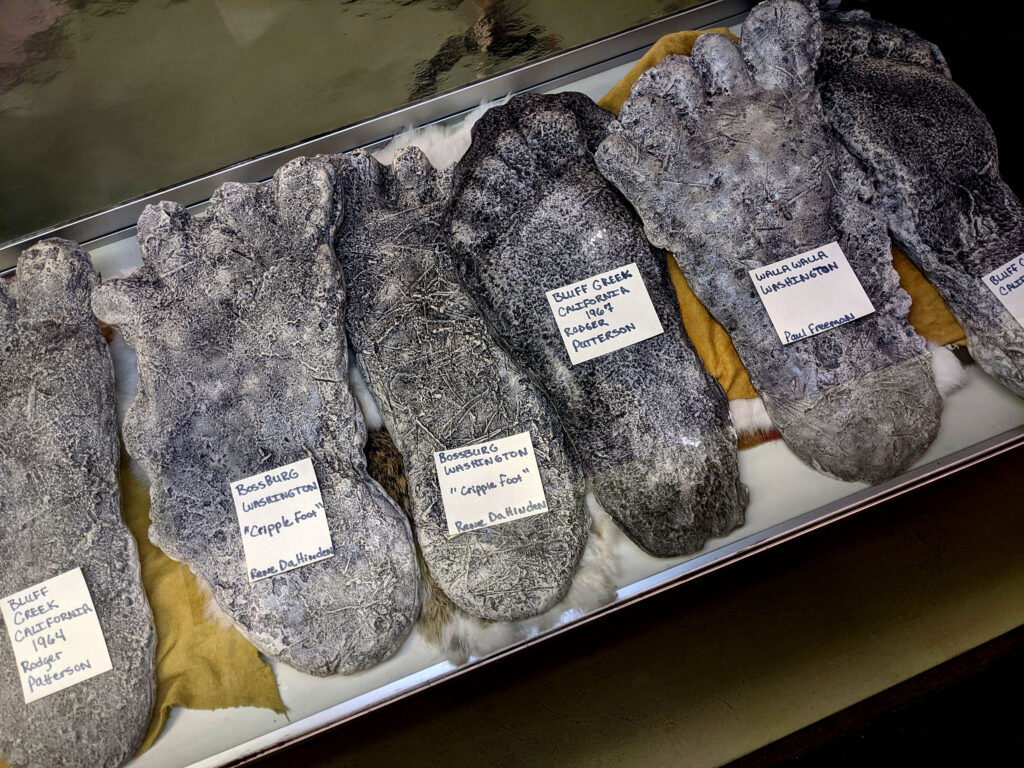
The centerpiece of the release is a real federal field investigation. In June 1982, in the Mill Creek Watershed of the Umatilla National Forest on the Washington side of the line near Walla Walla, a part time forest patrolman named Paul Freeman reported enormous footprints in the mud. The Department of Agriculture did not laugh it off. It tasked a wildlife biologist, Rodney L. Johnson, to investigate a reported find of “Bigfoot” tracks.
Johnson went to three separate muddy sites. He measured tracks approximately 15 inches long and 7 inches wide. His team took color photographs and poured plaster casts to preserve the prints. His six page memo to the Department of Agriculture is dated June 18, 1982, and his conclusion was that the tracks were man made, cut with some type of soft plaster or rubber coated foot. A Border Patrol tracker named Joel Hardin backed him in a July 28 memo, calling the tracks a very clever attempt at a hoax, and suggesting the hoax may have been staged at the agency itself, to borrow the government’s credibility for the story.
That is the official verdict, and The Info Soldier prints it in full. It also prints what sits inside the same paperwork. The investigators who walked that mud noted that they sank deeper into it than whatever left the tracks. A man in plaster feet is a man, and a man has a man’s weight. The file records the problem and then records the verdict anyway. The file does not record who made the prints, and in 44 years nobody has ever been named.
THE HUNTER WHO DID NOT WANT TO CATCH UP
The second file is older and stranger. It is a six page account written in 1980 by a Montana man named Leo Kinney, recounting a hunting trip to Petty Creek in 1949. Kinney and three other men went in to retrieve an elk carcass. The carcass was gone. What they found instead was a line of huge tracks in the snow.
Kinney’s account, preserved in a federal file for four decades, does not claim a sighting. It claims a feeling, and it is the most honest sentence in the whole release. The men, he wrote, were not particularly anxious to catch up to whatever it was, and afterward admitted to each other that they had all had a very uneasy feeling, with chills running up and down their backs. Four armed hunters, an elk carcass missing, tracks too big for any animal in those woods, and nobody walked forward. The Forest Service kept that letter. Agencies throw away paper by the ton. They kept this.
The third file is a January 15, 2003 clipping from the Clark Fork Valley Press in Montana, reporting hundreds of large tracks found near River Road West in Sanders County. A newspaper clipping is not evidence of an animal. It is evidence of a filing habit. For decades, when the tracks showed up, somebody in a federal office cut the story out and put it in the Bigfoot drawer.
THE FBI TESTED THE HAIR
The Forest Service files are not the first time the federal government has put Bigfoot on official paper, and they are not the most remarkable. In 1976, Peter Byrne of the Bigfoot Information Center in The Dalles, Oregon, wrote to the FBI. Byrne had about 15 hairs attached to a tiny piece of skin that his organization could not identify, the first sample in six years he thought might matter, and he asked the Bureau to run a comparative analysis.
The FBI’s laboratories exist for criminal evidence. The Bureau made an exception. Assistant Director Jay Cochran Jr. agreed to examine the sample in the interest of research and scientific inquiry, and in early 1977 he wrote back with the result: the hairs were of deer family origin. The file, 22 pages of it, sat in the Bureau’s records until it was released on June 5, 2019, in the FBI’s online Vault. Byrne maintained for the rest of his life that he never received Cochran’s letters.
What pushed Byrne to write in the first place is the part of the record almost nobody knows. In 1975, the United States Army Corps of Engineers published the Washington Environmental Atlas, a serious, expensive, official survey of the state’s environment. In it, alongside the salmon and the timber, the Army gave Sasquatch a full entry, with a sightings map and a description of an animal up to 12 feet tall, reported in the region since 1840. The atlas even repeated a claim that the FBI had once tested Sasquatch hair and matched it to no known animal. That claim is what Byrne was asking the Bureau to confirm. One agency’s publication sent a citizen to another agency’s laboratory, and the second agency ran the test. That is not how governments treat a joke.
PROTECTED BY LAW SINCE 1969
One government in America went further than files. On April 1, 1969, Skamania County, Washington, adopted Ordinance 69-01. Its preamble states that there is evidence to indicate the possible existence in the county of a nocturnal primate mammal, an ape like creature commonly known as Sasquatch. The ordinance made the premeditated slaying of such a creature a felony, punishable by up to five years in jail and a 10,000 dollar fine. In 1984 the county amended the law, reduced the penalty, and formally designated the county a Sasquatch refuge. Whatcom County followed in 1992 with a resolution declaring Sasquatch a protected species. The Skamania law is still on the books today.
Read that again. A county in the United States has, for 57 years, maintained a law against killing an animal that the official position says does not exist. You cannot be charged with poaching a unicorn. There is no fine for shooting a ghost. Legislatures write laws about things they believe might walk into a hunter’s sights.
WHAT THE FILES ACTUALLY PROVE
Strip the release to what is verified and this is what remains. The Forest Service investigated 15 inch tracks with a biologist, photographs, and plaster, and its own file contains a weight problem its hoax verdict does not answer. The FBI broke its own rules to test the hair. The Army Corps of Engineers printed the animal in an official atlas. A county made it a felony to kill one, and keeps the law in force. And the Forest Service’s own public position, maintained through forums it hosted for the public on the subject, is that it can neither confirm nor deny the creature’s existence.
Neither confirm nor deny. That is not the language of an agency closing a folklore file. That is the language an agency uses for a question it does not intend to answer.
The image spreading with this story pairs the files with frame 352 of the Patterson-Gimlin film, shot at Bluff Creek, California, on October 20, 1967, still the most examined piece of footage in the history of the subject, never proven a hoax and never proven real in 59 years. The film and the files are separate things. But they rhyme. In both cases the paper and the celluloid outlasted every official attempt to wave them away, and in both cases the government’s answer, when it finally came, was to open the drawer and let the public read what it had been keeping.
The files released on October 15 settle nothing about the animal. They settle something about the government. It looked. It measured. It cast the prints in plaster and tested the hair in the federal laboratory and wrote the animal into an atlas and a county law. Then it filed all of it away, and waited 44 years to mention it, on a quiet October day, with no announcement at all.
The question the release raises is not whether Bigfoot is real. The question is what else is sitting in the reading rooms, in the drawers that have not been opened yet.
Sources: U.S. Forest Service, “Bigfoot/Sasquatch Records,” FOIA reading room release, October 15, 2026; Washington Post, reporting on the release, November 20, 2026; Rodney L. Johnson, memorandum to the U.S. Department of Agriculture, June 18, 1982; Joel Hardin, U.S. Border Patrol memorandum, July 28, 1982; FBI Records Vault, Bigfoot file, released June 5, 2019; U.S. Army Corps of Engineers, Washington Environmental Atlas, 1975; Skamania County Ordinance 69-01 (1969), amended by Ordinance 1984-2 (1984); Clark Fork Valley Press, January 15, 2003.