




The Features Desk · The Doomsday File
THE ASTEROID NAMED FOR THE GOD OF CHAOS ARRIVES ON FRIDAY THE 13TH
On Friday, April 13, 2029, a 340 meter asteroid named for the Egyptian god of chaos will pass inside the ring of geostationary satellites, one tenth of the distance to the Moon. The official word is that it will miss. The official word on this same rock once said one in 37.
November 22, 2026
By Edward Dawe
OKLAHOMA CITY, November 22, 2026. On Friday, April 13, 2029, a mountain of rock the size of three football fields will pass closer to the Earth than the satellites that carry your television, your phone calls, and your GPS. It will come in at about 31,600 kilometers above the surface, inside the ring of geostationary satellites at 35,786 kilometers, roughly one tenth of the distance to the Moon, moving at about 7.4 kilometers a second. On a clear dark night across Europe, Africa, and western Asia, about two billion people will be able to watch it with their own eyes, a dim star sliding across the sky.
KEY POINTS
- On Friday, April 13, 2029, asteroid 99942 Apophis will pass about 31,600 kilometers above the surface of the Earth, inside the ring of geostationary satellites and roughly one tenth of the distance to the Moon, visible to the naked eye across Europe, Africa, and western Asia.
- In December 2004 the calculated chance of a 2029 impact peaked at 2.7 percent, one in 37, and Apophis was given a Level 4 on the Torino Impact Hazard Scale, the highest rating ever assigned to any object.
- Radar observations in March 2021 refined the orbit enough for NASA to remove Apophis from its Sentry risk table, and the official assessment is no impact for at least the next 100 years; the 2036 and 2068 scenarios were ruled out along the way.
- A published study found that a small asteroid striking Apophis could in theory nudge its path, with the probability of a dangerous deflection below one in a billion, and ESA’s Ramses mission and NASA’s OSIRIS-APEX spacecraft will both visit the asteroid around the 2029 flyby.
It is named Apophis. The name is the Greek version of Apep, the Egyptian god of chaos and darkness, the serpent that tries to swallow the sun. The astronomers who discovered it on June 19, 2004, at Kitt Peak Observatory in Arizona chose the name on purpose. They knew what they had found.
THE ONE TIME THEY TOLD US TO WORRY
The official record contains a fact the official story would rather you forget. In December 2004, with only a short observation arc to work from, the calculated chance that Apophis would hit the Earth on April 13, 2029, rose to 2.7 percent. One in 37. The asteroid was given a Level 4 on the Torino Impact Hazard Scale, the highest rating ever assigned to any object in the history of the scale. Torino 4 means a close encounter meriting attention by astronomers, with a greater than one percent chance of an impact capable of regional devastation. No asteroid has ever scored higher.
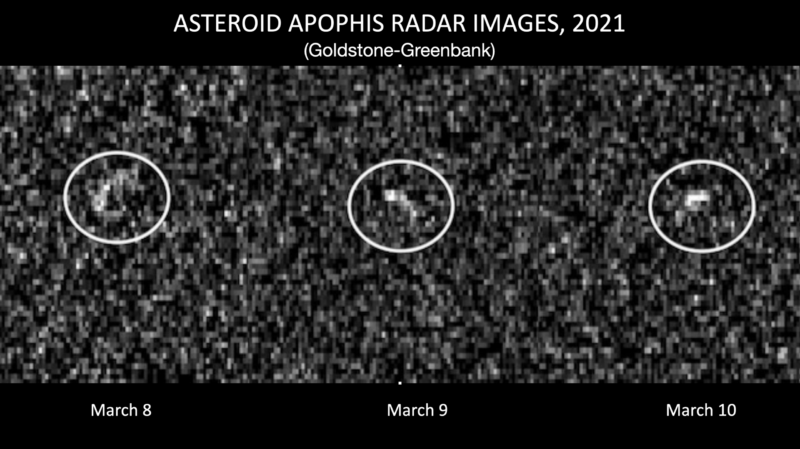
Then, on December 27, 2004, the same day the probability peaked, astronomers found older photographs of Apophis in archival images. The extra data killed the 2029 impact. The danger moved to 2036, through a gravitational keyhole a few hundred meters wide, a patch of space so narrow that passing through it would bend the rock’s orbit just enough to line up a return collision seven years later. Radar work in 2013 killed the 2036 scenario. A radar campaign by NASA’s Goldstone antenna and the Green Bank Observatory in March 2021 killed the 2068 scenario too, and NASA removed Apophis from its Sentry risk table on March 25, 2021. The European Space Agency took it off its own risk list the next day.
That is the official timeline, and every date in it is real. Read it the way the record reads it and the question is not whether the numbers changed. The question is what the numbers mean. In 2004, the best instruments on Earth looked at this object and said one in 37. The system was not wrong in the way a lie is wrong. It was wrong in the way a system is wrong when it does not yet know. The same system, with better radar, now says the danger is zero for the next hundred years. The Info Soldier prints both numbers, because both numbers are the record. The one in 37 is the part nobody in authority wants to say out loud anymore.
WHAT IT WOULD DO IF IT CAME DOWN
The physics is not in dispute, and it is the reason the story matters even on the official version of events. A 340 meter stony asteroid, its longest side more than 450 meters, striking at the speeds these objects travel, releases on the order of a thousand megatons of TNT, with published estimates running from about 750 to 1,500 megatons. The largest nuclear weapon ever detonated was about 50 megatons. A land impact would dig a crater four to six kilometers wide. Blast, heat, and ground shock would level a region. An ocean impact, more likely on a planet that is 70 percent water, would throw up waves tens of meters high against nearby coasts. Dust and aerosols thrown into the stratosphere would dim the sun and cool the harvest for a year or more in the impact zone.
It would not end the world. The dinosaur killer was about 10 kilometers across, roughly thirty times wider, and the energy scales with the cube of the size. An Apophis impact is a regional catastrophe, not an extinction. But regional is the word the planners use, and regional means whole cities, whole coastlines, whole harvests. The difference between regional and global is cold comfort to anyone living in the region.
THE FLYBY ITSELF WILL CHANGE THE ROCK
Even on the miss, the encounter is not harmless, and nobody pretends it is. Earth’s gravity will bend Apophis’s path by about 27 degrees and throw it from its current orbit into a longer one, stretching its year from about 324 days to about 423 days. Tidal forces during the pass may trigger landslides on its surface, shake loose boulders, and shift its slow tumble. The asteroid will leave the encounter a different object than the one that arrived. That is not speculation. That is the stated reason two space agencies are sending spacecraft to watch it happen.
The European Space Agency’s Ramses mission, built with Japan’s space agency, launches in the spring of 2028 and arrives at the asteroid in February 2029, two months before the pass, to ride along through the encounter and measure what Earth’s gravity does to it. NASA’s repurposed OSIRIS-APEX spacecraft arrives in June 2029, after the pass, to study the changed rock for 18 months, including firing its thrusters at the surface to expose what lies underneath. The United Nations has declared 2029 the International Year of Asteroid Awareness and Planetary Defence.
The Info Soldier notes the shape of this. Two governments, a combined bill in the hundreds of millions, spacecraft timed to arrive before and after, and a United Nations year of awareness, all for an object the same governments say cannot hit us. That is consistent with a scientific opportunity. It is also consistent with a system that does not take chances with a 340 meter rock, and does not say so out loud.
THE ADMISSION BURIED IN THE FINE PRINT
Here is the fact that makes this story a doomsday file and not a science page. The official all clear rests on the orbit as measured, and the orbit as measured assumes nothing touches the rock between now and 2029. Astronomer Paul Wiegert studied exactly that question: could a small, undetected asteroid strike Apophis and nudge it? His answer was that an object about three meters across, hitting in the right direction, could supply the change. The published probability of a dangerous deflection is below one in a billion. That is a reassuring number, and it is also a confession. The safety of the planet on Friday the 13th depends on nothing in the dark between here and there so much as brushing a mountain that is already falling past us at 16,000 miles an hour.
NASA’s own 2022 Apophis Specific Action Team went further. In a 59 page report, the agency’s scientists explicitly asked whether sending spacecraft to Apophis could itself change the asteroid’s trajectory and create a hazard. They concluded the risk was manageable. The question was asked because it is a real question, and the people running the missions know it is a real question.
THE LIST DOES NOT END WITH APOPHIS
Apophis came off the risk list in 2021. The list did not close behind it. The European Space Agency’s catalogue, updated November 21, 2026, carries 2,218 asteroids with some non-zero computed chance of hitting the Earth, and two names sit above all the rest.
The first is Bennu, about 490 meters across, bigger than Apophis. On September 24, 2182, Bennu has a 1 in 2,700 chance of striking the Earth, the highest rated risk of any known object. To get there it would have to thread a gravitational keyhole about 5 kilometers wide in the year 2135. NASA has landed on this one. The OSIRIS-REx spacecraft orbited it, touched it, and brought a sample home in September 2023, which makes Bennu’s orbit the most precisely measured of any asteroid in existence. Even so, the number on the books is 1 in 2,700, and the date is written down.
The second is 1950 DA, the largest object on the list at about 1.3 kilometers across, wide enough that an impact stops being regional. Its date is March 16, 2880, at roughly 1 in 51,000. It earned its name honestly. It was discovered in 1950, observed for 17 nights, and then lost for 50 years before telescopes found it again on the last night of the year 2000. For half a century the biggest rock on the risk list was simply missing.
Below those two, the near dates belong to small rocks. The earliest date on the entire list is December 28, 2026, weeks from now, for an object called 2023 BZ, only 13 to 29 meters across, at 1 in 40,322. On May 1, 2027, an object called 2008 JL3, 23 to 50 meters, passes its own test at 1 in 6,024. The highest raw odds on the whole list belong to 2023 VD3, 1 in 425 for November 2034, and it is 11 to 24 meters wide. Rocks that size burn and burst in the air. The one at Chelyabinsk in 2013 was about 20 meters, and it blew out windows across a city and put about 1,500 people in hospital without ever touching the ground. The only large object with a date this century is 1979 XB, somewhere between 400 and 900 meters, December 12, 2056, at 1 in 3.8 million. It was observed briefly in 1979 and lost, and its number is mostly fog.
The most recent scare followed the Apophis script exactly. Asteroid 2024 YR4, about 60 meters, was discovered on December 27, 2024, and within weeks its calculated chance of hitting the Earth on December 22, 2032, climbed to 3 percent, the highest figure since Apophis itself. By March 2025 the Earth impact was ruled out. A leftover 4 percent chance that it would hit the Moon instead survived until March 2026, when the James Webb Space Telescope pinned its path down and cleared the Moon too. Every entry on the current list, all 2,218 of them, sits at Torino 0. That is the record. The record also shows what the numbers looked like before they settled.
THE ONES NOT ON ANY LIST
Here is the part of the record that should keep a reader up at night, because it keeps the professionals up. In February 2026, NASA’s acting planetary defense officer, Kelly Fast, told a scientific conference that of the roughly 25,000 asteroids larger than 140 meters believed to exist near the Earth, only about 40 percent have been found. About 15,000 city killers are unaccounted for. Her words were that it keeps her up at night.
The full census, as NASA’s Center for Near-Earth Object Studies had it in October 2026, runs like this. Astronomers have cataloged 42,616 near-Earth asteroids in total. For the largest class, over one kilometer wide, the shelf is nearly swept: 879 found, about 95 percent of the estimated population, and none of them a threat. For the 140 meter class, the count is about 11,700 found out of an estimated 25,000, fewer than half. For rocks of 50 meters and up, the Tunguska class, an estimated 230,000 or more exist, and fewer than 8 percent have been detected.
The arithmetic that follows is the arithmetic of averages. An impact by a 140 meter object happens somewhere on Earth about once every 20,000 years, which is why the agencies can honestly call any given year safe. But averages do not send warnings, and the missing 15,000 cannot be assigned probabilities at all, because nobody knows where they are. The precedents are not reassuring. Chelyabinsk arrived in 2013 out of the direction of the sun, and no telescope on Earth saw it coming. In July 2019, an asteroid roughly 100 meters wide, designated 2019 OK, passed about 65,000 kilometers from the Earth, closer than many satellites, and it was spotted about a day before it arrived. Had it been aimed at a city instead of empty space beside us, the warning would have been measured in hours.
The tools to close the gap exist on paper. NASA’s NEO Surveyor, an infrared space telescope built to find the dark rocks that visible light misses, is scheduled to launch in late 2027 and is meant to push the census of the 140 meter class toward 90 percent within a decade of work. Until it flies, the honest state of planetary defense was stated this year by one of the scientists who ran the DART deflection mission: we do not know where half of the 140 meter asteroids are, and we would not have any way to actively deflect one right now. The rock that matters most is not Apophis, and it is not Bennu. It is the one that has not been cataloged yet, falling through a sky we have only half mapped.
WHAT TO DO BEFORE FRIDAY THE 13TH
The Info Soldier does not tell readers to panic. It tells them to prepare, because preparation is the same whether the rock misses or the lights go out for another reason entirely. The system that failed to see a 340 meter object until 2004, and then gave it a one in 37 chance of killing a city, is the same system that runs your water, your power, and your food supply. Get ready on your own terms.
Water first. One gallon per person per day, two weeks at minimum, and if you are serious about this, months. Store food you actually eat, rotated and replaced, not a pile of cans you will never touch. Keep cash in small bills, because card readers die with the grid. Keep your medications ahead, a battery or hand crank radio, flashlights and spare batteries, copies of your documents in a waterproof bag, and fuel in the tank. Keep N95 masks and a way to seal a room, because any impact throws dust into the air and dust is what kills the harvest and the lungs after the blast is over. If you live on a coast, know your high ground inland and know it before you need it, because a wave does not wait for a press conference.
And watch the sky yourself. By 2027 and 2028 the international observing campaign will be running at full strength, and amateur astronomers around the world will be tracking this rock independently of any agency. A backyard telescope and the public tracking data are the cheapest insurance on Earth. If the numbers ever move, the amateurs will see it move. Trust the sky, not the statement.
The god of chaos arrives on a Friday the 13th, inside the ring of our own satellites, close enough to see with the naked eye, and close enough that the difference between a miss and a city is a distance smaller than the width of some countries. The official word is that it will miss. The official word has been wrong before, on this very rock, and it said so itself in 2004. Prepare like it matters. Because it does.
Sources: NASA Jet Propulsion Laboratory, Center for Near Earth Object Studies, Sentry risk table and Apophis close approach data; NASA, announcement removing Apophis from the Sentry risk table, March 25, 2021; European Space Agency, NEO Risk List, updated November 21, 2026, and Ramses mission documentation; NASA, OSIRIS-APEX mission documentation; NASA Apophis Specific Action Team report, 2022; Paul Wiegert, study of collision induced deflection of Apophis.