




The Features Desk · The Drone File
AMAZON’S DRONE FELL ON A GARAGE
What do you call it when an 83 pound robot falls out of the sky onto your roof? Amazon calls it a landing. On Friday a Prime Air MK30 delivered a bottle of shampoo, hit a line climbing out, and came down on the neighbor’s garage. On Sunday the NTSB said it is deciding whether that was an aviation accident.
November 22, 2026

By Edward Dawe
HUNTINGTON WOODS, Michigan, November 22, 2026. On Friday, November 20, at about 4:30 in the afternoon, an Amazon Prime Air MK30 delivery drone finished dropping a bottle of shampoo in a backyard in Huntington Woods, a Detroit suburb, climbed back into the air, and hit an overhead line, according to the customer and the neighbor it came down on. The customer, Jim Brennan, told WXYZ that the drone rose into a fiber optic line and lost a propeller. “When it caught that, it just, it went crazy,” Brennan said. The drone spiraled, tangled in a power line, and came to rest on the garage roof next door, damaging the shingles, according to Logan Coomes, the 30 year old homeowner whose garage it hit. Nobody was hurt. That sentence, nobody was hurt, is doing all the work in this story, and everyone in it knows it.
On Sunday, November 22, the National Transportation Safety Board confirmed to the Detroit Free Press that it is gathering information about the crash to decide whether to open an investigation. The federal government is now deciding whether a shampoo delivery is an aviation accident. That is where the future arrived on Friday: not with a bang, but tangled in a power line over a garage in Michigan.
KEY POINTS
- Friday, November 20, about 4:30 PM: an Amazon Prime Air MK30, launched from Amazon’s Hazel Park distribution center, dropped shampoo at a Huntington Woods home, then hit an overhead line climbing out, lost a propeller, tangled in a power line and landed on the neighbor’s garage, damaging shingles (Detroit Free Press; WXYZ).
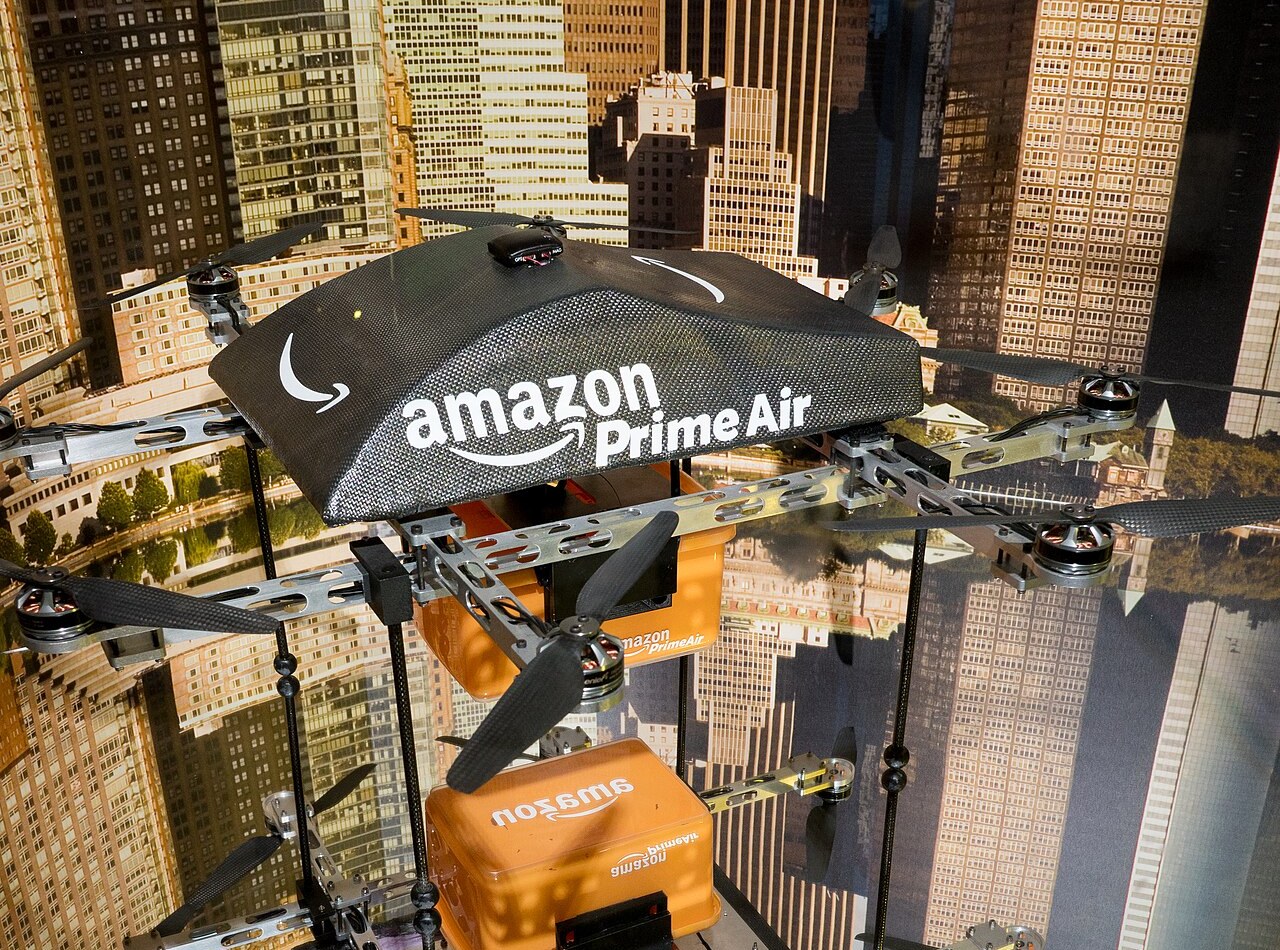
- The drone weighs more than 80 pounds. The FAA’s May 2026 environmental assessment for the Detroit area service puts the MK30 at about 78 pounds empty and 83.2 pounds at maximum takeoff weight, carrying a payload of up to 5 pounds within a 7.5 mile radius.
- DTE Energy said the drone was caught in a service drop line, the wire running from a pole to a home. The utility had to de-energize the line, help remove the drone, and then restore power and reattach the service drop.
- Amazon spokesman Jack Stelzner said a Prime Air drone “landed on a resident’s shed,” that safety is the company’s top priority, that incidents are extremely rare, and that Amazon investigates any delivery that does not go as planned. He did not respond when the Free Press asked whether Amazon would adjust service because of the crash.
- The garage owner, Logan Coomes, said Amazon prioritized removing the drone’s battery because of its high heat, signaled it would help remedy the damage, and, per WXYZ, gave him a $100 gift card. The drone came off the roof about three hours after it landed, with DTE’s help.
- Huntington Woods public safety said the FAA and NTSB were notified and that the NTSB would conduct the primary investigatory follow up. NTSB spokesman Peter Knudson told the Free Press on November 22 the agency was “aware of the incident and continuing to gather information,” and that “no decision has yet been made as to whether we will open an investigation.”
- The Free Press reports at least a dozen Prime Air crashes nationwide since Amazon began testing the drones in 2021. In October 2025, two MK30s struck a construction crane in Arizona, drawing FAA and NTSB investigations. In November 2025, an MK30 climbing away from a delivery in Waco, Texas severed an internet cable with a propeller.
- Amazon’s drones fly under an FAA exemption that allows autonomous flights beyond an operator’s line of sight. The Friday crash is the first publicly reported in southeast Michigan since Prime Air rolled out last year from Hazel Park and Pontiac, two of 18 centers offering air delivery across 10 states.
THE NEIGHBOR DID NOT ORDER ANYTHING
Read the cast of this story carefully, because it is the whole argument. The customer ordered shampoo. The neighbor ordered nothing, agreed to nothing, and got an 83 pound aircraft on his garage, a dead power line, and a hot battery on his roof. Coomes told the Free Press he was grateful the damage was not worse, and then he said the quiet part: “I think they should look into reconstructing the zones and who is eligible for these drone drop offs because, say they had cut an electrical wire and sparked a flame, then our whole house is in flames.”
And even the customer’s side of the fence is not the consent story Amazon advertises. Brennan told reporters the couple was not expecting delivery by drone, because they did not knowingly select it on their November 20 order. The man who ordered the shampoo did not choose the robot. The man whose roof it landed on was never asked at all. Somewhere between those two houses sits the entire drone delivery model: the sky over your street gets enrolled first, and the paperwork catches up later, usually after something falls on it.
Coomes is no enemy of the machines. He told the Free Press “the technology is cool and that’s the way our world is moving,” and that he believes the service should continue. His ask was smaller than a ban: regulations and guidelines assessing who is eligible, in neighborhoods like his, where tight backyards are criss crossed by wires and flanked by detached garages. Huntington Woods is not a test range. It is a suburb that was turned into one, with the residents as the range safety data.
CRASHED, OR “LANDED ON A SHED”?
Now watch the language, because the language is the tell. The customer says the drone hit a line, lost a propeller and went crazy. The garage owner says it spiraled, tangled in a power line and damaged his shingles. The utility says it had to kill power to a service line to get the thing down. The local public safety department calls it a crash and notified two federal agencies. Amazon’s spokesman calls it a drone that “landed on a resident’s shed.”
Garage or shed, crash or landing: one of these vocabularies belongs to the people who live under the flight path, and the other belongs to the company that owns it. And the wording is not the only place the accounts split. WXYZ reported that sources familiar with Amazon’s drone program say this was not the first crash in Michigan. Amazon denies any earlier crash in the state. Both statements are on the record. Only one of them can be true, and the NTSB file, if the board opens one, is where that gets settled, which is exactly why the board’s Sunday answer matters: aware, gathering information, no decision yet.
This is also not a one off airframe meeting a one off wire. The record, in public, runs: two MK30s into the same construction crane in Tolleson, Arizona in October 2025, a propeller through an internet cable in Waco in November 2025, and now a power line and a garage in Michigan in November 2026, in the same month the FAA was grounding airplanes and the country’s systems were blinking on and off. At least a dozen reported crashes since testing began in 2021, per the Free Press’s count of news reports. Amazon’s word for that record is “extremely rare,” and the company says Prime Air has delivered hundreds of thousands of packages this year. Both numbers can be quoted. Only one of them lands on your roof.
THE INFO SOLDIER’S VERDICT
The Info Soldier’s verdict is in. An 83 pound autonomous aircraft, flying beyond anyone’s line of sight under a federal exemption, carrying a bottle of shampoo, hit a wire over a Michigan suburb, took out a power line, and sat on a neighbor’s garage for three hours with a battery hot enough to be the first thing the recovery team pulled. The neighbor never ordered anything. The customer never picked a drone. The company called it a landing on a shed, and the federal safety board is deciding whether it counts as an aviation accident.
They are filling the sky over your street with machines you did not vote for, under rules you did not write, and when one falls, the first product off the line is a softer word for it. So learn the vocabulary now, while the incidents are still called rare: in the new sky, a crash is a landing, a garage is a shed, and your roof is a delivery zone. The next one is already warming up on a pad in Hazel Park.
Sources: Detroit Free Press, “Amazon drone crashes in Huntington Woods; NTSB weighs probe,” November 22, 2026; WXYZ Channel 7 (ABC Detroit), November 22, 2026, as summarized by DroneXL, November 22, 2026; sUAS News, “Another MK30 down,” November 2026 (MK30 incident timeline); FAA Final Environmental Assessment for Amazon Prime Air, Detroit, Michigan, May 2026 (MK30 weight, payload and range figures).